| Subject: The Dogons And Sirus B. |
| From: "John Winston" <johnfw@mlode.com> |
| Date: 05/07/2011, 16:56 |
| Newsgroups: alt.conspiracy.area51 |
Subject: Question From A Reader.
July 5, 2011.


  Here is a question sent to me by a reader.

..............................................
..............................................

Dear John,

I hope you are well. I'm helping make a series of shows for the National
Geographic channel about ancient mysteries. One mystery that I'm personally
interested in is the Dogon's tribes high level of astrophysical knowledge. I
have studied astrophysics but I know next to nothing about the dogons.

I've seen a few of your posts on the web and wandered if you might know
someone who might be good to talk to about it.

Kind regards rory

RORY G-IFFIN
PRODUCER/DIRECTOR

John Winston.  johnfw@mlode.com
Subject: The Dogon And Sirius B.
July 5, 2011.

  Here is something about the Dogon people in Africa.

................................................................
................................................................

http://www.unmuseum.org/nommoc3d.jpg
http://www.unmuseum.org/stericn.gif
(Copyright Lee K-ystek

In Mali, West Africa, lives a tribe of people called
the Dogon. The Dogon are believed to be of Egyptian decent
and their astronomical lore goes back thousands of years to 3200 BC.
According to their traditions, the star Sirius has a companion star which is
invisible to the human eye. This companion star has a 50 year
elliptical orbit around the visible Sirius and is extremely heavy.
It also rotates on its axis.
This legend might be of little interest to anybody but
the two French anthropologists, Marcel Griaule and Germain
Dieterlen, who recorded it from four Dogon priests in the
1930's. Of little interest except that it is exactly true. How did a people
who
lacked any kind of astronomical devices know so much about an
invisible star? The star, which scientists call Sirius B, wasn't
even photographed until it was done by a large telescope in
1970.
The Dogon stories explain that also.
According to their oral traditions, a r-ace people from the Sirius system
called the Nommos visited Earth thousands of years ago. The Nommos
were ugly, amphibious beings that resembled mermen and mermaids.
They also appear in Babylonian, Accadian, and Sumerian myths. The
Egyptian Goddess Isis, who is sometimes depicted as a mermaid, is
also linked with the star Sirius.
The Nommos, according to the Dogon legend, lived on a planet that orbits
another star in the Sirius system. They landed on Earth in an "ark"
that made a spinning decent to the ground with great noise and wind.
It was the Nommos that gave the Dogon the knowledge about Sirius B.
http://www.unmuseum.org/siriuloc.gif
The legend goes on to say the Nommos also furnished the Dogon's with
some interesting information about our own solar system:
That the planet Jupiter has four major moons, that Saturn has rings
and that the planets orbit the sun. These were all facts discovered
by Westerners only after Galileo invented the telescope.
The story of the Dogon and their legend was first brought to popular
attention by Robert K.G. Temple in a book published in 1977 called
The Sirius Mystery. Science writer Ian Ridpath and astronomer Carl
Sagan made a reply to Temple's book, suggesting that this modern
knowledge about Sirius must have come from Westerners who
discussed astronomy with the Dogon priests. The priests then
included this new information into the older traditions. This, in turn,
mislead the anthropologists.
This is a possibility considering Sirius B's existence was suspected
as early as 1844 and seen was through a telescope in 1862. It doesn't
seem to explain a 400-year old Dogon artifact that apparently depicts
the Sirius configuration nor the ceremonies held by the Dogon since
the 13th century to celebrate the cycle of Sirius A and B. It also
doesn't explain how the Dogons knew about the super-density of
Sirius B, a fact only discovered a few years before the anthropologists
recorded the Dogon stories.

http://www.unmuseum.org/siriupre.gif
It is also important to remember that although many parts
of the Dogon legends seem to ring true, other portions are clearly
mistaken. One of the Dogon's beliefs is that Sirius B occupied
the place where our Sun is now. Physics clearly prohibits this.
Also, if the Dogon believe that Sirius B orbits Sirius A every 50 years,
why do they hold their celebrations every 60 years?
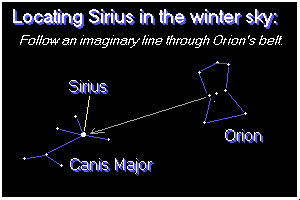
Sirius A is the brightest star in our sky and can easily be seen in the
winter months in the northern hemisphere. Look for the constellation
Orion. Orion's belt are the three bright stars in a row. Follow an
imaginary line through the three stars to Sirius which is just above
the horizon. It is bluish in color.
Sirius is only 8.6 light years from Earth. Astronomer W.Bessel was
the first to suspect that Sirius had an invisible companion when he
observed that the path of the star wobbled. In the 1920's it was
determined that Sirius B, the companion of Sirius, was a "white
dwarf" star. The pull of its gravity caused Sirius's wavy movement.
White dwarfs are small, dense stars that burn dimly.
Sirius B is, in fact, smaller than the planet Earth. One teaspoon of
Sirius B is so dense that it weighs 5 tons.
So did alien fish-men pay a visit to ancient Earth and give the Dogon
their knowledge? Or was the Dogon's culture contaminated by western
visitors? Or could the Dogon's have had ancient technical or
non-technical means to find this information out? Or is the whole thing
just a matter of coincidence?
The question maybe settled as larger and more powerful telescopes
take a look at the Sirius system. According to the legend there is a
third star: Sirius C, and it is around Sirius C that the home planet of the
Nommos orbits. Most scientists do not consider any part of the Sirius
system a prime candidate for life, though.

When Temple first issued his book in the 1970's there was no solid
evidence of a Sirius C. In 1995, however, two French researchers,
Daniel Benest and J.L. Duvent, authored an article in the prestigious
journal Astronomy and Astrophysics with the title Is Sirius a Triple Star?
and suggested (based on observations of motions in the Sirius system)
there is a small third star there. They thought the star was probably of
a type known as a "red dwarf" and only had about .05 the mass of Sirius
B.
So has the home star of the Nommos been discovered? Or is this just
another strange coincidence?

http://www.unmuseum.org/bookstor.htm#temple
http://www.unmuseum.org/bookicn.gif
Book: The Sirius Mystery: New Scientific Evidence
http://www.unmuseum.org/unmain.htm
http://www.unmuseum.org/unmuicn.gif"
Copyright Lee Krystek 1998.
All Rights Reserved
Philadelphia Experiment
http://www.unmuseum.org/cropcir.htm
Crop Circles
http://www.unmuseum.org/hollow.htm
Hollow Earth
http://www.unmuseum.org/siriusb.htm
Dogon's Legend of Sirius
http://www.unmuseum.org/fairies.htm
Cottingley Fairies
http://www.unmuseum.org/winchester.htm
Winchester Mansion
http://www.unmuseum.org/werewolf.htm
Werewolf
http://www.unmuseum.org/lambtonworm.htm
Lambton Worm
http://www.unmuseum.org/aautopsy.htm
Alein Autopsy
http://www.unmuseum.org/biblec.htm
B-ble Codes

John Winston. johnfw@mlode.com