In article <bq0dqp$1irc$1@pencil.math.missouri.edu>, President, USA Exile Govt.
says...
Forwarded with Compliments of Government of the USA in Exile (GUSAE):
Free Americans Proclaiming Total Emancipation and Working Towards
Democracy.   NOTE:  Here's the current home page of the extremely
helpful Physics911.org site; beneath it I've appended part two of
Gerard Holmgren's admirable three-part analysis of the Pentagon
crash.   --  kl, pp

Physics911.org - Home Page

Welcome to Physics911.org

Physics911.org is the independent initiative of concerned citizens
>from various countries and walks of life.
The Physics911.org website presents the work of SPINE, the Scientific
Panel Investigating Nine Eleven.

Applying basic scientific principles, SPINE aims to cast light on the
true nature of the dramatic events of September 11th 2001.

The 9/11 Enigma

The truth about 9/11 is obviously of central importance.

We're incessantly reminded that "September 11th changed everything".
9/11 has become the defining event of the new century, used to
justify an unprecedented surge in militaristic and repressive
policies within the USA and elsewhere.

Yet despite the evident significance of 9/11, there has been a marked
lack of informed discussion in the mainstream media about what really
took place that day. Many anomalies and suspicious leads in the
official story, curiosities which the mass media often helped to put
into the public domain, have not been followed up or given the
attention they clearly merit. The obvious question: "why is the US
Administration is so averse to a transparent public inquiry?" has
barely been asked. Indeed, the reluctance of the mass media to
critically examine the official version of events - and its central
role in propagating this unlikely story - has itself become a
phenomenon which merits investigation.

This site features several recent analyses of the 9/11 crime.

Two general scenarios investigate the broader context and attempt to
identify the most likely perpetrators .- September 11th and the Bush
Administration: Compelling Evidence for Complicity by Dr Walter Davis
and September 11 - Islamic Jihad or another Northwoods? by Dr Tim
Howells.

Operation Pearl - an alternative '9/11' scenario by Professor A.K.
Dewdney is narrower in focus. Dewdney presents an alternative
hypothesis for what actually occured on 9/11 - one which better fits
the known facts than the 'official version' of that day's events.

Two articles examine the attack on the Pentagon. The Missing Wings -
an analysis by A.K. Dewdney and Gerry Longspaugh - is possibly the
best place to begin if you're not currently sceptical about the
official 9/11 story. It is complemented by a three-part analysis by
Gerard Holmgren: Physical and Mathematical Analysis of the Pentagon
Crash.

>From the outset, the collapse of the World Trade Center towers
astonished commentators. Remarkably, three tower blocks collapsed on
9/11. Official reports acknowledge that molten steel was found in
the rubble. In the mysterious collapse of WTC tower 7, Scott
Loughrey examines the most mysterious collapse of all. Dr Jim
Hoffman mounts a detailed case in The North Tower's Dust Cloud that
the observed dust cloud was measurably far too energetic for a cloud
generated simply by gravitational collapse. Calculations on the
Possible Use of Thermite to Melt Sections of the WTC Core Columns, a
new article by Dr Derrick Grimmer, established the technical
feasibility of demolishing the WTC towers using thermite in a
controlled implosion, as one possible explanation for the observed
events.
The official version of events included numerous reports of cellphone
calls made from hijacked planes on 9/11. These reports lent
credibility to the official 'Arab hijacker' story within hours of the
attacks, in the most dramatic manner. Yet the cell phone calls from
fast-moving aircraft are not commonplace. Calls of the type allegedly
made on 9/11, in the quantity reported, stretch credulity. Is this
the Achilles Heel of the Bush/CNN account of 9/11?

Collectively, we believe this material deals a fatal blow to the
credibility of the 'official version' of 9/11. We invite you to read
them and consider the evidence for yourself.

Over time, Physics911.org plans to publish more material on related topics.

To comment on articles in this website and receive our occasional
email newsletter, please register and login.

If you are already registered, login HERE

Afterword

There's no substitute for reading the evidence - and we suggest you
begin with articles on this website. We're reluctant to present even
the broad outlines of a case BEFORE you've had a chance to examine
this material.

For those who prefer to progress from a broader context to specifics,
this Brief Overview of 9/11 Theories may help situate Physics911.org
in the current debate about the events of September 11th 2001.

The Physics911.org Weblog.will note major additions to the site, as
and when new material is added.

Visitors who can afford to do so are urged to donate to
Physics911.org, which has been built on a shoe-string with no
external support at the cost of many months of foregone income.

Weblog

*	9/11: Jihad, LIHOP or Black Op? (12th November 2003)
*	Dust, Democracy and Fakery (24th October 2003)
*	What Really Happened? (21st October 2003)
*	Physics911.org launched! (20th October 2003)

========================

Physics911.org - FOCUS

September 11th and the Bush Administration:
Compelling Evidence for Complicity

by Walter E. Davis, PhD, Kent State University

October 29th 2003

This article will appear in Bernd Hamm (Ed) (2003).
Bushgang America. London: Zed Books.

Acknowledgements: I would like to thank Bernd Hamm, Ed Rippy, Paul
Wolf, Karen Capel, J. Walter Plinge, and Timothy Chandler for their
helpful comments.

Abstract
Why 9/11 was not prevented is one of the most critical questions in
current times, because answers may well reveal to more people than
ever before, the true nature of the U.S. corporate global empire -
the most extensive and most destructive in human history. Newspapers
across the U.S. called for an investigation into Bush's lies about
the reason for war on Iraq. While it is relatively easy for the
American people to accept deception for the killing of the Arab
people in distant lands, few people will be as accepting if it is
shown that this Administration was complicit in acts of atrocities
against its own people.

The evidence I present in this article suggests that the most
plausible explanation of the events surrounding September 11, 2001,
is that the Bush Administration was complicit in the terrorist
attacks and has orchestrated its cover-up. The sources cited contain
extensive detailed information, additional sources, and analysis
beyond what is possible to provide in this summary. I hope that this
information will incite public outrage leading to full accountability.
Read more...
0 comments | write comment

*	Calculations on the Possible Use of The... (2003/11/23)
*	September 11 - Islamic Jihad or another... (2003/11/9)
*	The Missing Wings (2003/11/4)

=======================================================================

Physics911.org

Physical and Mathematical Analysis of the Pentagon Crash - Part 2
by Gerard Holmgren

PART 7. WERE THE LAWS OF PHYSICS DIFFERENT ON SEPT 11?

There are some who like to point to the WTC crashes to make the point
that planes can and do explode into nothing in a crash. It is curious
that the only examples which can be found of this allegedly explosive
cremation of crashing planes just happens to be on Sept 11, 2001. A
thorough examination of the history of aviation disasters on any
other day shows that this simply doesn't happen. This will be
demonstrated by a library of aviation disaster photos to be presented
shortly.

Unless the laws of physics were different on sept 11 2001, all that
the WTC crashes demonstrate is that these planes must have been
loaded with explosives, because a tank of kerosine does not have the
capability for that kind of explosive force without the input of an
extra energy source, nor the total available energy to do the job.
Following is a series of photos of planes which crashed into
mountains, nosedived into the ground, collided with other aircraft,
crashed on take off, crashed into buildings, streets or forests, had
bombs planted aboard them, or crashed next to petrol stations. Note
the remarkably intact wreckage compared to what happened in the WTC
crashes and what is alleged to have happened in to AA 77.

Not all of the crashes are entirely comparable in terms of impact and
fuel load, but there are enough different situations here to make the
point that total cremation of crashing aircraft, without the input of
additional energy other than the fuel load does not and cannot happen.

Here's a good comparison. An American Airlines Boeing 757 which
crashed into a mountain.

*	http://www.planecrashinfo.com/w951220.htm

Here's three more 757 crashes and a 767

*	http://www.airsafetyonline.com/photos/britannia226/1.shtml
*	http://www.airsafetyonline.com/photos/transavia.1/1.shtml
*	http://www.airsafetyonline.com/photos/xiamen8301/1.shtml
*	http://www.airsafetyonline.com/photos/lauda004/1.shtml

This plane crashed into a field 80 degrees nose down.

*	http://www.airdisaster.com/photos/yr-lcc/photo.shtml

This DC 10 crashed into a mountain.

*	http://www.planecrashinfo.com/w791128.htm

This one crashed right next to a petrol station and still didn't blow
anything up.

*	http://www.airsafetyonline.com/photos/swa1455/1.shtml

And here's a whole lot of other crashes This is what real wreckage of
real plane crashes looks like.

*	http://www.airsafetyonline.com/photos/aa1420/1.shtml
*	http://www.airsafetyonline.com/photos/korean1533/1.shtml
*	http://www.planecrashinfo.com/w651111.htm
*	http://www.airsafetyonline.com/photos/hapag-lloyd3378/2.shtml
*	http://www.planecrashinfo.com/w601216.htm
*	http://www.planecrashinfo.com/w551101.htm
*	http://www.planecrashinfo.com/w920928.htm
*	http://www.planecrashinfo.com/w850219.htm
*	http://www.planecrashinfo.com/w820709.htm
*	http://www.planecrashinfo.com/w720618.htm
*	http://www.planecrashinfo.com/w650520.htm
*	http://www.airdisaster.com/photos/f-ogqs/photo.shtml
*	http://www.airsafetyonline.com/photos/crossair3597/1.shtml
*	http://www.airsafetyonline.com/photos/aa587exclusive/25.shtml
*	http://www.airsafetyonline.com/photos/vladivostokavia/4.shtml
*	http://www.airsafetyonline.com/photos/sq006/4.shtml
*	http://www.airsafetyonline.com/photos/af-concorde/6.shtml
*	http://www.airsafetyonline.com/photos/allianceairlines7412/1.shtml
*	http://www.airsafetyonline.com/photos/airphilippines541/1.shtml
*	http://www.airsafetyonline.com/photos/airfrance.3/1.shtml
*	http://www.airsafetyonline.com/photos/alaska261/2.shtml
*	http://www.airsafetyonline.com/photos/qantas001/3.shtml
*	http://www.airsafetyonline.com/photos/uni873/2.shtml
*	http://www.planecrashinfo.com/w580206.htm
*	http://www.planecrashinfo.com/w000419.htm

Wreckage photos of the plane which crashed into the Empire State
Building in 1945 are unclear, but here is a description of the
wreckage.

*	http://history1900s.about.com/library/misc/blempirecrash.htm

[[Some debris from the crash fell to the streets below, sending
pedestrians scurrying for cover, but most fell onto the buildings
setbacks at the fifth floor.Still, a bulk of wreckage remained stuck
in the side of the building. After the flames were extinguished and
the remains of the victims removed, the rest of the wreckage was
removed through the building.]]

Here's the wreckage of the cessna which crashed into a building in
Tampa in Jan 2002.

*	http://www.cnn.com/2002/US/01/06/tampa.crash/

That should be enough to make the point. But in case you want to see
more, these sites - from which the above photos were sourced,

*	http://www.airsafetyonline.com/photos/
*	http://www.planecrashinfo.com/
*	http://www.airdisaster.com/photos/

have photos of hundreds more crashes which I haven't linked to
individually. In the first list, they are listed from top to bottom
by date. One famous date is conspicuous by its absence. Sept 11,
2001. There were 4 plane crashes that day. But none of them left any
wreckage. What it means is that the WTC crash planes and whatever hit
the Pentagon were destroyed with powerful explosives. Information
about UAL 93 has been so scarce that its hard to comment.  (Why the
secrecy?)  The preceeding photos demonstrate that the WTC crashes
were unique in aviation history. It's already been demonstrated that
a full tank of jet fuel doesn't have the available energy to do the
job.

The analysis below demonstrates from a different perspective why
crashed planes do not explode in massively destructive fireballs.
Kerosine (jet fuel) is not a volatile enough material. But what would
happen, just supposing we could get a fuel tank to blow up? Although
jet fuel is not a particularly explosive substance, it is possible to
get it to explode in some situations.

Because it so rarely happens, we are forced to examine a different
kind of air disaster - TWA 800, which blew up in mid air, shortly
after take off. The official story is that it was caused by an
exploding fuel tank. Sceptics say that it was hit by a missile.
Regardless of which it was, there was plenty of wreckage.The
following analysis of arguments relating to TWA 800, demonstrate that
both sides of the argument act to debunk the official story of AA 77.
If it was hit by a missile, then it demonstrates that even an impact
of this ferocity still doesn't reduce a plane to dust and ashes, and
doesn't set off a catastrophic fuel tank inferno capable of cremating
a plane. If the official story is true, then the arguments put
forward to support it (several years before AA 77) act as inadvertent
rebuttals to the official AA 77 story.

In this article on TWA 800, Petroleum engineering research offers
clue to TWA 800 explosion by David S Salisbury,
http://www.stanford.edu/dept/news/report/news/july30/twa800.html

he discusses a theory put forward by Stanford University Professor
Sullivan S. Marsden about why TWA 800 exploded. Professor Sullivan
has had to propose a very complex set of circumstances to try to
explain how such a unique event as the alleged explosion of a fuel
tank could have occurred.

Salisbury writes:

[[Jet fuel normally is not explosive at temperatures below 100
degrees Fahrenheit. But on TWA 800 the air-conditioner heat
exchangers probably warmed the air/fuel mixture in the tank above
that point. When the aircraft is flying, the energy given off by the
heat exchangers is effectively dissipated to the outside air. But
when the air conditioners are run while the aircraft is on the ground
and the tank is nearly empty, the heat exchangers put out enough heat
to raise the temperature of the air/fuel mixture into the danger
zone, Marsden says.]]

In other words, it's impossible to blow up a full tank of fuel,
without input of extra energy, because the air/fuel mixture isn't
right, and the presence of the full fuel load cools it to below
explosive temperature. Even a full fuel tank falls ridiculously short
of the energy required to even melt a plane, let alone cremate it,
and this theory is saying that the only real risk of an explosion is
with a near empty tank. Which is why TWA didn't get blown into
nothing . And why it simply can't happen, even when planes have bombs
planted aboard or are shot down.

TWA 800 was a 747. Marsden's theory cited very specific concerns with
the fuel delivery systems of 747s. Whether or not his ideas on TWA
800 are plausible, what it demonstrates is that aviation experts,
even when concocting cover stories for the government, if this is
what Marsden was doing, do not accept that aircraft simply explode
and are cremated as a matter of course. It's a very complex argument
to try to explain how a fuel tank might have exploded. Or at least,
that was the official view before Sept 11, 2001

Sceptics claim that even Marsden's theory is ludicrously
overestimating the explosive capabilities of jet fuel. From this
Washington post article. http://members.aol.com/bardonia/washtime.htm

[[September 27, 1997

William S. Donaldson says the "misted fuel" in the airliner's center
wing tank wasn't hot enough to explode and that only a blast outside
the plane could have set off the chain of events.

Legislator Probes TWA 800 Countertheory

Congress has quietly begun probing a retired Navy officer's claim
that jet fuel in TWA flight 800's center wing tank was too cold to
explode without being first shaken into a volatile mist. William S.
Donaldson's assertion challenges virtually every remaining theory of
the NTSB in its search for the cause of the July 17 .... crash. Rep.
James A. Traficant Jr., Ohio Democrat, who has been probing the issue
virtually alone, was asked by aviation subcommittee Chairman John J.
Duncan Jr., Tennessee Republican to "investigate all the
circumstances" and report back. Mr. Duncan ordered staff help for Mr.
Traficant, whose staff has consulted with Mr. Donaldson. "You could
basically sit in that tank with a lit cigarette and snuff the
cigarette out in the fuel and it won't explode," said Paul Marcone,
Mr.. Traficant's top aide. "Your agency has been depicting the
volatility of the fuel as if it were nitrobenzene," the former navy
jet pilot said in a combative letter to NTSB Chairman James E. Hall,
accusing him of covering up important facts and basing his judgments
on fuel-temperature testing done on the ground in a desert. he said
the fuel never reached the danger point of 127 degrees Fahrenheit and
believes only an explosion outside the plane could have set off the
chain of events.]]

This is a significant comment. [[ "You could basically sit in that
tank with a lit cigarette and snuff the cigarette out in the fuel and
it won't explode... Your agency has been depicting the volatility of
the fuel as if it were nitrobenzene." ]]

5 years later, with the occurrence of the Sept 11 crashes, the
allegedly explosive nature of jet fuel has been further ramped up to
the power of dynamite.

Of course, the article also cites opinions rebutting Donaldson's
remarks, but it reinforces the point that a glib statement that "AA
77 blew up and disintegrated to nothing - perfectly normal, end of
story, what's the argument all about? " is not credible.

The controversy over TWA 800 continues, shedding more light on how
ridiculous is the claim that it was a full fuel load which blew AA 77
into nothing. In this extract, a supporter of the official TWA 800
story suggests that a full fuel tank is safer than an empty one.

*	http://members.aol.com/bardonia/prime.htm (June 1997)

[[Large airliners don't need to fill up all their fuel tanks for most
of their flights. They save money and reduce the risk of accidents by
not carrying excess fuel. Loeb sees a hazard in this. TWA 800, with
no more than 100 gallons of fuel in its big center wing fuel tank,
had been waiting two hours to take off. Loeb claimed on PrimeTime
Live that its air-conditioning packs, located beneath the fuel tank,
heated the fuel enough to vaporize some of it, creating what host Sam
Donaldson called "a virtual bomb ready to explode." Loeb admitted
that the investigators had not been able to find anything that might
have ignited this "bomb," but he brushed that aside, saying if there
had been no explosive vapor, there would have been no accident.]]

So, even those who are claiming that TWA 800 went down because of an
exploding fuel tank, have as a central part of their theory, that a
full fuel tank reduces the risk of explosion. From the same article:

[[The New York Times reported that the NTSB planned to set off a 747
center wing fuel tank explosion this year to see if the vapor from
100 gallons of fuel would have enough force to break a 747 in two.
That important test has not been made, and there are no plans to make
it. Instead, the NTSB plans to explode a small bomb near the center
wing fuel tank of a 747 in England in July to see what kind of damage
a small shaped charge will do and "more importantly," they say, what
sound it will make.]]

So they're arguing about whether an exploding fuel tank can even
break a plane in two, not whether it can reduce it to dust and ashes.
According to their theories, it can't explode if it's full (it still
wouldn't have enough energy anyway) and if it's empty enough to
explode, it's arguable whether it could break a plane in two.

Another article about TWA 800:

Herald International Tribune July 24 1996

*	http://www.aircrash.org/burnelli/ht960724.htm

[["If it was an accident, it would scare the hell out of us," said
Michael Barr, director of aviation safety programs at the University
of Southern California. "These planes just don't blow up. There's too
many fire walls, too many checks and balances.'

Christopher Ronay is equally troubled.  As head of the FBI bomb unit
for seven years, he investigated 30 aircraft bombings before retiring
in 1994.

"I can't recall anything that has had a catastrophic effect like this
case," he said. "You could blow the hell out of a cargo compartment
with a luggage bomb, but you have to blow up a fuel cell or an engine
to get an explosion like that."]]

And yet, this explosion, of a violence unprecedented in aviation
history still left lots of wreckage.

*	http://www.airsafetyonline.com/photos/twa800/1.shtml

From the same article:

[[The specific fuel involved is called Jet A, a derivative of
kerosene and a sluggish explosive. To explode, it must mix with air,
an indication that one or more of the eight fuel cells in the jumbo
jet's wings were breached--either by violent engine or mechanical
failure, by a well- placed bomb or possibly by a missile.

There have been cases of sudden mechanical failure that caused fire
and the loss of aircraft. An Air Force C-141 transport plane crashed
in Europe in the late 1970s when an engine exploded; spraying hot
fragments that ignited paint in a cargo hold.

A Boeing 767 ripped to pieces over Thailand in 1991 when a computer
error caused one engine to deploy its reverse thruster, sending the
plane into a vicious spin.

But in neither case was there a cataclysmic explosion.

Before TWA 800 went down last week, there had never been an explosion
of such ferocity aboard a 747-100, a 'wet-wing,' or plane that
carries all its fuel in wing tanks.

"You have to have instant ignition into a large fuel source," said
Mr. Barr, who trains accident investigators. "The way those fuel
tanks are sealed, it just doesn't happen."

Few bombings of commercial aircraft have ended in such a fiery
conclusion. In many cases, jetliners have survived even severe damage
>from explosions and landed safely.
In 1986, terrorists planted a sheet of plastic explosive the size of
a business letter under one seat on a TWA flight from Rome to Athens.
The explosion killed one man, blowing his seat out of the plane. A
grandmother, daughter and grandchild were sucked out of the resulting
hole. But the plane survived.

In the 1988 crash of Pan Am 103 at Lockerbie, Scotland, there was no
fiery explosion- until fuel-laden parts of the plane hit the ground.

In that case, a bomb using 10 to 14 ounces (about 340 grams) of a
plastic explosive was hidden in a radio cassette player. When
detonated by a amine device, it blew a hole in the fuselage skin,
which rapidly fractured and peeled away. The plane broke into five
sections that tumbled to Earth over the Scottish countryside.]]

This mentions a fiery explosion at the Lockerbie site, when fuel
laden parts hit the ground. I'm not saying that no explosion can
occur. What I'm saying is that it's not easily triggered, and doesn't
have enough energy to cremate a plane. In the case of the Lockerbie
bombing, the bomb itself was not enough to trigger an explosion of
the fuel tank. Since the plane broke up into five sections, the
impact of the exploding fuel upon the full wreckage could not be
tested. Here's one section of the wreckage.

*	http://www.airsafetyonline.com/photos/panam103/1.shtml

So if a bomb, breaking a plane into 5 pieces, still doesn't trigger a
sudden explosion of the fuel tank, then what does? Crashing into
something solid, like a mountain or a building - but apparently only
on sept 11, 2001.There's no evidence that an explosion of the type
and power alleged to have cremated AA 77 or the WTC planes has ever
happened to any other plane, or ever could in the situation of a
normal crash. Although the political circumstance behind the Sept 11
crashes, and (in the case of WTC crash 2 ) the spectacular imagery
involved was unprecedented, there was nothing unusual in the impact
physics of the crashes. Planes regularly crash into mountains,
streets, the ground, buildings and other planes, and are not cremated.

Web author Jack Cashill writes (August 16 2001)

*	http://www.worldnetdaily.com/news/article.asp?ARTICLE_ID=24075

[[Until recently, the only listed "fuel tank explosion" in the
80-year history of airline disasters was a Philippine Air Lines 737
that blew while the plane was backing out a Manila airport gate in
May of 1990. And even this case is suspect.]]

In all of these cases significant wreckage - at least - survived. In
some cases, the whole plane. So many are saying that even the alleged
explosion of jet fuel aboard TWA 800, which left plenty of
identifiable wreckage, was impossible. If the official story on TWA
800 is a cover up, then the fuel tank never exploded, and the whole
matter of an allegedly exploding fuel tank even breaking a plane in
two is an outrageous lie. If the official story is correct, or at
least genuinely plausible, then fuel tank explosions are only a risk
with near empty tanks, and don't have anything like the necessary
energy to disintegrate a plane. And photographic records of aviation
disasters demonstrate that fuel tank explosions don't happen as a
result of regular crashes, or if they do they don't cremate the
planes.

In the entire history of aviation, only four passenger jets have ever
exploded into nothing, or are alleged to have done so as a result of
a crash. All four just happen to have been the Sept 11 planes. And in
the case of the WTC, the impact surface was mostly glass - about as
soft a target as a plane can hit, with the possible exception of
water. So this debun
s any assertion that the alleged explosion of AA
77 was a result of being flown into a fiercely resistant surface,
which itself is already debunked by examples of planes which flew
into mountains and weren't cremated, including the earlier linked
photo of an American Airlines 757 which crashed into a mountain.
That's about as conclusive a comparison as one can get. The only
possible conclusion is that the WTC planes had powerful explosives
aboard, and that whatever hit the Pentagon was a much smaller object,
also destroyed by explosives.

Not only was the alleged explosion of AA 77 impossible in the context
of the modest damage to the Pentagon wall , and impossible because
there wasn't enough energy in the fuel - it's also been shown
anecdotally to be impossible in the context of aviation history.

Nevertheless, I'm once again going to suspend these findings, to
examine another aspect.

PART 8. "BUT WRECKAGE WAS FOUND."

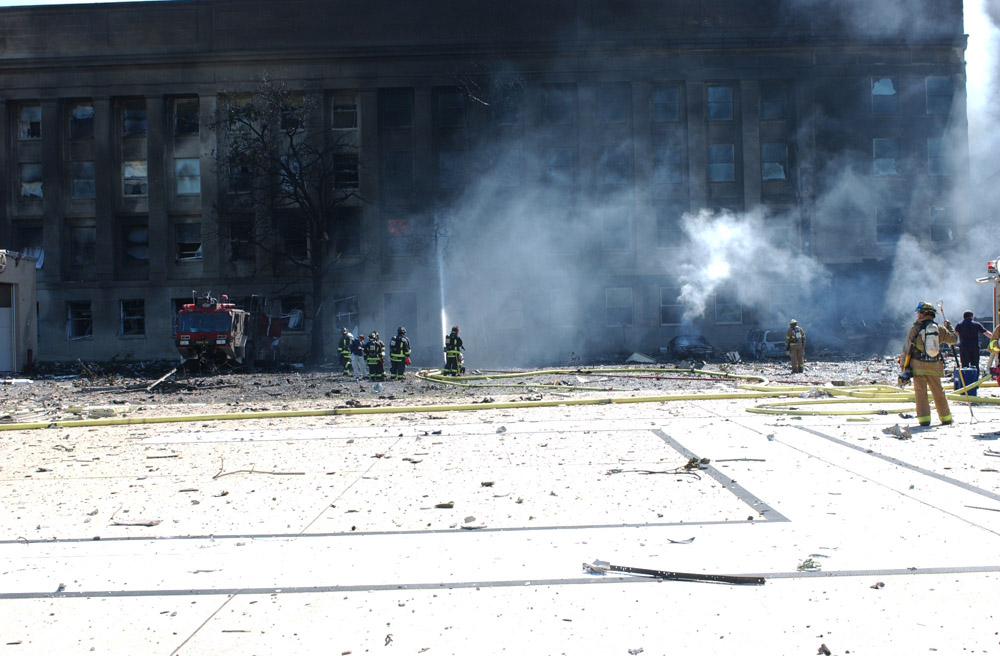
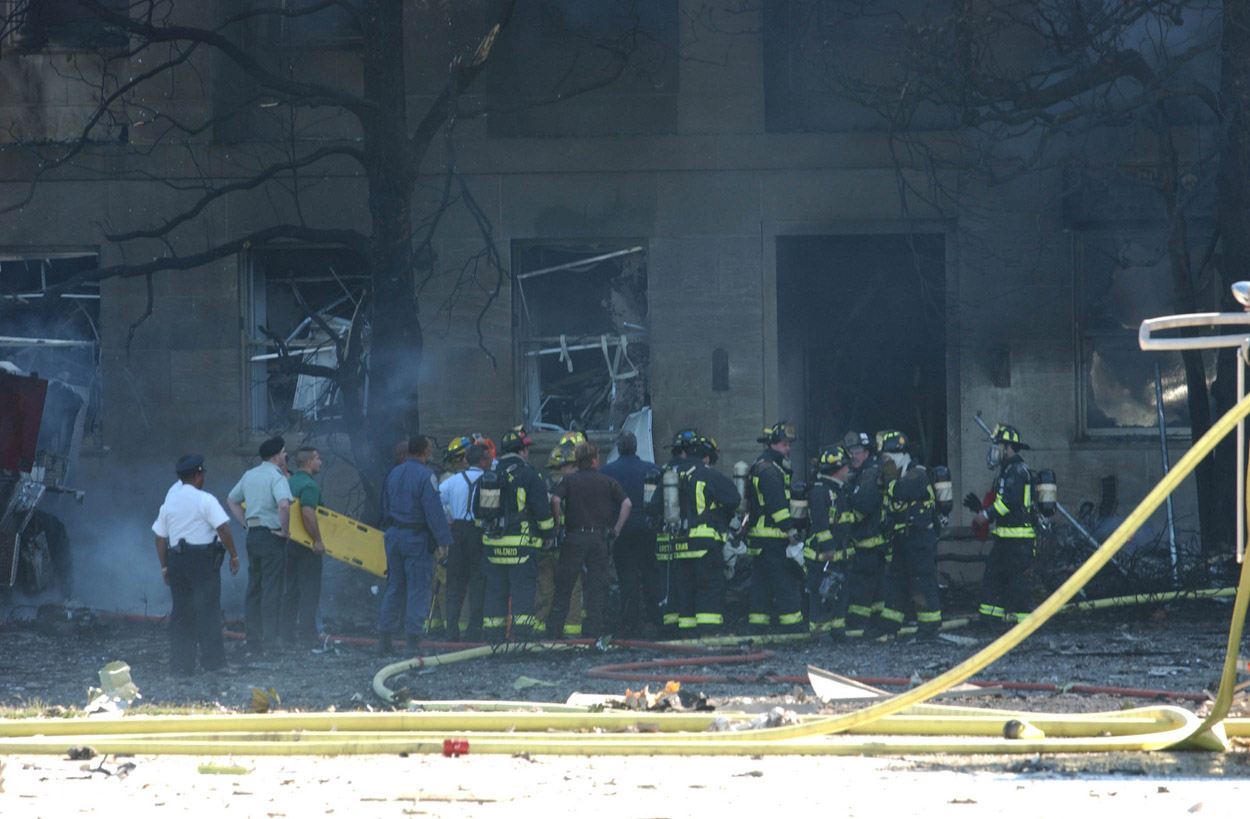
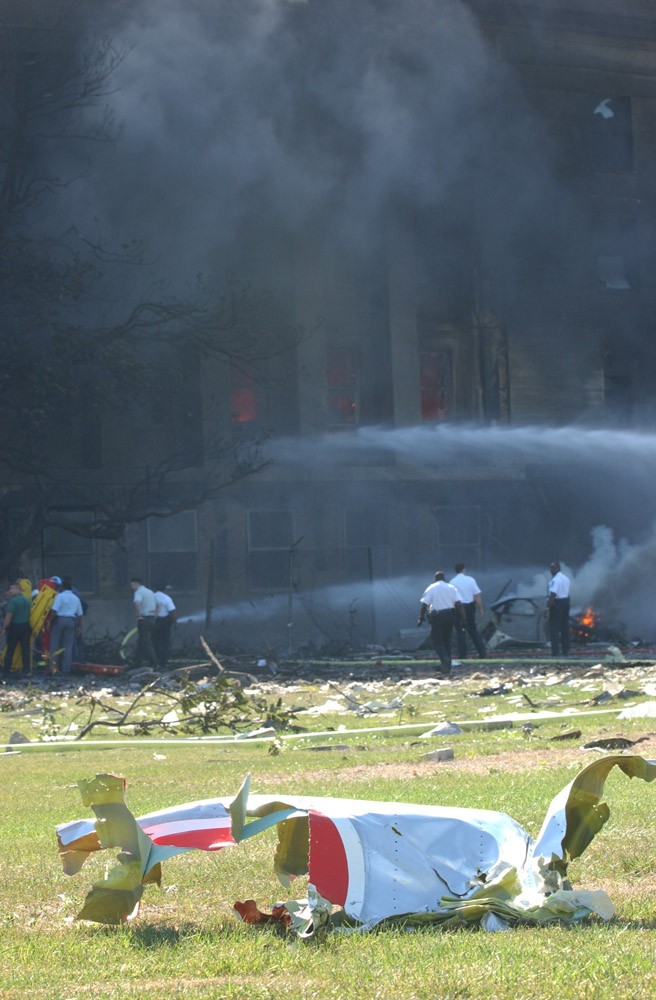
So let's have a look at the photos of the alleged wreckage.

*	http://www.geoffmetcalf.com/pentagon/images/11.jpg
*	http://www.geoffmetcalf.com/pentagon/images/12.jpg
*	http://www.mdw.army.mil/news/news_photos/911/pages/planepiece.html
*	http://www.dtic.mil/armylink/photos/Sep2001/roll4112.jpg

Additional to the fact that this represents less than 0.1 % of the
volume of the alleged plane, what evidence is there that any of this
was once part of a Boeing 757 ? It could be from anything. We know
that something hit the Pentagon, that there was an explosion, and
that where there is an explosion there will be debris of some sort.

To argue that this provides any evidence for either side of the
argument is witchcraft trial logic. " You must be a witch, because
you wouldn't have been accused if you weren't ".

"We know that a 757 was there. That proves that this is debris from a
757. And the fact that this is debris from a 757 proves that it was
there..."

This debris is totally unidentifiable, and it's volume is too
insignificant to adress the problem of unaccounted for wreckage

Supporters of the 757 theory claim this fragment to be wreckage from
AA 77, citing the AA colours as proof.

*	http://www.geoffmetcalf.com/pentagon/images/13.jpg

In fact, it is the alleged AA colours which prove conclusively that
this cannot possibly be part of the alleged plane. Has American
Airlines invented a new kind of indestructible paint? This fragment
has allegedly been violently flung out from an explosion which
reduced a giant airliner to the dust and ashes and unidentifiable
tiny fragments shown in the above photo. And yet the paint is as
shiny and new as the day it was applied. Does it take more energy to
peel and blacken paint, than to destroy 100 tons of aircraft? Clearly
painted sections survive most crashes, as shown in the crash photos.
But in those cases, no one is alleging an explosion catastrophic
enough to vaporize 100 tons of plane. They break up and perhaps burn
a bit. In really fierce crashes, some of the plane may actually be
destroyed, but even in these cases, tons of reasonaly intact wreckage
remains. So these scenarios are consistent with the recovery of
painted sections, even in bad crashes. The allegation that this
brightly painted fragment survived is irreconcilable with the claim
that 99.99% of the plane was vapourized.

This is about as believable as the stories that the alleged hijackers
were identified by the discovery of their miraculously unscathed
passports at crash sites which cremated the planes and occupants. The
metal is also shiny and new looking, and there is no sign of grass
singeing from the heat in the area where it landed. It is quite
impossible for this to be from an aircraft which had just been
reduced to a pile of ashes.

I anticipate an accusation of inconsistency here.

"First you complain that wreckage is not identifiable, then when it
is, you say that such identification would be impossible, proving
it's a fake."

Not so. The photos shown earlier were examples of identifiable and
credible wreckage.

There's a further problem with this piece of wreckage. The colours
are wrong anyway. Take a close look at the colour scheme used by
American Airlines. First, note that the alleged wreckage has a white
stripe next to red which is of a larger area than the white stripe.
Note the absence of any blue stripe.Now let's look at some actual AA
plane photos and you'll see that that this colour scheme isn't used.
Except possibly in the American Airlines lettering on the top front
part of the fuselage, a point I'll come back to.

This link will take you to a page with thumbnail photos of American
Airlines planes. I chose not to supply the direct links to the
enlarged thumbnails, because the URLs were extraordinarily long, and
faced a significant risk of breaking once published on the web.

*
	http://www.airliners.net/search/photo.search?airlinesearch=American%20Airlines&distinct_entry=true

Note that the striped colour scheme which the crude fake has
attempted to copy does not appear on the wings or tail fins. The
reason I make this point, is that this rules out the possibility that
this piece of the plane was sheared off during the approach, before
the explosion, by hitting a lightpole. If there's any possibility
that it's a genuine AA colour scheme, it can only have come from part
of the American Airlines lettering, on the top and front part of the
fuselage, which means that this piece could not have been sheared off
on the way in, and therefore must have been subject to the explosion.
And that is impossible, even if we were to pretend that such an
explosion was generally possible. Furthermore the only part of the
plane which it could possibly have come from is towards the front. If
the explosion occurred in the middle of the plane, debris from the
front area would have been flung forwards into the building not away
>from it. And if the explosion occurred in the front part of the
plane, making it possible to blow this piece backwards, then this
area of the plane would have been subject to the most powerful part
of the blast, so if we were going to see surviving pieces of debris
flung backwards, (especially with paintwork still intact ) they
should be from the rear of the plane. And if it's alleged that it was
thrown forward with such force that it hit something else and bounced
back all this distance, wouldn't the paintwork, be just a little
scratched?

Whoever designed and planted this fake, didn't think it through.

PART 9. DNA TESTING

Authorities would have us believe that 63 of the 64 people aboard AA
77 were identified from DNA testing.

This link

*	http://www.giveyourvoice.com/dna-faq.html

(See question 20)

explains why DNA testing is not able to identify all of the WTC
victims. Because DNA is destroyed by high temperatures. Read any
article or technical paper on DNA storage and sampling, and it will
mention the critical role of correct temperature in maintaining the
integrity of the samples. And they're not talking about temperatures
above 600 degrees C as being destructive, but temperatures below 150.
It needed a minimum temperature of 660 to melt the plane. Actually, a
lot more because it would have to have been 660 minimum at the
extremities, so it would have been much higher in most of the centre
fuselage where the people were. The temperatures required to cremate
it are almost unimaginable. And yet we are supposed to believe both
stories, that nothing remains of the plane, but 63 of 64 victims
still had their DNA intact, while at the same time the heat generated
in the WTC is a serious obstacle to DNA testing.

We were told that even many victims of the Bali bombing in Oct 2002
might never be identified.

*	http://www.theage.com.au/articles/2002/10/15/1034561155736.html

[[ Some Australians killed in the Bali terrorist attack are so badly
mutilated they might never be identified...The equipment included
medical supplies, DNA testing facilities and refrigerated containers
to ease the crisis at Denpasar's vastly overworked makeshift morgue.

But officials admitted today the carnage was so horrific that
technology would make no difference in some cases.

"It's highly likely that some victims will be unable to be
identified," said Australia's consul-general in Bali, Ross Tysoe.

Foreign Minister Alexander Downer, visiting the scene for the first
time, said: "Many of them are burnt beyond recognition."

Those close to the deadliest of the two explosions, at Sari's
nightclub in the Kuta tourist strip, would have "disintegrated", Mr
Downer said.]]

And yet we are supposed to believe that those at the centre of a
blast which vapourized a 100-ton aircraft left DNA which tested 98.4%
successful.

To analogize this it's worth going back to the 1 to 10,000 scale
model. It's like suggesting that before you set fire to it, you
placed inside 64 small pieces of plant or animal material. After the
catastrophic explosion of the 1/2 gallon of kerosine successfully
reduced the 18 lb aluminium model to dust and ashes, 63 of the 64
pieces of material inside, were still able to be successfully DNA
tested.

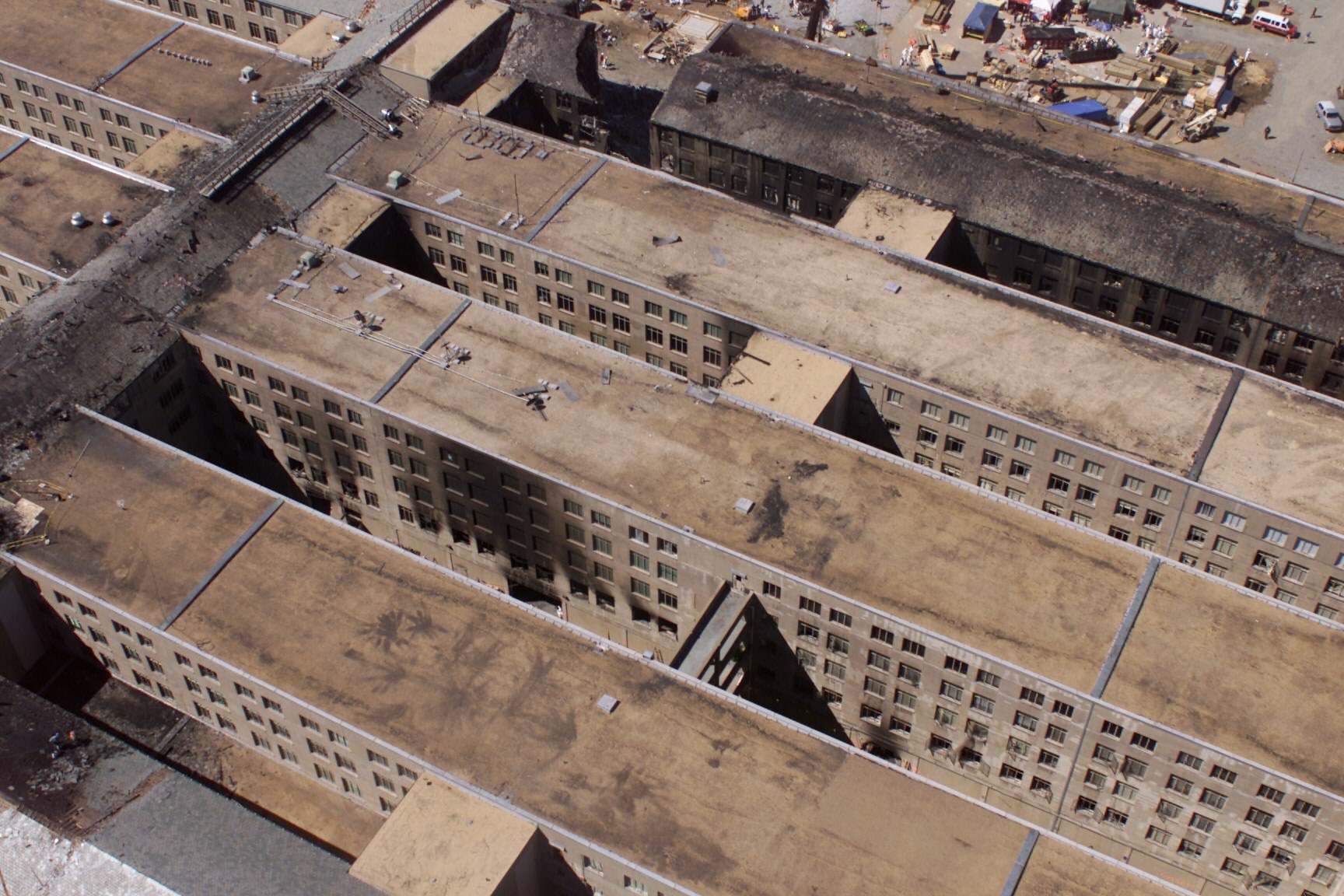
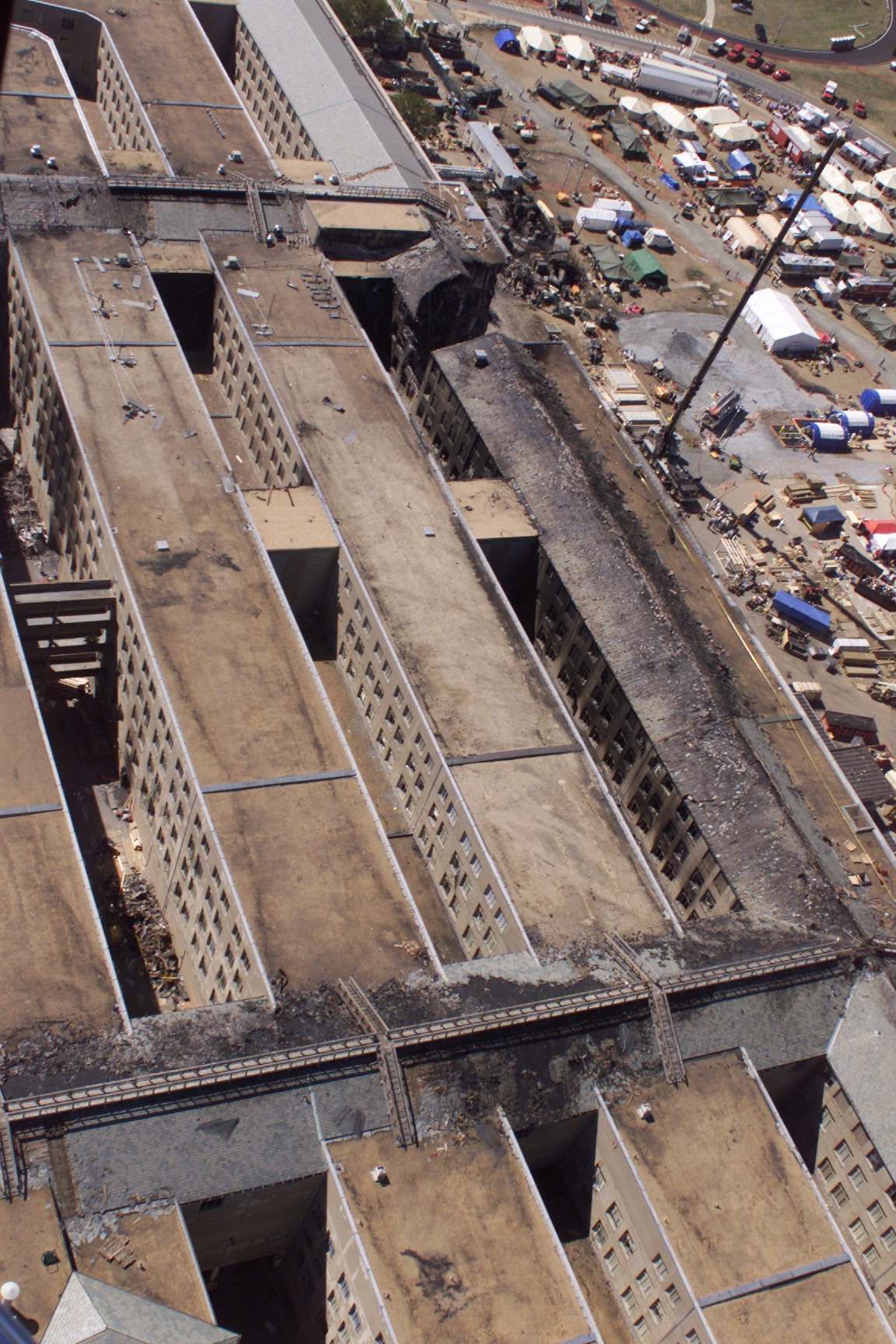
PART 10. THE HOLE IN THE OTHER SIDE OF THE WALL

This photo shows a hole punched through the Pentagon wall at the back
of the damaged area.

http://www.mediacen.navy.mil/pubs/allhands/nov01/war18.jpg

Let's find its exact location.

In the next photo, scroll to the bottom and look approximately in the
middle of the photo, at the back of the third ring, below the second
set of windows to the right of the bridge between the rings, casting
a large shadow You'll see the top half of a circular hole.

*	http://www.geoffmetcalf.com/pentagon/images/16.jpg

Here's the same scene from a different angle.You can now see all of the hole .

*	http://www.geoffmetcalf.com/pentagon/images/17.jpg

It appears to be at angle of something like 45 degrees from the first
ring damage area. How much stone has been penetrated to make this
hole? Assuming no internal walls, 6 walls. If each wall is 3 feet
thick, that's 18 ft of stone, plus or minus any inaccuracy of the
guess of the thickness of the walls, perhaps plus anything that was
in the way, inside the buildings. Because its at a 45 degree angle,
whatever has made it has actually had to punch out 27 ft of stone.

An explosion that digs tunnels? Not even the hard line 757
enthusiasts are suggesting that this was caused by the impossible
explosion. The logical explanation is a missile. The 757 supporters
claim that it was punched through the wall by one of the plane's
engines.

The engines are mounted on the wings. The wings were allegedly
cremated. How did the engine not only escape disintegration, but
propel itself forward two to three rings beyond where any of the rest
of the plane got to? (Three rings beyond refers to some scenarios
that the plane never actually penetrated the building but crashed
just outside.)

There are only two available energy sources for any part of the plane
to move through the wall. The momentum of the plane,and the alleged
force of the explosion. If the energy source was the latter, why did
it propel one small part of the plane forward, while destroying the
rest of it? And if the energy source was the momentum of the plane,
why hasn't the 100 ton fuselage burst through the rings, instead of
the 6 ton engine?

I'm going to try to construct the best argument I can that this was
caused by an engine. The engine became disconnected from the wing
before the plane blew up. Otherwise the engine would have blown up
too.

The engine must have been jolted free of the wing and propelled
forward by it's existing motion at the same time as something else
stopped the rest of the plane in it's tracks. By the time the
explosion happened, the engine was out of range of the destructive
blast, and already punching it's way through the wall. Why did the
engine burst free? As the plane was approaching the building, the
wing hit a light pole weakening the mountings around the engine so
that it was hanging by a thread. As the nose slammed into the wall,
or perhaps the plane hit the ground just in front of the wall, the
resultant change of momentum stopped the plane very quickly, jolting
the engine free. It fired into the wall, bursting through as the
plane blew up.

That's the best I can do, but there are huge problems.

For a start, the engine weighed about 6 tons, according to these
specifications for similar engines

*	http://home.swipnet.se/~w-48037/l1011techsp.htm

(Note: The weights listed next to the engine on the Boeing technical
site referenced at the beginning of the article, do not refer to the
engine's weight, but to its thrust power.)

Its a little difficult to imagine that the mountings attatching an
engine of this weight could be so critically weakened by hitting a
pole, but never mind - ignoring reality has become a regular
necessity for any attempt to keep the 757 theory alive. Lets press on.

If we speculate that the nose of the 100 ton plane hit the wall,and
stopped dead, hardly penetrating, then we can't seriously suggest
that an engine, 6% of the weight, now travelling at a lesser speed
than what the plane would have been doing when it hit the wall, could
punch it's way through three rings. If the plane hit the ground, and
stopped dead, a few feet from the wall, and then blew up, where is
the 155ft fuselage crater,and the sideways damage from the wings?
That's without the explosion. Where is the circle of devastation
which should be a radius of something more than 77 ft? This photo
demonstrates that this didn't happen.

*	http://66.129.143.7/june2aa.htm

If the engine didn't detach until after the explosion then it can't
have outrun the blast. Everything would have been blown up together.
If the engine detached from the shock of impact, as the nose hit the
wall, and then flew towards the wall, the nose had no reason to stop
penetrating the wall until the explosion blew it up. This means that
the nose was always further forward than the engine, so if the nose
is blown up, so is the engine. If we postulate an angle for the plane
and a position for the nose, to try to create a scenario that the
engine shoots wide of the blast area, then it's also shooting wide of
the impact area. You'd have to produce evidence of a second entry
point. Whichever engine it was, it has to pass through the 65 ft hole
area, and in any scenario where the nose penetrates the wall, it's
going to pass through later than the nose. And since they must both
be travelling into the building at the same angle, then the distance
between them will never widen as a result of angle.

So unless you want to suggest that the engine actually fired from the
wing before the impact ( like a missile ), then any scenario which
has the nose penetrating the wall is impossible. In case someone
suggests that the engine fired off immediately upon hitting a light
pole, I'll point out that they're built to withstand that kind of
contact, and even if they weren't, that would knock the engine
backwards, not shoot it ahead of the plane. In fact, whatever the
cause of it's detachment, if it came off when the plane was still
moving, it's impossible for it to have been fired off faster than
what the plane was moving, so if anything happened beforehand, it
would have fallen off, not shot forward like a missile.

If the scenario involving the nose hitting the wall is impossible,
and the scenario of the nose not hitting the wall is also impossible,
then it didn't happen.

So it was a missile. But lets pretend that the previous analysis
doesn't exist and look at other aspects of this question, pretending
that the engine theory is still alive.

Let's pretend that it was possible for the plane to stop short of the
wall and blow up outside, ignoring the lack of damage to the lawns,
and say that the engine was jolted free by the previously speculated
method, and managed to outrun the blast, before the plane blew up.

If the plane was doing 400 mph when it suddenly stopped, and the
engine flew off at a speed of about 300 mph, then it was travelling
towards the wall at about 440 ft per second. The way the engines are
mounted on a 757

*	http://www.airliners.net/open.file/281582/L/

The engine would have about 60 ft to travel to strike the wall,
allowing for the plane stopping 5 ft short of the wall. (90 degree
fuselage angle) Angling the fuselage at 45 degrees to make the
engine's flight path compatible with the direction of the third ring
hole, makes negligible difference to the distance from engine to
wall, as long we postulate that it was the inner wing engine. If it
was the outer wing, it has to travel about 120 ft to strike the wall.
Also, the effective horizontal width created to the north (assuming
the plane to have approached from the south) by the outer engine
angle, means that the front of the fuselage has to be placed hard
against the right edge of the 65 ft hole, to fit the engine's entry
point into the damaged area. This is significant, because we are now
postulating a scenario where the wall suffered no impact other than
the engine strike and the explosion. It's impossible to make a
credible case for the fuselage cremation happening hard up against
the edge of the hole, when just a few feet away windows were
unbroken. So we need to assume that it was the inner engine. This
enables the nose to be placed close to the centre of the area of 65
ft damage, while still allowing the engine to fire through the
damaged area, avoiding the problem of having to suggest a
non-existent second entry point.

So the engine had about 60 ft to travel to the wall. At 440 ft per
second this would take close enough to 150 milliseconds. If the plane
blew up before this, the engine would be toasted along with
everything else, because it's travelling a line which takes the inner
side of it only 15 ft from the exploding fuselage. So even if had
reached the wall, that still wouldn't save it. We really need to give
it time to burrow into the wall a safe distance from the blast. If
it's speed halved to 220 ft per second, when it struck the wall, then
it would take about another 50 ms to fully enter it's 11.5 ft length
into the wall, and we need to allow another 50 ms for it to burrow a
further 10 ft to be safe. Even this might not be enough because it's
penetration path is crossing the middle of the 65-ft hole, in front
of where the nose is blowing up - the part of the wall that would be
subject to the most force. It might need another 50 ms of burrowing.
So to keep the engine safe from the blast, we have to postulate a
delay of 250 to 300 ms after the plane crashed, before it blew up.
Instinctively, this seems impossible, although I can't produce hard
data to prove it. But the scenario as a whole is impossible.

This is what had to happen. The plane can't have hit with the nose
pointing sharply down into the ground, because then the engine would
have been fired into the ground. So it had to land just about level,
but stop dead - like a sudden 90 degree belly flop straight out of a
momentum of 400 mph. Then we have to postulate a 250 to 300 ms delay,
before it suddenly blows up with a ferocity never before seen in
aviation history. During this delay, we have to postulate that it
didn't break up significantly, otherwise other wreckage would have
gone flying off and also escaped the blast. Then it suddenly cremated
itself, and did all this without damaging the lawns that it belly
flopped on to. Impossible.

Postulating tilted wings to try to change distances and angles only
makes it worse. If the wings were tilted at 45 degrees, then the
lowest point of the upper engine is about 55 ft off the ground, and
the the lowest point of the lower engine is about 20 ft off the
ground. Since the hole is at ground level, you'd have to describe a
precise downwards angle for the nose to get the engine to finish up
at ground level after its penetration through the rings. But the
bigger problem here is that the nose can't have hit the ground with
the wings tilted, because the lower wing would have broken off first.
This makes it rather difficult to suggest the sudden stop necessary
to fire off the upper engine wing with any speed. When is the sudden
jolt ? When the wing breaks off, or when the nose hits? We probably
have to speculate a halved speed for the engine now - if it could
still happen at all - meaning that the delay before the explosion is
now 500 - 600 ms, which is getting quite ridiculous, and the engine
is now lacking the power it needs to have any chance of charging
through 27 ft of stone, which is now a bit more, because its being
fired from a raised angle. So if you want the wings tilted, you have
suggest that the nose was hitting the wall, which takes us back to
the same problems that first led us to suggest that it must have hit
the ground instead. And its even worse now. With the wings tilted at
45 degrees, the nose would be hitting the wall at a height of about
40 ft, meaning that we have to suggest that it simply bounced off, or
stuck in the wall and hung there (while the engine powered through
the wall) or if the nose burst through the wall, we're back to the
same old problems.

So the whole engine theory is impossible all round, which ever way
you look at it. Nevertheless, lets pretend it's still alive and press
on.

There's the question of whether the momentum and weight of the engine
was enough to power its way through 3 rings of the building.

Let's do some comparisons with weapons specifically made to penetrate
strong buildings.

During WW 2, the British developed the "Tall Boy" Bomb

*	http://www.members.aol.com/nukeinfo2/

It weighed 12,000 lb and could punch it's way through 10 ft of steel
reinforced concrete, when dropped from a great height (a Lancaster
bomber).  Very impressive! The Pentagon may not be as strong, but the
engine is alleged to have punched through nearly triple this width.
The engine weighs about the same as the "Tall Boy." However the "Tall
Boy" was travelling at several times the speed, and also contained
explosives. And yet, somehow, it appears to be only marginally more
effective, perhaps even less. All that engineering for nothing! If
the penetrative performance of the 757 engine is anything to go on,
it seems that the Brits would been better off to save their money and
just drop big lumps of scrap metal. Not learning this lesson, they
went on to develop the heaviest bomb of WW 2 , the 22,000 lb "Grand
slam" bomb which could penetrate steel reinforced concrete to a depth
of about 12 ft. In addition to it's enormous weight and explosive
power, it was dropped from Lancaster bombers, giving it great speed
by the time of impact. The article mentions that the bombs were
exceeding the speed of sound (760 mph), by the time they hit, but
doesn't mention by how much. That could be calculated if you knew the
height at which the Bombers were flying.

*	http://www.accessweb.com/users/mconstab/bombs.htm (also see
previous link)

Considering that the engine did not have an explosive inside it, was
travelling (optimistically) at 300 mph and weighed about half of the
"Grand Slam", it's a little difficult to work out how it was able to
a penetration job which would appear to be about equal to that which
the Grand Slam was capable of, and do it easily by the look of the
photo. Even more remarkable is the fact that the face of the engine
is the worst shape possible for penetrating a target. Tens of
thousands of years ago, people worked out that pointed surfaces
penetrate targets more easily than flat surfaces, and arrows, spears
swords, bullets and missiles are designed according to this
principle. The above articles mention that the "grand slam" was
aerodynamically designed to ensure that the pointed end would be
facing down when it struck. So the engine was really just like a
heavier and more powerful version of the old mediaeval catapult. They
had less powerful propulsion and couldn't throw anything approaching
that weight, but if they'd had even 10% of the alleged penetrative
power of this remarkable engine, then most castles would have been
demolished within the first hour of the siege.

In Dec 2001 it was reported that the US airforce's new cave and
bunker busting bombs could penetrate 11 ft of reinforced concrete,
perhaps more.

*	http://www.globalsecurity.org/org/news/2001/011213-attack02.htm

What a remarkable achievement! Decades of experience and research in
the area of missile development, swallowing billions of dollars, have
finally achieved a penetrative power approaching that of a flat
ended, non explosive, 6 ton chunk of metal hurled through the air at
a few hundred mph, like a bigger version of an ancient siege engine.

Where is this engine? Did it miraculously disintegrate after punching
it's way through three rings? Or have authorities rushed it away
somewhere to hide any evidence for their own story?

In summary, any scenario which postulates the nose entering the wall
to any significant degree is impossible, because the engine can't
have penetrated the wall more effectively than the nose, and would
have been blown up along with the rest of the plane. Any scenario
which has the nose bouncing off the wall is impossible, because then
the engine couldn't have penetrated, and it also creates the problem
of why there's no sign of the impact and explosion 110 ft out into
the lawns.(Allowing for a 45 degree fuselage angle) Any scenario
which postulates that the plane never contacted the building is
impossible for the same reason, and also that the engine probably
wouldn't have had time to get to the wall before the explosion,
unless we invoke the impossible combination of the belly flop and the
long delay. The suggestion that the engine had enough penetrative
power to create that hole is attributing to it powers equal to state
of the art missile technology, and of the heaviest high explosive
bombs of WW 2.

Even if it could have penetrated, where did it finish up, and why has
it vanished? So it was a missile. Once more, the argument is
concluded, but I will again suspend the findings to examine another
aspect.

Back to Page 1 (Parts 1-6)                   Continue to Page 3 (Part 11+)

Copyright: Gerard Holmgren. October 23 2002.This work may be freely
copied and distributed without permission as long as it is not for
commercial purposes. Please include the author's name, the web
address where you found it, and the copyright notice.

Physics911.org