| Subject: Re: How smart are SETI@homers? |
| From: Louis Scheffer |
| Date: 18/05/2004, 19:56 |
| Newsgroups: sci.astro.seti,alt.sci.seti,sci.space.policy |
Rich <someone@somewhere.com> writes:
In infinite wisdom Joseph Lazio answered:
R> You extrapolate from "at least two Earth-mass extrasolar planets"
R> straight to "Earth-mass planets are widespread."??

No, I extrapolate from two facts.  First, at least two Earth-mass
planets are known around PSR B1257+12, *and*, second, an analysis of
planetary masses from the current census suggests that the planets
become more frequent at lower masses (or the planetary mass
distribution function is weighted toward low mass planets).
You just pulled the last part out of thin air.
There is no evidence that "planets become more frequent at lower
masses". Such planets cannot yet be detected. And any analysis which
concludes something the exact opposite of what is shown by the
dataset is, to be generous, suspect.
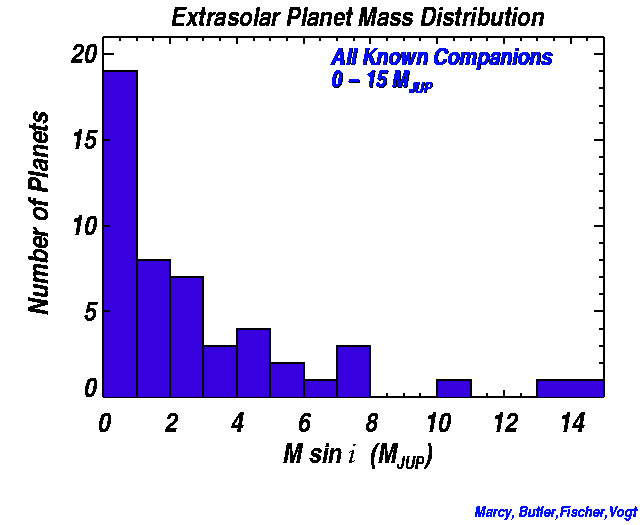
Take a look at
http://exoplanets.org/masshist.gif

We can't detect Earth mass planets yet, but all indications from planets
we *can* detect indicate there are more low mass ones than high mass
ones.  This is not proof, but it's an extremely strong indication.
As for the material's that compose terrestrial planets, it
is not clear that first or second generation stars will have such
materials, at least not if you accept that the big bang produced
primarily hydrogen and helium.
There is recent data showing some very early stars had solar like metallicities.
THis makes some sense since the early stars were massive, and turned into
supernovas rather quickly on astronomical time scales.  Also, there is a lot
of iron and dust visible in very early galaxies already:
http://arxiv.org/abs/astro-ph/0403237
Of course, finding ET life via a SETI program would establish quickly
that life is sufficiently robust that it could originate at least twice.
It would say nothing about robustness at all.
That is not true.  From the data we have now, it could be one intelligent
civilization per billion galaxies, or a billion intelligent civilizations
per galaxy.  If we found another intelligent civilization in our galaxy,
then the bottom end of this range is ruled out, statistically speaking.
We could then conclude, from the data, that intelligent life probably
arises at least once per galaxy.
However, that's enough to justify SETI.  If you think that intelligent
life may exist elsewhere, the only way to find out is to look.
This does not necessarily follow. Even if life exists everywhere, there
is no guarantee that looking will show it.
The two statements above are both true, and do not contradict each other.
It may be sufficient for you. I prefer to go by the data. I'm from
Kansas (philosophically speaking), show me.
OK, show me why SETI is a waste of money, based upon real data.
Can you prove it?  I think not, by your own admission.
I'll accept that it's not impossible. But as to how likely it is, there
remains no data with which to make such an assessment.
Can you show that no suitable planets exist?  No, you cannot, and
the available evidence suggests, but does not prove, the opposite.

Can you show that no suitable chemicals are present?  No, they, or
very similar chemicals, seem quite common.

Can you show that life does not arise if the right chemicals are
present on the right planet?  No, the only example we have indicates
that it is at least possible that life arises quickly.

Can you show that life does not become intelligent?  No, you can only
speculate.  We have one example which is statistically useless.

So you have your opinion that intelligent life may be rare, but you
can't prove it.  I have my opinion that it might be common, but I
can't prove it either.  So the only sensible, the only scientific,
the only possible approach is to look.

   Lou Scheffer