In infinite wisdom Louis Scheffer answered:
Rich <someone@somewhere.com> writes:
In infinite wisdom Joseph Lazio answered:
R> You extrapolate from "at least two Earth-mass extrasolar planets"
R> straight to "Earth-mass planets are widespread."??
No, I extrapolate from two facts. First, at least two Earth-mass
planets are known around PSR B1257+12, *and*, second, an analysis of
planetary masses from the current census suggests that the planets
become more frequent at lower masses (or the planetary mass
distribution function is weighted toward low mass planets).
You just pulled the last part out of thin air.
There is no evidence that "planets become more frequent at lower
masses". Such planets cannot yet be detected. And any analysis which
concludes something the exact opposite of what is shown by the
dataset is, to be generous, suspect.
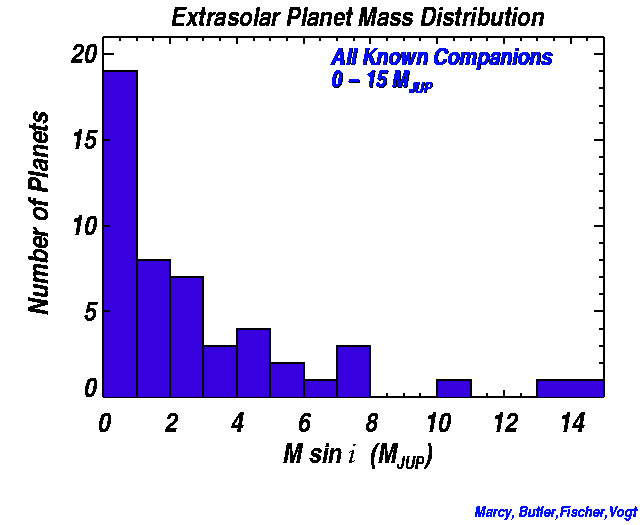
Take a look at
http://exoplanets.org/masshist.gif
It shows that the lower bound of the detected planetary mass clusters
more around jupiter mass than much greater than jupiter mass.
One thing not usually mentioned is that what is listed as the planetary
mass is the lower bound, assuming that the plane of the planetary orbit
cuts the earth. If it does not then the planet's mass is greater. While
it may be a good choice to list the lower bound, I tend to think that
the odds of being exactly in said planets orbital plane very low. If it
were true we could see transits of every planet. And only one planet
has been discovered this way. So almost certainly all the planets have
a greater mass than the lists show, how much more depends upon just
how far away from their orbital plane we are observing at, and there is
no way to know from doppler observations (as accurate as they may
otherwise be).
We can't detect Earth mass planets yet, but all indications from planets
we *can* detect indicate there are more low mass ones than high mass
ones.
By low mass, you mean source means near jupiter's mass rather
than 5 or 8 times jupiter mass. It most assuredly does not mean
terrestrial mass. Nor do we see planetary systems for many stars,
not yet anyway.
I think you are conflating 'near jupiter mass' (a lower bound near
jupiter mass) with 'terrestrial mass' and that is not supported by
the data we have at all. Further, many of the detected planets are
jupiter mass planets at or near 1 AU. That's around where we need a
terrestrial planet for ET to exist. Most of the observed stars with
planets could not harbor a terrestrial planet where it would need
to be.
This is not proof, but it's an extremely strong indication.
Not of the existence of terrestrial planets.
Interestingly, many of the things originally pegged as
planets have been found out to be brown dwarves, and are
now listed as 'not a planet'. And yet these occupy the
range from maybe 20 jupiter masses up. So in part we
have a label issue, we simply don't call em planets if
they are too massive, even if they are nowhere near being
stars.
As for the material's that compose terrestrial planets, it
is not clear that first or second generation stars will have such
materials, at least not if you accept that the big bang produced
primarily hydrogen and helium.
There is recent data showing some very early stars had solar like metallicities.
THis makes some sense since the early stars were massive, and turned into
supernovas rather quickly on astronomical time scales. Also, there is a lot
of iron and dust visible in very early galaxies already:
http://arxiv.org/abs/astro-ph/0403237
There seems to be some discussion WRT this point.
From the web page you listed above...
---
http://exoplanets.org/newsframe.html
[...]
The percentage of stars that have planets rises with iron
abundance. In all, 754 stars were grouped according to
their iron content relative to the sun. The spectrum of
each star was analyzed by simulating the transfer of light
through the atmosphere of the star using a local
thermodynamic equilibrium (LTE) model. Fischer and Valenti
adjusted the iron abundance of the model to fit the shapes
of 100 iron absorption line profiles in detail. After
grouping the stars according to iron abundance, each group
of stars was examined for the presence of planets by the
usual Doppler technique (California and Carnegie Planet
Search). All 61 of these planets are published in refereed
scientific journals. The number above each bar indicates
the number of planetary systems in each group of iron
content. Stars with large amounts of iron are more likely
to harbor planets than iron-poor stars. Credit: Debra
Fischer, UC Berkeley/Jeff Valenti, STScI
Monday, JULY 21 Presentation at the International
Astronomical Union Meeting in Sydney by D.A.Fischer and
J.A. Valenti Paper on Metalicity and Planets Presented at
the IAU General Assembly Meeting
Sydney, Australia - A comparison of 754 nearby stars like
our sun - some with planets and some without - shows
definitively that the more iron and other metals there are
in a star, the greater the chance it has a companion
planet.
"Astronomers have noted that only 5 percent of stars have
planets, but that's not a very precise assessment," said
Debra Fischer, a research astronomer at the University of
California, Berkeley. "We now know that stars which are
abundant in heavy metals are five times more likely to
harbor orbiting planets than are stars deficient in metals.
If you look at the metal-rich stars, 20 percent have
planets. That's stunning."
"The metals are the seeds from which planets form," added
colleague Jeff Valenti, an assistant astronomer at the
Space Telescope Science Institute (STScI) in Baltimore,
Md.
Iron and other elements heavier than helium - what
astronomers lump together as "metals" - are created by
fusion reactions inside stars and sown into the
interstellar medium by spectacular supernova explosions.
Thus, while metals were extremely rare in the early history
of the Milky Way galaxy, over time, each successive
generation of stars became richer in these elements,
increasing the chances of forming a planet.
"Stars forming today are much more likely to have planets
than early generations of stars," Valenti said. "It's a
planetary baby boom."
---
Another interesting observation is...
---
CIRCULAR ORBITS: THE PLANETARY NORM ?
The occurrence of circular orbits may require special
initial conditions. More common initial conditions may lead
to gravitational perturbations of planes by other planets
or by the protoplanetary disk, leading to orbital
ellipticities or ejection. Perhaps our Solar System, with
its coplanar, nearly circular orbits, represents a
fortuitous unperturbed, low-entropy state for a planetary
system.
The circular orbit of Jupiter in our Solar System promotes
the stability of circular orbits among the other 8 planets.
If our Jupiter were in an eccentric orbit, the Earth and
Mars would likely be gravitationally scattered, perhaps out
of the Solar System. Thus an anthropic argument can be made
for Jupiter's circular orbit, if it affects the onset or
the evolution of biology on Earth. It remains a question of
molecular and evolutionary biology regarding the necessity
of circular orbits and the resulting nearly uniform
temperatures for life.
Eccentric orbits may occur relatively commonly in
extrasolar planetary systems. The second law of
thermodynamics suggests that orbits, once scrambled, will
remain so. While an eccentric giant planet would certainly
induce dynamical dominoes for terrestrial planets, the
supposed demise of life may be a circular argument.
---
Of course, finding ET life via a SETI program would establish quickly
that life is sufficiently robust that it could originate at least twice.
It would say nothing about robustness at all.
That is not true. From the data we have now, it could be one intelligent
civilization per billion galaxies, or a billion intelligent civilizations
per galaxy. If we found another intelligent civilization in our galaxy,
then the bottom end of this range is ruled out, statistically speaking.
Statistics if properly done are descriptive of group distributions,
they are not predictive.
We could then conclude, from the data, that intelligent life probably
arises at least once per galaxy.
We have no data for any other galaxy. We cannot create population
statistics from a single data point.
However, that's enough to justify SETI. If you think that intelligent
life may exist elsewhere, the only way to find out is to look.
This does not necessarily follow. Even if life exists everywhere, there
is no guarantee that looking will show it.
The two statements above are both true, and do not contradict each other.
I dispute that there is any direct correlation between looking and
finding. Many who look find nothing. Some who do not look find many
things. There are also things like serendipity and luck (both good
and bad).
It may be sufficient for you. I prefer to go by the data. I'm from
Kansas (philosophically speaking), show me.
OK, show me why SETI is a waste of money, based upon real data.
I asked you to show me. Clearly you cannot. And waste or not,
the question remains, what should we spend the money we have
on? And since it ain't your own money you want to spend, you'd
better come up with something better than a totally irrelevant
personal attack (or simply spend your own money, that works too).
Can you prove it? I think not, by your own admission.
You need positive evidence dude. There are a million million things
that do not exist. I can't prove any of em don't exist, and since
the issue of disproof is a logical fallacy anyway, what's the point?
Lack of evidence to the contrary is not proof, or even evidence. It's
also not a compelling bet for financial investment.
I'll accept that it's not impossible. But as to how likely it is, there
remains no data with which to make such an assessment.
Can you show that no suitable planets exist? No, you cannot, and
the available evidence suggests, but does not prove, the opposite.
Can you show that no suitable chemicals are present? No, they, or
very similar chemicals, seem quite common.
Can you show that life does not arise if the right chemicals are
present on the right planet? No, the only example we have indicates
that it is at least possible that life arises quickly.
Can you show that life does not become intelligent? No, you can only
speculate. We have one example which is statistically useless.
Weren't you the one just deriving galactic ETI stats from a sample
size of one?
So you have your opinion that intelligent life may be rare, but you
can't prove it.
No, I have the observation that there is, as yet, no basis for making
any claim about ET life, not even that it exists. It's not an opinion.
You claim different, give me some non-abstract basis, cause so far
you're long on theory and short on relevant data.
I have my opinion that it might be common, but I
can't prove it either.
The difference is that you are willing to spend $200 million+ of other
people's money for your search.
So the only sensible, the only scientific,
the only possible approach is to look.
I disagree, science and discovery are quite different things. It is not
necessary to do science to find things, and many who claim to do science
today have been found to falsify data for funding and status. And things
like the copenhagen interpretation and entanglement are not science at
all.
The scientific method may be pure, but not all who claim to use it are.
Rich
Lou Scheffer