
| Links | |
| Books |
|
|
Referring back to the marked closeup map, it seems that the following is fairly close to the actual course of the object:
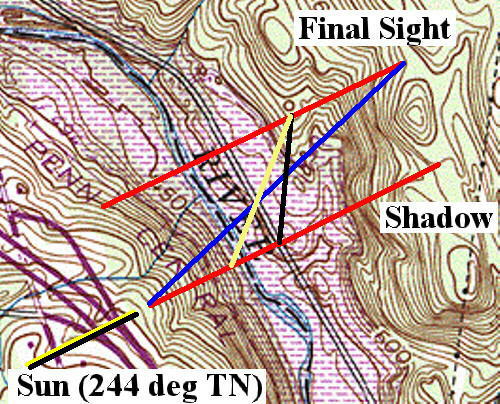
Here it can be seen that the path angle lies, as seemed likely, between the two extremes of the west ridge and the road. The blue path may be the closest, except that it intersects the shadow line too far from the road (500+ feet), however it is also possible that the object changed course when it was not visible to the witnesses.
At time 0, the object crosses the shadow line, at which point, its shadow, 200 feet to its ENE. passes over the road in front of the witness vehicle, somewhere between 0 and 400 feet ahead, but probably closest to the further limit. Some of the shadow may have spilled over the far side of the rise and not been visible. The object is approximately 500 feet in diameter and about 200 feet AGL. Its shadow is approximately 500 feet in diameter.
Some seconds later (perhaps 8-10 as discussed under observational constraints), the object becomes visible to the witnesses as it crosses the road, travelling approximately 65-75 mph. During this interval, it is seems likely that the object changed course from a parallel or near parallel to a perpendicular flight path, but this was not observed, and is only inferred from the data in the constraints. The calculated results, however, could also be due to a change in speed after appearance.
Over the next 10-15 seconds, the witness' vehicle coasts at a speed averaging slightly less than 30 mph toward the final sight line, where the object is then seen to pass over the ridge.
We must be cautious about these conclusions. There may be other explanations. Nevertheless, there is reason to be optimistic, since the witnesses could hardly predict that their size, time of day and duration estimates, along with the lack of observation by the party witnesses would generate a result in close match between calculated behavior and observed behavior, and thus the potential for fabrication seems reduced.
Additionally, though the absence of additional witnesses at the party is disappointing, the calculations suggest it was to be expected. Because the party can be specifically pinned down to a family reunion party on a specific date, this is a strong indicator of the reliability of the witness' memory. This also allows us with some confidence to assign the date as July 15, 1995. The only fault in the witness memory is the color of the house, which is pale blue, not white as reported.
Oddly enough, though perhaps a coincidence, the object flight path appears to be closely on course for the nearby power substation. Additional canvassing in the region of the substation is indicated and has not yet been completed. However, and informal contact with a local police officer who lives close to the substation indicates that any UFO observation was not known. At the calculated speed, perhaps this is not so unusual.
No mundane cause for this sighting has been able to be found. Balloons are too small, look wrong and travel too slowly. Blimps are probably too small (even allowing for observational errors), their maximum speed is close to that observed. However both types of aircraft are easily recognizable at much greater distances than those caclulated.
With a distance between a few hundred and 2400 feet, a size of about 500 feet, and a relatively extended observation period, this falls nearly into the range of a CE1. At any rate, it is certainly a spectacular DD case.
This site is an archive of the content of the MUFON CT website from the late 1990s. The current MUFON CT organization should be contacted through the MUFON web site.