
| Links | |
| Books |
|
|
This document describes the sighting of an unusual light formation on the evening of 8/19/97 between 9:50 and 9:55 PM
Investigator 1, driving home from Woodbury CT after an evening of rock climbing. Witness does not drink or smoke, and was under no medication. Witness does have an interest in UFO phenomena (at the time Assistant State Director for MUFON CT). Witness is an experienced artist and aircraft watcher, and has lived for over 15 years in the neighborhood of Bradley Airport. Witness had completed flight instruction and had about 40 hours of light aircraft time but did not obtain his license.
Prospect Hill Rd, Windsor, CT 06095 starting west of Lat. -72.676491, Long. 41.892602
Moon was up and nearly full. Sky was clear, but slightly hazy. Jupiter was East of the Moon. Venus had been west, but had long since set.
At approximately 9:50 PM, witness turned west from Rt 75 onto Prospect Hill Rd. Remaining estimates are elapsed times from this point.
At approx. 17 sec. / .1 mi first noticed whitish light to left (South), which was also West of Moon.
At approx. 41 sec. / .3 mi slowed and pulled over to observe more closely past backyard of house across street. Noticed was actually two lights, one above the other. Angle seemed odd for normal aircraft lights. Pulled back into road after a few seconds, dismissing as aircraft, possibly helicopter. Elevation 20-30 degrees.
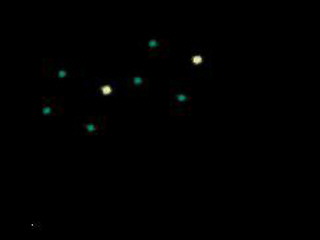
At approx. 1:08 / .4 mi slowed again, looked (South) down telephone pole cut and decided that angle between lights did not fit any aircraft with which he was familiar. Angle between lights was 45 degrees, which seemed excessive for helicopter. However, a tiny greenish light was observed on the left side of the lower light, which did not quite fit aircraft pattern. Witness departed and turned almost immediately NNW onto West St., pulled over after .05 mi. Elevation 30 degrees. See image 1.
At approx. 1:26 / .45 mi. Witness stopped, looking upward as lights emerged over trees to South. Immediately noticed more green lights and that collection of lights formed a pattern of two diamonds, one following the other, each with leading whitish lights (approx. or less than half the brightness of a typical landing light) and rest of lights dim greenish (less bright than the white one). Diamonds were separated by only a short distance. No red lights and no strobes observed. Witness turned off engine and cracked door (window does not roll down) to see and listen. No sound was heard. Elevation when perpendicular to road was 70 degrees. Witness looked for lights to pass stars but sky was too bright. Witness looked for silhouette, but did not observe any. Witness listened for sound, but did not hear any. Angular size of each diamond was roughly a thumbnail at arms length, which, measured against the full moon was about two full moons, or about 1 degree. The formation travelled at about 1.5 degree per second. See image 2.
After observing for 5 or 6 seconds, witness was distracted by a loud conventional aircraft propeller sound from behind him (E). A conventional aircraft with unusual wing lighting was apparently departing Bradley pattern on a bearing to the WSW. Wing lighting was two rows of pinkish / orange rectangular lights, two pair on each wing. Aircraft appeared to be high wing single engine aircraft. Witness observed aircraft for about 3 seconds.
Witness returned attention to diamond formation which was at that time approaching the NNW treeline, and decided to see if formation was going to land at Bradley Airport. Drove NNW then E on West St to Rt 75 with intermittent sight of lights. Turned left onto Rt 75 and drove N with intermittent sight of lights to Dairy Mart intersection (4:09 / 1.8 mi), took right fork, and passed graveyard which was on L (W) (4:15 / 2.0 mi), stopped at bank parking lot where it became apparent that formation had long since passed Airport. Formation now appeared much more like conventional aircraft and only two whitish lights with a red light between were visible, gradually dimming in the haze toward the horizon and disappeared at roughly 5 minutes into sighting, witness having driven 2.2 miles from first observation. Elevation at disappearance was 10-15 degrees.
Visibility was 9mi several hours later. when witness was able to get current conditions from the Weather Channel. It is possible that visibility was greater earlier in the evening, since more haze formed by the time the weather report was obtained.
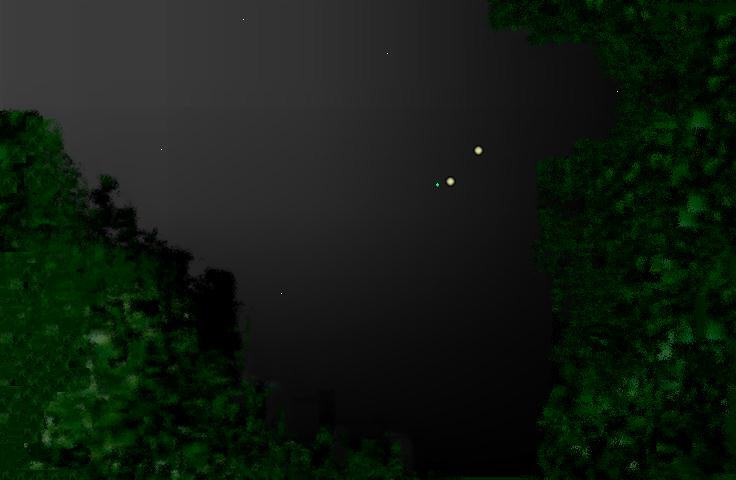
Image at Observation 3; note that if green light represents right tip of diamond, vertical separation is less than 50 feet. (Digital painting by the witness from sketches made within 15 mins of sighting)
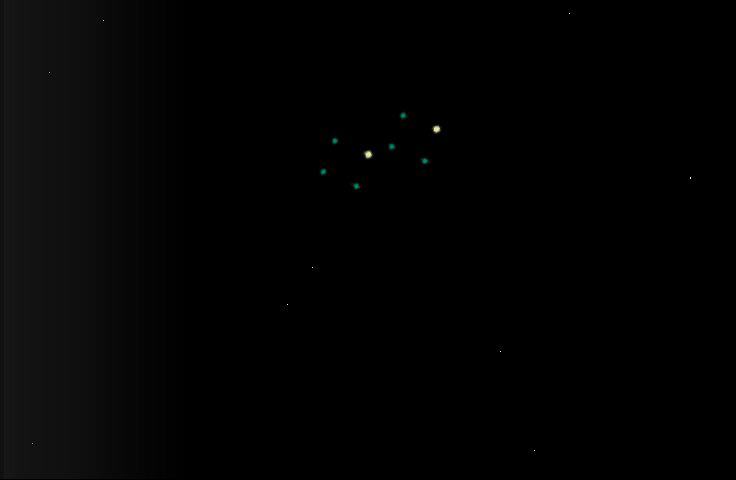
Image at Observation 4; note that if objects are twenty feet across, horizontal separation is less than 10 feet. (Digital painting by the witness from sketches made within 15 mins of sighting)
Investigator 1 drove the streets the next evening to obtain distances and timing while the sighting was still fresh, despite my conviction that I had probably observed a formation of A-10s. Investigator 1 also determined the approximate angles to the lights from each of the points where they were observed and where Investigator 1 thought he had sufficient recall to determine azimuth and elevation. To obtain elevation Investigator 1 centered a piece of paper with one corner at the center of my eye and marked the edge at the approximate recalled elevation. A line drawn to the marking from the corner provided the angle. To obtain azimuth, Investigator 1 drove the course again, with circles having a centerline representing the direction of the car front, and attempted to base his judgement of azimuth on that orientation.
Investigator 1 then took the distances and plotted a point for each major location on a digital map. Investigator 1 then added the azimuth lines. Since the most detailed observation angle was 70 degrees or so, Investigator 1 knew that the distance of the course from my location could not be too great, and Investigator 1also knew that the course had passed west of Bradley. This resulted in the following track:
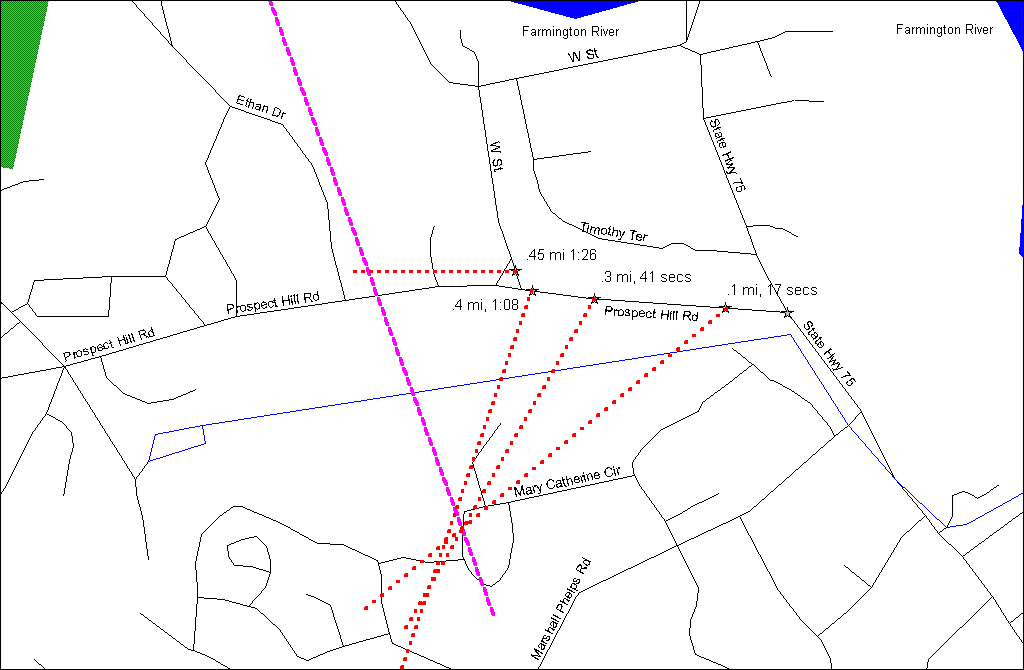
Map 1 - Triangulated Track and First Phase Observation Locations
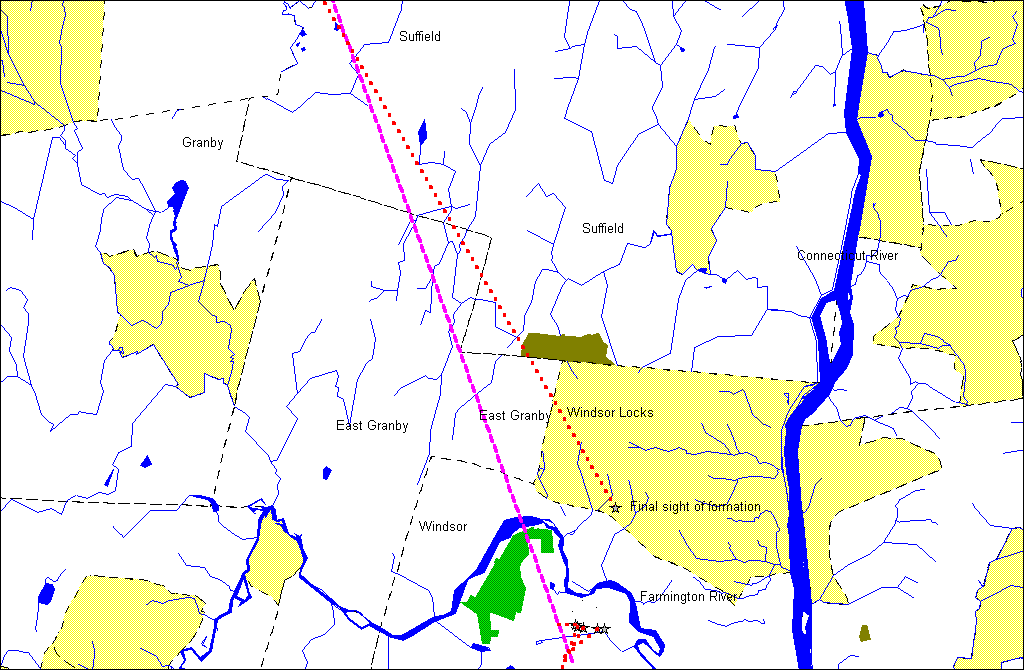
Map 2 - Complete Estimated Track From Initial View To Loss of Sight
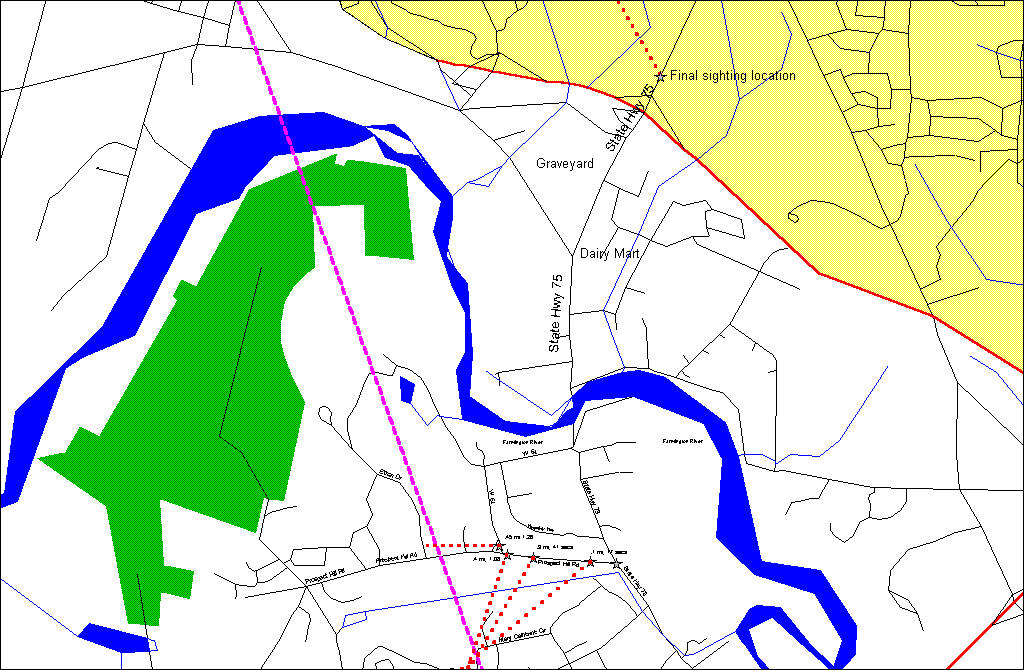
Map 3 - Street Map Of All Sighting Locations
Observations 1 and 2 converge very well, which is normal since they are the first two observations. The third observation also converges well, which provides a higher confidence that the distance computed from the first two is correct. It also makes sense, because the observations are within seconds of each other, meaning that the aircraft would probably not have time to move far in the interval.
In critiquing the result, Investigator 1 made the assumption that the direction of travel was a straight line from initial appearance to disappearance, and that the speed and altitude also remained constant.
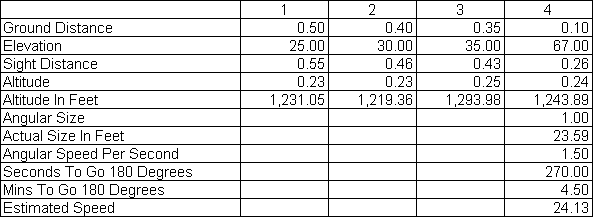
Only observation 4 allowed for a good estimate of either angular size or speed. However, the results are in good agreement with observation, cross-checked as follows:
However... The length of the complete track from first observation to loss of sight is about 9 miles. At 24.13 MPH the formation would travel 9 miles in 22 mins. This can be explained either by assuming that the distance to last observation is smaller than estimated (2 mi) or by assuming that the formation increased speed so that its average speed was 4.4 times the estimate or 106.172 MPH, or by assuming that some other aircraft was observed at Observation 5.
The following contacts were made to determine if this formation were a military or civilian flight:
Investigator 1 spoke to the CT ANG Operations (via the Wing Commander's office). Investigator 1 was informed that they were not flying operations that evening, but they offered to call Mass ops to find out if they were. They were not. Investigator 1 asked about the lighting configuration. It was suggested that the aircraft could be recovering from a restricted area in Long Island Sound. Because the pilots wear night vision equipment during combat simulations in restricted areas, they do not fly the normal strobes, although one aircraft is required to light the strobes when out of the restricted area. They suggested that one of the pilots might not have remembered to light a strobe, in which case the dimmer lights were probably formation lights. They stated that there were formation lights on the nose, but that these would not be bright. There is also a nose illumination light which lights the nose from the main gear, but it was stated that this would be incompatible with night vision systems, since it would be too bright. Unfortunately, about the only way Investigator 1 can make this work with what was observed is to assume they shed their night gear, still forgot to turn on their strobes, but remembered to turn on their nose illumination. However, this theory is squashed if the nose illumination would light the fuselage at all since the leading light seen was very round, not elongated.
CT ANG Operations further indicated that the ANG flight profile for A-10s recovering at Bradley would be 10k feet over water, 6k feet over land, 4k feet near airport. These are much higher than my calculated altitudes, but, of course, I could have made any number of errors.
Called Westover public affairs - no flights after 6 pm.
Called VT ANG - they fly F-16s, not A-10s. No aircraft out.
Called Barnes Airport in Westfield MA - No known formations, no known landings that night.
Called the FAA Windsor Locks - They don't handle military flight plans. Referred me to...
The AF / civilian liason - No additional information.
Called NY ANG - No A10s based there; not likely any other aircraft from NY. The individual Investigator 1 spoke with was an ultralight pilot - indicated ultralights could be silent but would be crazy to fly in Bradley area. Typical ultralights cruise altitude 1200 feet; airspeed 26 to 80 knots, fits profile.
TRACON at Bradley does not log transits, could go through radar logs but would be hard and expensive. Said ultralights would be crazy.
The speed, altitude, and size are all somewhat consistent with an ultralight aircraft being flown at night. The green lights are presumably some sort of indiglo or biolume type lighting, while the front light is some sort of headlight. Presumably the small size of the aircraft caused them to go out of sight sooner than expected and the estimate of disappearance angle was somehow wildly incorrect, or, perhaps the reason the aircraft appeared to have more conventional lighting in the distance was that it was a different aircraft which had departed Bradley.
However, the ultralight pilots were violating FAA rules, which restrict ultralight operation to within one hour of sunset, and in addition violated basic safety procedures by flying in the vicinity of Bradley at pattern altitude in the dark, which risked an accident with another aircraft.
Further, the estimated speed is extremely close to the regulation stalling speed for an ultralight.
If these were ultralights, their pilots must have been highly experienced (and crazy), which may mean they are well-known in the local ultralight community. No additional information has surfaced to identify them.
http://www.cs.fredonia.edu/~stei0302/www/ultra/ultraFAQ.html#q1:
In the U.S.A. an ultralight is defined in Federal aviation regulations FAR Part 103 (and subsequent advisory circulars) as a *single* seat powered flying machine which weighs less than 254 lbs, has a top speed of 55 knots (63 mph), stalls at 24 knots (28 mph) or less and carries no more than 5 gal. of fuel. Excluded from the empty weight are floats for water landings and safety devices intended for deployment in an emergency. The weight allowance for an emergency parachute is 24 lbs. so an ultralight with a parachute could weigh 278 lbs.
There are strict operating limitations (see question Q202:), but no mandatory license or registration. Special 2-seat exemptions are granted to instructors for training purposes only. These training aircraft can weigh 496 lbs and carry 10 gal. of fuel. All single seat ultralights which exceed the above limits and any 2-seater not used solely for instruction must be registered as an Amateur built aircraft and must be flown by a licensed pilot. Regulations vary outside the USA, but many nations allow more weight, speed, fuel, and 2-seat operations at the expense of more safety requirements. Some call them microlights.
http://www.cs.fredonia.edu/~stei0302/www/ultra/ultraFAQ.html#q2
Q202: Are there any regulations on these things?
Yes! Aside from the vehicle definition (see question 201) there are strict operating limitations (USA) designed to limit the dangers to the non-participant. (You are permitted to risk your own neck.)
1. No passengers allowed
2. No flying over towns or settlements
3. No flying at night or above (or in) the clouds
4. No flying in airspace around airports with control towers and certain other airspace without prior permission.
5. No commercial operations (for hire) except instruction.
6. Ultralights must yield right-of-way to ALL OTHER AIRCRAFT.
7. No! You don't have to have a pilots license (yet).
Investigator 1 solicited comments from some experienced ultralight pilots via the Internet. The comments were solicited from pilots based nearby who had responded to a web based survey on types of ultralights flown. Comments in italics are the questions.
An FAA Accident Prevention Councilor, a general aviation and ultralight pilot:
"1) Regulations require ultralight aircraft to cease operations within an hour of sundown. --
>Correct, Federal Aviation Regulation 103.11(a)" No person may operate an ultralight vehicle except between the hours of sunrise to sunset." If the ultralight is equipped with anticollision lights and operated in uncontrolled airspace it may be flown 30 minutes before sunrise to 30 minutes after sunset.
2) It would be a severe violation of safe procedures to be flying within the Bradley area at night in an ultralight, especially so close to pattern altitude.
>To enter Bradley airspace (Class C) an aircraft needs something called a Mode "C" altitude encoding transponder, must establish radio contact with the controllers and the pilot must have at least a student permit. Ultralights therefore can not enter Bradley airspace. But....with prior permission from Air Traffic Control it is possible under special circumstances or in an emergency.
I am unaware of the formation flying characteristics of ultralights. My best estimates indicate that these aircraft were flying in a formation with a horizontal separation of less than ten feet and a vertical separation of less than forty feet.
>From my experience it would be impossible for most u/l pilots to maintain the precision required. Because u/l's are so light the slightest movement of air pushes them around. Note: formation flying is allowed so long as both, or all, pilots agree to it.
>I have a hard time believing they were u/l's, unless they were some escapees from a mental institution. Flying at night in regular aircraft is hard enough even when you've had training but most u/l pilots don't have private licenses and have no idea how to fly at night. It would be almost certain death without training. I only fly at night once or twice a year and I still pay an experienced instructor to come with me. The speed you estimated is extremely low, even for u/l's. There are a few that might be able to maintain level flight at that speed but most stall at about 26 mph and a u/l pilot has not been trained in what's called MCA (minimum controllable airspeed.) All in all, Mark I don't believe what you saw were ultralights, although anything is possible, it's extremely unlikely. The 2 stroke engines they use can be heard for a long distance especially at night.
>I don't know what you saw Mark, but I met some people from the NYC area about 3 years ago that described a sighting very similar to what you saw. It was seen by many people including many well known public officials. In the end the government said it was a bunch of ultralights flying in close formation at night but I still believe that 's not possible. I've flown u/l's for about 4 years and I have the experience to know what they can or can't do."
Another ultralight pilot wrote:
"of lights were each about 20 feet across and long, were at an altitude of between 1200 and 1300 feet, and were travelling about 24 MPH ground speed.
The speed is too slow for an ultralight airplane. However, powered parachutes travel at 26 MPH IAS.
These results indicate that the formation observed was a formation of 2 ultralight aircraft. However, I have been informed that 1) Regulations require ultralight aircraft to cease operations within an hour of sundown.
>Unless they are registered and have an N number.
2) It would be a severe violation of safe procedures to be flying within the Bradley area at night in an ultralight, especially so close to pattern altitude.
>The floor of the Bradley airspace is 2000 MSL unless you are fairly close to the airport.
I am unaware of the formation flying characteristics of ultralights. My best estimates indicate that these aircraft were flying in a formation with a horizontal separation of less than ten feet and a vertical separation of less than forty feet.
>No sane ultralight pilot would fly that close. It's even too close for a powered parachute.
Investigator 1 is very hesitant to declare this an unknown. There were no unusual maneuvers, except for the formation flying. There are many possible sources of error in the measurements. However...
There are several points against military aircraft:
None were known to be flying that night.
The formation is unusual. A-10s, for instance, usually fly in formations of two, but I have never seen them fly in-line, and a comment from the AF / FAA liason indicated that such a formation would be unusual, especially during a recovery (though it might be used in a tactical situation). Note that an inline formation exposes the follower to wake turbulence and possible exhaust turbulence from the leader. The lower position of the trailing aircraft would make the turbulence situation worse, because wakes droop.
One of the possibilities for a military in-line formation would be refueling. In this case, the refueling would have to be between identical aircraft. Also, refueling in the Bradley area would seem unlikely.
Even at high altitudes, it is unusual in still air to not be able to hear conventional aircraft engines once they have passed.
Triangulation indications of size and speed are inconsistent with military aircraft.
There are points against civilian aircraft:
Conventional civilian aircraft do not normally fly formation. Again, an in-line formation would be unusual, and would be difficult to maintain at the observed distances.
Even at high altitudes, it is unusual in still air to not be able to hear conventional aircraft engines once they have passed.
Triangulation estimates of speed and size are inconsistent with this hypothesis.
There are also objections to ultralights:
No engine sound.
Formation flying is unusual and dangerous, and a precise formation could not be maintained. The turbulence effects of the inline formation would be similar to the above cases. In addition, the typical pusher prop configuration of the ultralight would seem to increase the effects. Despite the small angular size, variations in formation as small as 5 feet should have been visible but were not. The formation was as solid as it would be if the lights were all on one object.
The presence of the formation at that time and location violated a number of FAA regulations. Fines for those violations are very high. In addition, the safety risk was significant, unless the formation was at a high altitude, which would indicate much larger size (at 10,000 feet, the aircraft would be 210 feet across, which would be bigger than a Lockheed Starlifter), and sound would be more likely.
Balloons have been suggested a few times. However,
The air was still at ground level, and the formation crossed about 100 degrees of sky in less than a minute, which would probably be inconsistent with balloon speeds, no matter how low the altitude.
The objects were lighted.
The objects followed a definite and measured course which could be triangulated.
The formation remained precise throughout the observation, which would tend to mitigate against a cluster of balloons.
Note that Investigator 1 has not checked winds aloft for the date, so this possibility cannot be totally eliminated.
Obviously, the angular rate and duration weigh against stars, planets, meteors, space debris, etc.
Unfortunately, this means that Investigator 1 must declare this "possible unknown". Investigator 1 would not be willing to be more definitive without specifically unusual maneuvers and / or additional witnesses.
Of course, this is by no stretch an important sighting, except for the distance, speed, and size estimates. Strangeness is fairly low (lighting, formation, low speed), and probability, in accordance with Hynek guidelines, can be no higher than 3, this being a single witness sighting.
This site is an archive of the content of the MUFON CT website from the late 1990s. The current MUFON CT organization should be contacted through the MUFON web site.