
| Links | |
| Books |
|
|
One suspect for the contrails observed might be an orbital debris reentry.
The following are decays for 12/1/1999 through 12/23/1999 from http://oigsysop.atsc.allied.com/scripts/foxweb.dll/cqdecay@app01?tdac=SW7UCOIM9OSUFY8TEV31
NOTE: There are no decays for 12/13/99
Query return total: 23
Query Date: 1999/12/28 04:03:08
From: 1999/12/01
Through: 1999/12/23
Decay Date: Ascending Order IntID/Name CatNo Source period Incl Apogee Perigee RCS ------------ ----- ------ ------ ------ ------ ------- -------- 1999-061E 25960 PRC 87.7 42.6 174 145 0.0000 SZ1 DEBRIS Launched (1999/11/19) Decayed [1999/12/01] 1993-074C 22924 US No current elements ATLAS 2 CENTAUR R/B(2) Launched (1993/11/28) Decayed [1999/12/05] 1994-029EF 24084 US 88.1 81.8 182 176 0.0833 PEGASUS DEB Launched (1994/05/19) Decayed [1999/12/08] 1992-093BE 22365 CIS 88.4 71.1 206 187 0.0518 SL-16 DEB Launched (1992/12/25) Decayed [1999/12/09] 1997-079J 25975 CIS 90.9 65.0 357 277 0.0190 COSMOS 2347 DEB Launched (1997/12/09) Decayed [1999/12/09] 1999-052B 25923 ESA 98.9 6.3 1307 105 7.9433 ARIANE 44LP R/B Launched (1999/09/25) Decayed [1999/12/10] 1997-079D 25970 CIS 89.3 65.0 265 215 0.0867 COSMOS 2347 DEB Launched (1997/12/09) Decayed [1999/12/10] 1992-093X 22334 CIS 90.3 70.6 311 269 0.0335 SL-16 DEB Launched (1992/12/25) Decayed [1999/12/11] 1997-079A 25088 CIS 87.5 65.0 169 129 19.1243 COSMOS 2347 Launched (1997/12/09) Decayed [1999/12/11] 1994-029CF 24034 US 88.8 81.9 217 209 0.0161 PEGASUS DEB Launched (1994/05/19) Decayed [1999/12/12] 1965-098L 25058 CA 92.3 79.6 453 318 0.1417 ALOUETTE 2 DEB Launched (1965/11/29) Decayed [1999/12/15] 1999-044A 25889 CIS 88.0 67.1 198 156 17.6921 COSMOS 2365 Launched (1999/08/18) Decayed [1999/12/15] 1988-069A 19377 CIS 91.8 62.6 648 80 9.1352 MOLNIYA 1-73 Launched (1988/08/12) Decayed [1999/12/16] 1992-093JE 23008 CIS 91.5 71.0 360 339 0.0003 SL-16 DEB Launched (1992/12/25) Decayed [1999/12/17] 1994-029FG 24109 US 88.7 81.9 216 200 0.0743 PEGASUS DEB Launched (1994/05/19) Decayed [1999/12/17] 1965-082DX 01832 US 87.7 32.0 170 155 0.2948 OV2-1/LCS 2 DEB Launched (1965/10/15) Decayed [1999/12/18] 1978-096F 23935 US 91.3 99.0 364 313 0.0686 TIROS N DEB Launched (1978/10/13) Decayed [1999/12/18] 1972-058CQ 07960 US 88.0 98.1 185 168 0.1629 DELTA 1 DEB Launched (1972/07/23) Decayed [1999/12/19] 1994-029PZ 24372 US 90.1 82.0 294 266 0.0228 PEGASUS DEB Launched (1994/05/19) Decayed [1999/12/19] 1999-034B 25790 US 87.2 98.5 152 123 11.6334 TITAN 2 R/B Launched (1999/06/20) Decayed [1999/12/20] 1970-025EZ 04869 US 89.1 99.9 232 225 0.0595 THORAD AGENA D DEB Launched (1970/04/08) Decayed [1999/12/21] 1970-025HB 04981 US 91.5 99.8 364 332 0.0362 THORAD AGENA D DEB Launched (1970/04/08) Decayed [1999/12/23] 1994-029FH 24110 US 90.8 81.9 323 306 0.0403 PEGASUS DEB Launched (1994/05/19) Decayed [1999/12/23]
The following information about the 12/12/99 decay was found at http://www.heavens-above.com/satinfo.asp?lat=41.824&lng=-72.894&alt=0&loc=Canton&TZ=EST&SatID=24034
Identification
Satellite Details
|
||||||
| Category: | Debris | |||||
| Country/Org. of Origin: | US | |||||
| Intrinsic brightness (Mag.): | ? |
Launch
| Date (UTC): | May 19, 1994 |
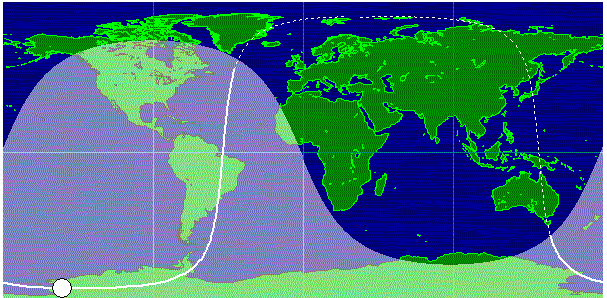
This orbital plot (from http://www.heavens-above.com/orbitdisplay.asp?lat=41.824&lng=-72.894&alt=0&loc=Canton&TZ=EST&satid=24034) shows that this reentry would not have a been in a position to produce the reported contrails to the west of the observers:
The following is from the same URL:
The orbit data is extracted from the following two-line orbital elements.
1 24034U 94029CF  99344.93607205  .05200752  00000-0  18320-1 0  8588
2 24034  81.9690  10.6228 0016312  82.3874 277.9246 15.85154936187293
| Epoch (UTC): | 12:00:00 AM, Saturday, December 30, 1899 |
| Eccentricity: | 0.0016312 |
| Inclination: | 81.9690° |
| Perigee Height: | 0 km |
| Apogee Height: | 0 km |
| Right Ascension of Ascending Node: | 10.6228° |
| Argument of Perigee: | 82.3874° |
| Revolutions per Day: | 15.85154936 |
| Mean Anomaly at Epoch: | 277.9246° |
| Orbit Number at Epoch: | 18729 |
The dashed part of the orbit path shows where the satellite is in the earth's shadow, and the full part is where it is sunlit.
The following decays around the report date were also checked:
1992-093X 22334 CIS 90.3 70.6 311 269 0.0335
SL-16 DEB Launched (1992/12/25) Decayed [1999/12/11] (high inclination, to east)1997-079A 25088 CIS
COSMOS 2347 Launched (1997/12/09) Decayed [1999/12/11] (high inclination, to west)1965-098L 25058 CA
ALOUETTE 2 DEB Launched (1965/11/29) Decayed [1999/12/15] (high inclination, far west)1999-044A 25889 CIS
COSMOS 2365 Launched (1999/08/18) Decayed [1999/12/15] (high inclination, to west)
High inclination orbits are poor candidates for any contrails to the west on a west heading, since contrails from such debris would go south to north or north to south.
Not a likely explanation for the contrails.
"GEMINIDS SHOULD PROVIDE GOOD SHOW THIS YEAR Geminids will start on December 7, but reach full scale observation on Monday December 13, 1999. Most well known meteor showers, like the Perseids and Leonids, are old. They've been observed for hundreds or even thousands of years. The earliest record of a modern-day meteor shower is probably a notation in Chinese annals dated 36 AD, regarding the Perseids, where it is said that "more than 100 meteors flew thither in the morning." The Geminids are a different story. The first Geminid meteors suddenly appeared in the mid-1800's. Those early showers were unimpressive, boasting a mere 10-20 shooting stars per hour. Since then, however, the Geminids have grown in intensity until today it is one of the most spectacular annual showers with as many as 140 per hour (zenithal hourly rate)" (Filer's Files)
According to the following chart of this year's Geminids (http://www.imo.net/news/news.html), compiled by the International Meteor Organization, the peak was actually 12/14/99; on the date in question, at the time of the sighting, the rate was roughly 38 per hour:
Date    Time     Sol     #   ZHR  ±
1999     UT   (2000.0)  Int
Dec 13  00.0h  260.542   2    27   5
        02.0      .608   4    45  10
        04.5      .714   7    37   8
        11.5   261.011   2    39  12
        14.5      .138   3    48  11
        17.5      .265   5    65  16
        21.0      .434  10    78  25
        23.0      .520  17    72  20
Dec 14  00.5      .562  11    86  27
        01.5      .604  11   106  23
        02.5      .646   8    95  22
        03.5      .689   8    95  24
        04.5      .731   8    90  25
        05.5      .774  10    90  24
        06.5      .816  10   110  30
        07.5      .859   9   105  40
        08.5      .901   7   100  30
        09.5      .943   8   105  35
        10.5      .985   6    95  15
        12.0   262.049   4    98   6
        14.0      .134   8   135  20
        16.0      .219  15   133  30
        18.0      .304  24   120  40
        20.5      .409  19   100  25
        23.0      .515   5    69  34
Dec 15  01.0      .600   5    60   9
        03.0      .685   3    60  15
        05.0      .769   2    44   5
        07.0      .854   2    24   7
This suggests that a meteor explanation is not impossible.
However, the existing literature suggests that meteors rarely leave contrails of any kind. Thus a meteoric explanation for the contrails, in the absence of a space debris reeentry, seems unlikely. In addition the duration of the contrails (estimated at minutes in length) seems to rule out meteors.
Aircraft are not inconsistent with the reported contrail appearance. The following elements tend to support an aircraft explanation for the contrails:
However, there are several offsetting factors:
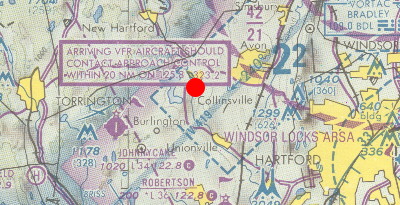
The closest airway is V 419 off the Bradley International VOR, which is significantly to the south, and V 106-405 (again off the Bradley VOR) to the north (not shown). Neither of these is even close to the direction in which the contrails were observed.
A straight line from the Putnam MA VOR to the Kingston NY VOR is the closest to the contrail course. There are no airways on this line.
Contrail Threshold Conditions Determined from Success Observations - Eric Jensen (http://hyperion.gsfc.nasa.gov/AEAP/jensen1abs.html) - We have used in situ DC-8 measurements to evaluate the environmental conditions required for contrail formation. Several cases of DC-8 contrail formation during the SUCCESS experiment have been identified using the DC-8 aft video, forward video from the T-39, and ground observations. These cases included contrails formed under threshold conditions, transient contrails, and persistent contrails. The ambient temperature and humidity were taken from the MMS, laser hygrometer, and cryogenic hygrometer measurements. Comparison with theoretical threshold temperatures indicates that the contrails only formed when the ambient temperature was below the liquid saturation threshold temperature; i.e., saturation with respect to liquid water must be reached in the plume for contrail initiation. This results suggests that aircraft exhaust particles may not be very effective ice nuclei. On several occasions, the DC-8 generated contrails in a relatively warm environment (as warm as -36C). These warm contrails only formed when the ambient air was highly supersaturated with respect to ice; again, this result is consistent with the requirement that liquid saturation be achieved within the plume for contrail formation. Since contrails formed at temperatures above about -45 to -50C (depending on the pressure) must be in supersaturated environment, these contrails should persist.
(http://www.seaport-beach.nl/contrails&science.htm#If you are attentive to contrail formation) If you are attentive to contrail formation and duration, you will notice that they can rapidly dissipate or spread horizontally into an extensive thin cirrus layer. How long a contrail remains intact, depends on the humidity structure and winds of the upper troposphere. If the atmosphere is near saturation, the contrail may exist for sometime. On the other hand, if the atmosphere is dry then as the contrail mixes with the environment it dissipates.
(http://www.mpimet.mpg.de/Depts/Physik/LES/chlond_abstract2.html) 1. Persistent contrails can only form in an atmosphere that is supersaturated with respect to ice.
All of these comments suggest the observed contrails formed in a dry atmospheric layer (they were non-persistent) and at a layer where the temperature was at or below -36 degrees C.Typically, these conditions are found at altitudes of several kilometers. I have been unable to find any discussion of "bursts" of the sort observed.
While not impossible, there is no specific support for an aircraft explanation for the contrails. It remains a possible explanation on general resemblance. However, the absence of a major high-altitude airway passing directly over Collinsville (required to account for the direction of the contrails, and the absence of apparent perspective effect), makes it difficult to sustain this explanation.
Almost the only sustainable explanation for the unusual dual objects would be balloons. Unfortunately for this explanation, even the most cursory analysis of angular size makes typical (approx 1 foot) balloons of a type which would be bound together, seem impossible. Such balloons, to demonstrate the observed angular size could not be distant, and would be recognized, especially given the duration and the number and variety of observers. In addition, the disappearance of the objects, if caused by the destruction of a larger balloon, would be expected to leave debris of some kind. While it is not impossible for such debris to have escaped over the dam, or around it, none was found at the dam or on the far shore. Finally, the grey color and the apparent lack of structural or opacity variations which one would expect for balloons, seems to rule out this explanation.
In addition, the "bullet" shaped geometry is an unusual one for a balloon.
Finally, the course the objects followed appears to have been relatively linear, and the objects paced each other, despite the variance in their drag profiles (one streamlined, the other not). This is not impossible, however, if the objects were carried by the wind, but no wobbling or bobbing, such as one might expect from near ground turbulence, were observed.
This site is an archive of the content of the MUFON CT website from the late 1990s. The current MUFON CT organization should be contacted through the MUFON web site.