
Zadar

Clu Sherril spent ten years working for the Cocteau Space Vehicle Design Directorate, some of which is described in the novel "Prometheus". During that time, she designed a number of spacecraft, but her favorite, and the one she stole to rescue Lan was one she called the Zadar.
The Zadar is 134 feet long. On the ground, it is supported by three landing gear, with 6 large wheels per truck to allow taxiing. It is capable of vertical takeoff and landing using propulsion ducted from a main engine system. That system can either function as a jet engine (using atmosphere as the oxidizer), or a rocket (using internally contained oxidizer). The vehicle can transition to horizontal flight by using the main engine outlet to drive forward on the vertical thrusters or can use its double wing system for lift.
Within the atmosphere, the vehicle can attain hypersonic straight line flight by virtue of its parabolic and reverse parabolic double wing system. It can use its engine system as a jet for tropospheric and stratospheric flight and switch to rocket at the ionospheric boundary. The thrusters are used to change the attitude of the vehicle in no non-atmospheric flight.
Once in space, the Zadar is capable of foldspace transits of up to 500 light years, depending on local and global conditions.
These images show some idealized perspectives on the Zadar (models are created in DAZ Hexagon and rendered in DAZ Carrara, using a variety of techniques):
| The Zadar seen from the right. The fold drive field emitters are the greenish objects near the center of the mail hull. The unusual profile not only allows for high speed, but is also capable of reflecting or trapping radar and other pulse based active sensor probes. | 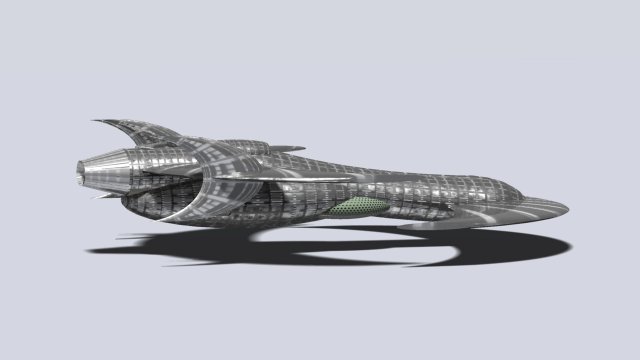 |
|
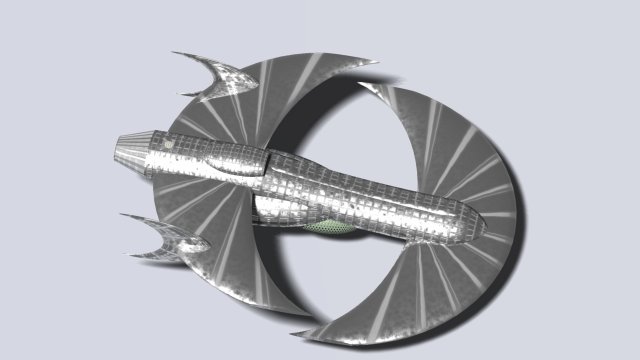
Seen from above, the most striking feature of the vehicle is the double parabolic wing system which provides high lift, low drag and reasonable manuverability. Care must be taken during atmospheric entry to avoid excessive wing loading and heating. The wings are used to carry fuel and oxidizer as well as to provide lift. The top rear of the hull shows the jet intake, which can be used to reduce oxidizer consumption. |
 |
|
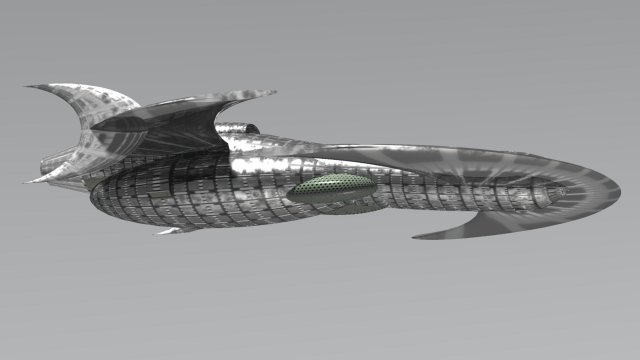
From below, the fold drive / cargo compartment is prominent. The forward part of the bulge contains the fold drive mechanisms and the primary power reactors (they are paired for redundancy, but the vehicle is capable of flight with only one of each). The fold drive emitters are metallic shields, perforated to create the field profile. To ensure appropriate aerodynamics, a clear shroud guards the emitters. |
 |
| Seen from the front, the rudder surfaces are prominently visible, and it can be clearly seen that the Zadar is, by design, a staggered biplane. Both forward and rearward curved wings provide minimal drag, but are capable of high lift. The wing configuration requires significant computerized control to provide dtynamic stability during atmospheric flight. | 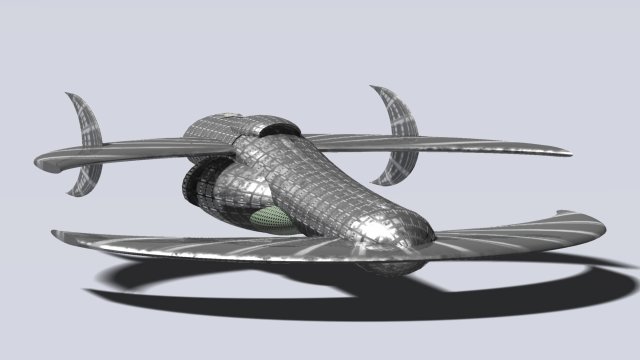 |
| From above rear, the Zadar's multi-purpose main engine outlet is visible. This nozzle is capable of functioning as a jet or rocket afterburner for additional thrust. | 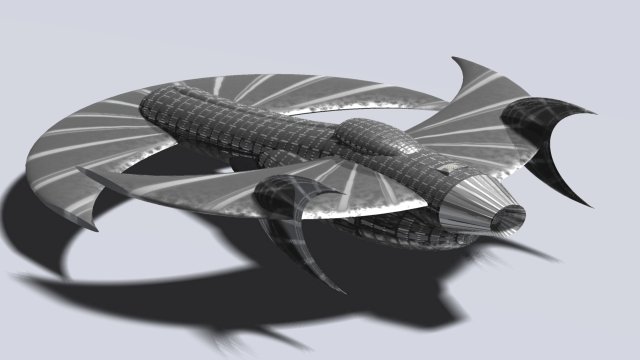 |
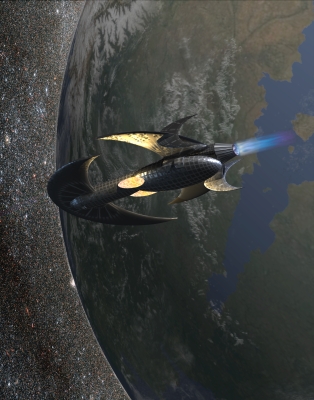
| This image shows the Zadar departing Cocteau orbit as Clu Sherril flees the system. |
 |