
The Making Of "Electricity Of Life"

Miscellaneous Items: Hands, Cobblestones, Puddle, and Lighting Management
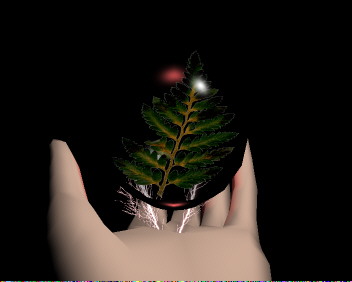
The hand came to me as I was wrestling with the inadequacy of the cedar to carry the composition. I wanted something to symbolically suggest a more explicit role for man in the process of creating a living technology. This led me to the idea of the hand and the lightning, with the lightning (electricity) supporting the life in the globe. I tried two different arrangements of the resulting objects, and the second one was adopted:
 |
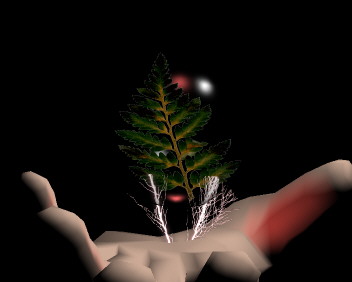 |
| The hand from the wrist | The hand from the front |
As you can see in the second image, I had made the filter plane that contained the lightning an emitter of a reddish light from an axis at the bottom of the plane (I envisioned the lightning casting light from inside the skin). This later caused me to pull the lightning plane up a bit higher so the light could actually be cast in raytrace mode (the hand would block it, otherwise).
Another area of interest is the addition of fingernails to the hand. The hand comes from the Crestline Software "Humanoid" collection, and it does not have fingernails. But with the hand so close to the camera, I thought the fingernails would be an important detail.
In some situations where a section is needed to conform to a complex surface, it is easier to make a copy of the base object and leave only the points which are in the needed area and then to extrude or otherwise modify those remaining polygons to suit one's needs. However, I lacked the patience to deal with the extremely complex geometry of the hand this way, and so I decided instead to base the nails on cylinders. I then created an open ended tube and placed in carefully so that one part of it stuck out through the "top" of the finger as a nail would. This required a lot of fiddly axis movements and frequent movement of the perspective view to get a good alignment. Once that was complete, I deleted all the points in the cylinder which were not above the finger. I then copied / pasted the remains and moved it to the second finger, where only small adjustments were needed to attain the correct position. This worked fine for the second and third finger, and even though the fourth finger was, of course, somewhat different in orientation, some adjustments to the rotation and scale of the nail were sufficient. The thumb, however, was so different that I opted to redo the base technique to create its nail. Then I made the nail attributes the same as the flesh attributes, with slightly more glossiness and no roughness.
The cobblestones needed no more than the "Pebbled" texture on a plane to create a sufficiently realistic appearance.
The need for the puddle became apparent as the rendering was approaching its final form. A good composition should unobtrusively guide the eye to all of the objects in the image and also cause the eye motions to flow within the composition. But the empty lower left was a problem from that perspective. I decided that a puddle would be perfect for that flow. A quick importation of a bitmap to make an object of the appropriate shape was sufficient. I added a rain texture, made the puddle a filter with moderate reflectivitym, and placed it appropriately in the composition.
The lighting for this scene was among the most complex I ever attempted. The two torches each supplied their own light,and another light was generated by the lightning plane axis. Finally, a fill light was located below the hand to ensure that it would show properly. The fern itself was bright, though not a light. The ceiling inside the building cast a rectangular parallel greyish light downward, while the floor case a parallel rectangular purplish light to fill the shadows from below. Each element of the lighting adds to the richness of the color, and each shadow adds to the mood of the scene.