
The Making Of "Electricity Of Life"

Pipes And Trees
The pipes were quite clearly the next largest challenge. It was theoretically possible to create the necessarily complexity by extruding a disk along a single complex path. But the truth of the matter was that a) I was unsure of the best distribution of pipes in space to create the effect I wanted and b) a path would not provide sufficient visual cues when working in the detail editor to be sure of what the result would be. I needed an incremental method to build the pipe complex. So I fell back on my programming background to decompose the problem into simpler subproblems. I built a parts kit.
The pipe parts kit was based on a cylinder and pieces from a torus. The pieces were 90 degree and 180 degree sections of a torus. It was essential to do a Make Sharp Edges on the ends of the cylinder and the torus sections, otherwise the Phong shading that made the rest of the pipe look so good would obscure their fitting together. I also made a few compound parts, like an S pipe from two 180 degree curves, a J pipe from a cylinder and a 90 degree curve, and a twisted curve from two out-of plane 90 degree curves.
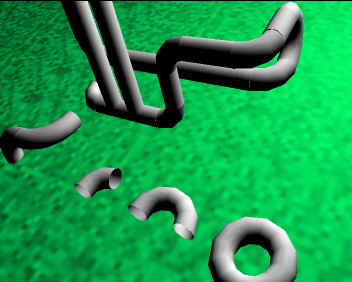
Pipe Kit Elements and Sample Assembly
The most difficult part of using the kit was making sense of what I was assembling. Rotating the perspective view on a frequent basis was essential, as was using all three isometric views for ensuring that components lined up properly. So I took a multi leveled approach and built subunits of the pipe complex, then copied / pasted them and shifted / rotated them to create combined pipe systems. I also started with a cube at the center of the array so that I could contour the pipes around the edges of the cube.
The tree trunk kit was similar, except that the basic component was an extrude of a disk along a slightly sinuous path (with a slightly smaller destination size). Actually, the tree was easier than the pipe kit, because a single base component was all that was needed. A forked branch could easily be produced by combining / rotating in space two or more of the base components.
In both of these cases however, it was essential to minimize the polygon count of the base components, as I found with my first experiment in placing a pipe complex in the building. Even with 30Mb of RAM in my Amiga, I ran out of memory for the rendering. So I went back and rebuilt the base kit with half the number of faces in each direction of the torus (12 rather than 24), and reconstructed the pipe complex with the new kit.
It was annoying to discover that it was much harder to fill the interior of the building with pipes in a way that would make the windows appear full of pipes. Eventually, I found it necessary to carefully place a smaller complex in the desired locations for the sight lines that camera would use. This left much of the interior empty, but led to a much more satisfactory appearance with a lower polygon count.
As for the trees - the trunk and branches turned out to be only half the problem.
At this point, I only knew that I wanted trees and either water droplets or a glass globe of some kind. I tried a branch hung near the camera, with two water drops, but the result was somber and at variance with the integration of technology with nature that was to be at the basis of this work. I realized that, to attain the appropriate symbolism, I needed living trees and I needed to show them as connected to the building in some fashion. But living trees meant foliage.
I decided to try using particle systems for the foliage. I had long thought that a pair of nested particle systems could give the multilevel appearance of foliage, without generating a drastically higher polygon count. This indeed turned out to be the case, although the development of the concept was not without its difficulties.
In the end I found several concepts which were useful:
- A sphere with a high polygon count (24 / 24 or 24 / 48) was needed as the basis.
- Stagger points made a more irregular (and thus more natural) appearance.
- A simple leaf was sufficient (two triangles at an angle).
- The outer shell was generally done best with the particles at small size and random orientation, while the inner shell could be done the same way or with particles of random size and random orientation - however, in this case the inner shell had to be made smaller to allow for the potentially large size of the inner polygons. This was not, however, a hard and fast rule.
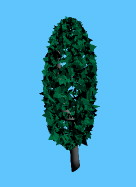
- The inner shell could be a duplicate of the outer shell (in the case of the cedar tree, this and the use of an identical seed allowed for the appearance of the growth margin of the cedar).
- Once the outer shell was created, it was a good idea to go into lasso points mode and randomly select points from the shell and scale them; first out, then a new set of points and scale in. Move could also be used on these random areas, which would break up the areas of foliage into clumps (larger polygons equate to open space when the particle size is constant (small, large, or specified)), as could rotate, though one had to be more careful with rotate to not do something inappropriate. Such a randomly deformed outer shell could then be copied, pasted, scaled smaller, and rotated (usually around Z) to make a reasonable inner shell.
My greatest disappointment was to find that the particles only would take on the geometry of the object assigned to the particle. I had hoped to be able to use a filter mapped leaf object (a plane) as a particle, but that only gave me blank polygons with the attributes of the particalized main object. However, for trees at some distance, this was not a problem, as even a simple leaf geometry sufficed.
 |
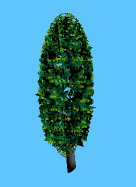 |
| Cedar inner shell | Cedar with outer shell |
As I developed the concept of the image further, I decided to connect a tree just beyond the building to the building, using the suggestion of an underground pipe. Originally, that led me to consider a tree (in this case a cedar) actually growing from a pipe on the wall, but a lighting analysis (that is, a quickrender) showed that the lighting just didn't work for that. It also lacked a certain excitement that I thought was needed.
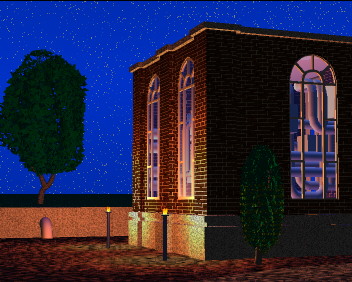
"Electricity Of Life" before the electricity (Scanline quickrender)