
The Making Of "Still Life With Plants"

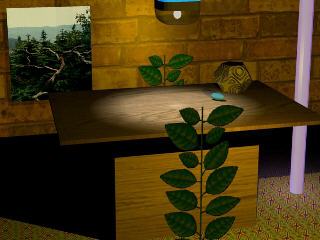
"Still Life With Plants" is the first complete work I have created with the Aladdin program. Aladdin is a program similar to the Imagine ray tracer which was my previous standard 3D program. Because the makers of Imagine have largely shifted from the Amiga to the PC platform, I have decided to begin exploring Aladdin.
This image uses many of the capabilities of Aladdin. Unlike Imagine, Aladdin is not a ray tracer. Its operation corresponds most closely to Imagine's "scanline" mode. Because of this, Aladdin does not directly support the creation of mirrored or refractive objects (such as glass spheres which distort the images of nearby objects).
In making any realistic scene with a 3D program, the ability to apply texture to geometric objects is essential. The walls use the excellent brick bitmap of Snap Maps, and the table uses an Aladdin supplied wood bitmap. Just as useful is the special bitmap style called "genlock" which makes all areas of the object to which the bitmap is applied show either image or, where the bitmap contains "color 0", makes the object transparent. This is used for the plant images, which are applied to zero thickness rectangles. And, of course, a photograph or other image can be applied to Aladdin objects, which can be seen in the picture on the wall. Aladdin also interpolates between pixels in the bitmap so that one can approach very closely to any object in the scene without the pixels of the bitmap becoming apparent.
But bitmap textures are only one of the two texture types in Aladdin. The other type is the Procedural texture, which are similar to what Imagine users know as "textures". They are mathematical textures, generated by program modules as the image is rendered. Aladdin comes with a number of procedural textures, one of which is shown as the pattern on the floor of "Still Life With Plants". More flexible than Imagine textures, Aladdin procedurals can be applied in all of the same modes available to bitmap textures, including genlock and bump map (which generates the appearance of raised and indented areas). In fact, the grooves on the dodecahedron (an Aladdin geometric primitive), are generated with an Aladdin procedural applied as a bump map.
Both bitmap and procedural textures can be combined as layered effects with varying strengths.
Along with realistic surfaces, the ability to create and position a variety of light sources is essential. In this image, there are three: Behind the camera, a spherical light source, the color of sunset light, broadly illuminates the scene; A second light, in the fixture above the table, broadcasts a cone of light down onto the table; A third, near the base of the glowing lavender pillar, casts a soft cone of light which represents the luminosity of the pillar.
But the pillar, the light bulb, the picture on the wall, and even the bluish stone on the table are not affected by the light sources - because they actually glow. For the blue stone and the picture, this is essential, because otherwise frontal orange light would eliminate their color variation.
Interestingly, Aladdin allows impossible visual effects which can nonetheless create realism. In the case of the blue stone, the stone is transparent, glows, and yet casts shadows from two lights - all of which contributes to a natural color variation and realistic appearance. Another case of this is the rear brick wall, which refuses cast shadows from the table. If this were not done, there would be too much black in the image, and the lower section of the wall behind the table, which helps provide the sensation of depth, would be invisible. However, this presented something of a problem for the picture which hangs on the wall, because realistic depth requires it to cast a shadow. This is overcome through the use of a semitransparent black rectangle which hangs in space just in front of the wall and just behind the picture.
Aladdin is a fascinating program with capabilities in still imaging which "Still Life With Plants" only begins to explore, not to mention advanced animation capabilities which will be the subject of future work. If you are an Amiga owner, visit the Nova Design website for more information.