
t e m p o r a l
d o o r w a y
UFO Surface Luminosity

The Tulsa, Oklahoma photo, featured in my analysis of a persistent feature in UFO descriptions, is an important photo for studying UFO luminosity.
First, let us look at the basic photo itself:
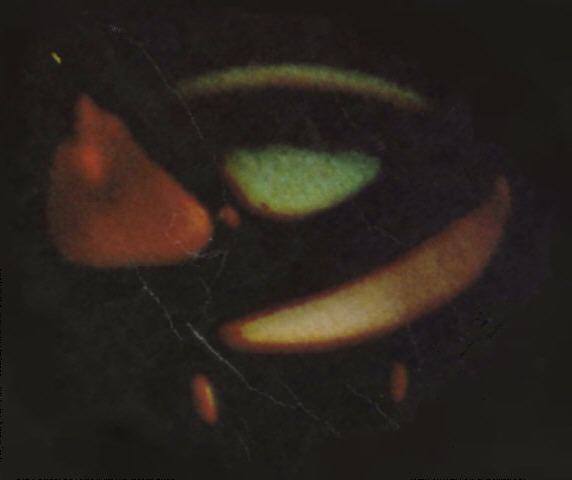
This photo clearly shows the object has areas of luminosity and areas which are not luminous. Comparison with the Mt. Clemens photo shows no specific surface feature which can be linked to the luminosity.
Each of the areas of luminosity has a characteristic color, shape, and appearance.
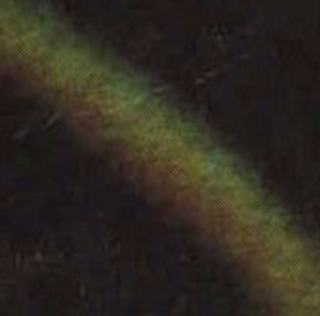 |
This shows the luminosity at the edge of
the object. This is particularly important, since it allows us to observe
a cross section of the luminosity. This cross section reveals that the luminosity is red close to the object and passes through yellow to green and possibly blue as distance from the surface of the object increases. |
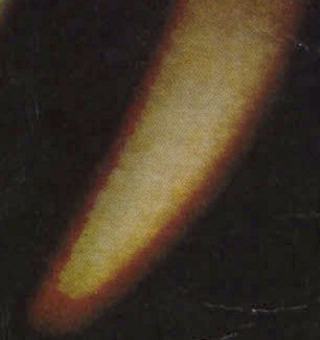 |
This is the luminosity on the side of the
object closest to the observer. It appears to be offering an opportunity
to look straight down into the luminosity. Given the observations above on the cross-section of the luminosity it seems that the edge of this luminosity is less thick than the center, since there is a consistent rim of red. This luminosity also shows an interesting phenomenon in that it decreases in brightness smoothly across the surface. It darkens before it becomes more red, indicating that part of the change in brightness may be due to limb darkening - a phenomenon observed on the sun, where looking though a thicker layer of plasma reduces the level of luminosity as the plasma curves around an edge. On the other hand, this appearance may represent distance from the energy source which generates the luminosity. |
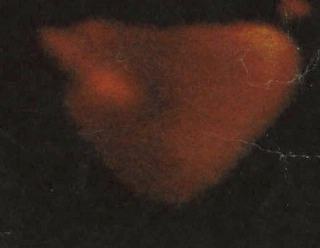 |
This shows the luminosity in the superstructure
area. The plasma appears to hug the surface of the spike. The brightest area of the plasma seems to be toward the leading edge of the superstructure, and on the side of the spike. The dark anterior area of the luminosity, if due to limb darkening, indicates a steep slope away from the observer. |
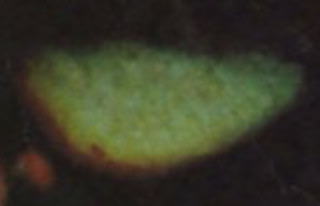 |
This image of the triangular area at the center of the object provides an oblique view of the greenish luminosity. It is clear from this image that the luminosity does have a thickness and that the red layer is lower than the yellow and green layers. It also appears that the luminosity can have fairly vertical edges and a sharp demarcation from the non-luminous area. |
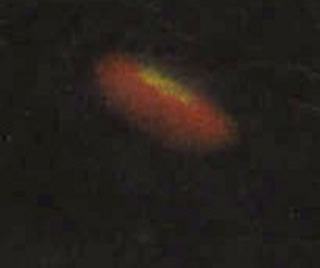 |
This image is of what appears to be an
exhaust on the side of the object. However, given what we now know about
the luminosity on this object, it is clear that we must invert our understanding
of the geometry of this feature. The red area is actually the closest to
the surface, and the yellow is where the plasma is the thickest. However, it is possible that this is still being emitted by some sort of duct, and the plasma is thickest in the mouth of the duct. |