
Are There Too Many Landings?

Introduction
One of the cornerstones of both the Paranormal Hypothesis (PNH) and the Control System Hypothesis (CSH) is the contention by Vallee in several references that "there are too many landings".[footnote 1]
Vallee implies that given the number of cataloged landings, and reductions in the number of reports at various times of day and the distribution of landings away from populated areas, one is justified in making certain mathematical assumptions which lead to the conclusion that UFOs cannot be accounted for as physical vehicles requiring logistical support.
Obviously, there are many assumptions underpinning this, and none of them are strongly supportable:
- Reductions in reports between midnight and dawn represent reductions in the number of available witnesses; UFO activity continues at the same rate during those periods.
- Reductions in reports from less populated areas represent reductions in the number of available witnesses; UFO activity continues at the same rate in all locales.
- Support for UFO activity operates on the same principles and methods available to 20th century logistical science.
We know that UFO sightings are not distributed evenly across the globe at any particular time. Concentrations, flaps, and waves all represent significant deviations from uniformity in the geographical distribution of sightings. We also know that such variations shift from one locale to another over time, again indicating against the idea that sightings or landings are uniformly distributed in time and space.
At any rate, it is also possible to see whether the available data supports Vallee's contention in one fashion or another. The approach taken in this paper is to analyze the landings from Vallee's Magonia catalog, which, one must expect, represents at least part of the support for Vallee's contention.
The Method Used
A hypothesis which is testable with regard to Vallee's contention is as follows:
- If UFO landings are equally distributed across time and space, there will be no trend with regard to whether the encounter seems to be accidental (i.e. at a distance, without reference to a witness or an area containing witnesses) or directed specifically toward the witness or toward a concentration of possible witnesses (i.e. population centers, property, vehicles, etc.).
Vallee's uniform distribution model assumes that UFOs go about their business largely without reference to witnesses. In essence, by that model, on any given day, the distribution of UFO landings is random. If the distribution of landings is random, then we must expect, first, that the chances are higher that landings will be observed in proximity to population centers, simply because of the larger number of available witnesses. Secondly, we can expect that the typical encounter will be a witness "coming across" a landed UFO or observing a landing at some distance.
Now, assuming the distribution is random, then we can see that the probability of a UFO landing which can be observed rises swiftly with distance from the potential witness (because the available area to "capture" the landing increases as the size of the circle increases, at a rate of pi x diameter), and then diminishes swiftly as the radius passes the observer horizon. Thus, again, we see that we should expect to see more landings at a distance from the observer if the distribution is random.
To determine if this is the case, I have classified the Magonia catalog entries according to a parameter I refer to as "coupling". This parameter indicates how the object and the witness seem to have come together. If there are no significant differences between the proportion classified as accidental and the proportion classified as purposive, the hypothesis will stand. Otherwise, it must fail.
Cautions
It must be noted that it is impossible to determine what, if any, selection effects have occurred in the Magonia catalog. Many of the accounts are drawn from press reports, and thus, one can assume that they tend to represent experiences of persons from less remote areas. However, if the distribution of UFO landings is random, then this may not have any effect.
One might also assume that Object / Occupant Purposive behavior would tend to gather more notice, and be more likely to be reported than events happening at a distance. Unfortunately, I cannot see any available correction factor for such an effect.
The Classifications Used
I created a database from the Magonia catalog and added a column for "coupling". It may have one of the following values:
- Accidental (A) - The witness observed the object from a distance and did not attempt to approach it, nor did the object attempt to approach the witness. The object was in an area which might appear to be devoid of witnesses (a wilderness, a woods, a field set away from property, over the ocean near the horizon)
- Witness purposive (WP) - The witness attempted to approach the object after observing it from a distance. The object was in an area which might appear to be devoid of witnesses.
- Object / occupant purposive (OP) - The object either attempted to approach the witness, followed the witness, blocked the witness path, interfered with the witness or witness vehicle, comunicated with the witness, or came into close proximity to an area obviously containing witnesses (a town, a building, a ship, an aircraft, a vehicle).
- Insufficient Information ? - Not enough information to determine coupling.
- A (?), WP (?), or OP (?) - classified as stated but there is some doubt as to the classification; this often occurs when a field or woods are referenced and proximity to a road, town or buildings is unclear.
- Irrelevant material includes known hoaxes, misinterpretations, stories, or events which may not be UFO events.
It is assumed that all entity encounters without objects are nonetheless UFO events. These represent a very small proportion of the total.
Objects rising from water are a sort of special case, but I have assumed that when they do so in close proximity to a ship that this represents an OP classification event, since, as with close approach to an aircraft, it is clear that UFOs can detect objects at a distance, and choose therefore to approach or avoid them.
Note also that some entries in the catalog refer to more than one UFO event, and in some cases, those events fall into more than one category. These cases are not counted separately, but if there is an object / occupant purposive component to the case, that is used as the classification.
One may consider that the Accidental and Witness Purposive classifications are probably different views of the same type of event - the accidental. Thus, in the analysis that follows, you may consider these two categories to be one.
The Results
The results of this study show a clear preference for the Object / Occupant Purposive classification, thus tending to falsify the hypothesis.
The following graph shows a complete breakdown of the results:
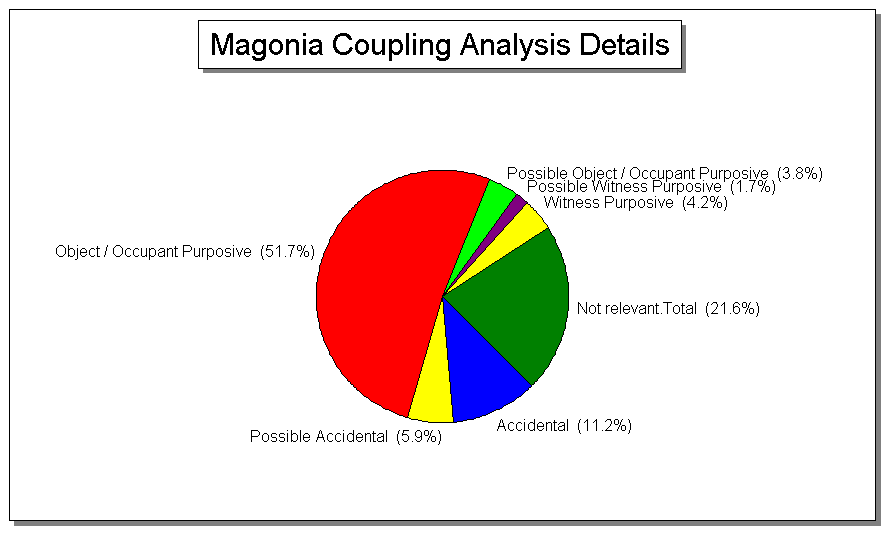
As you can see, the "possible" (i.e. borderline) categories represent a varying proportion of the result. For Object / Occupant Purposive, addition of the "possible"s represents a fairly small addition; but for Accidental it represents approximately 1/3 of the cases which are classed as Accidental.
The next graph merges the actual and possible categories for each classification:
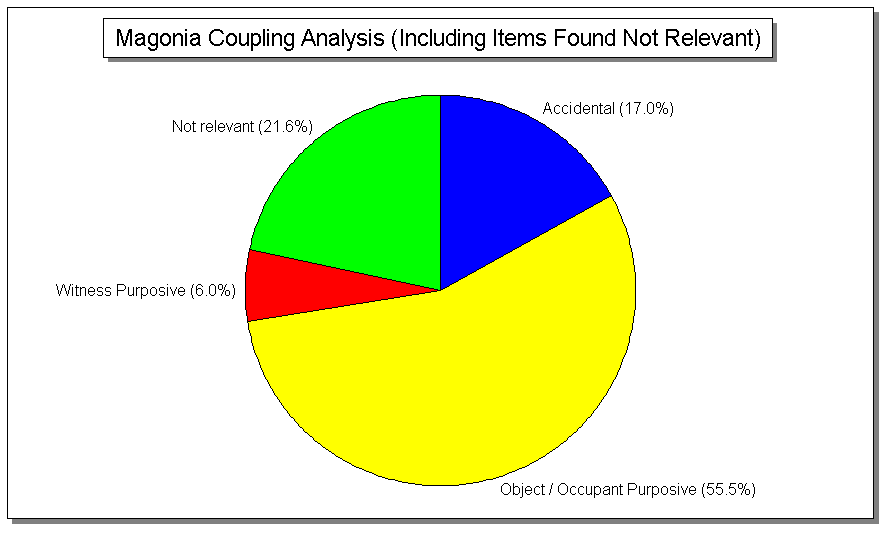
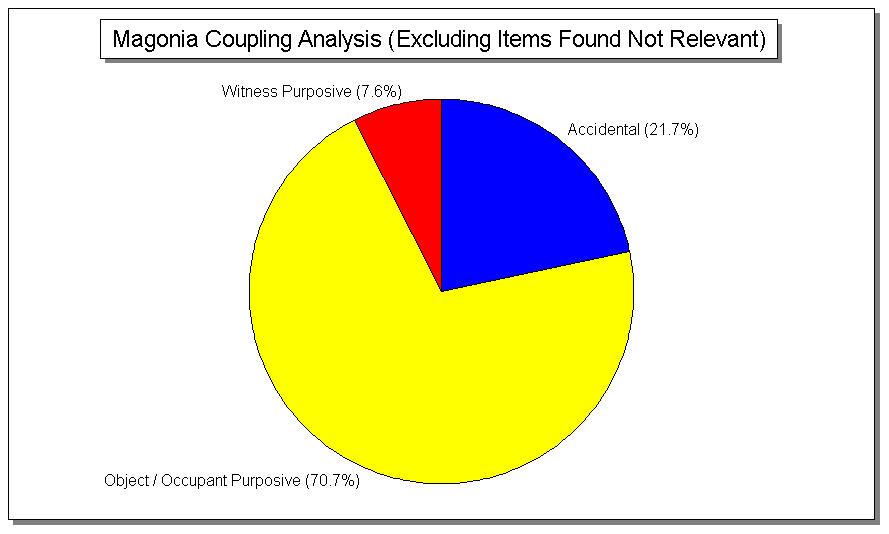
Not relevant (most often due to Insufficient Information) represents a significant chunk of the catalog. Therefore, it is best to examine the results with these removed.
Conclusion
The results of this study indicate that the encounters in the Magonia catalog are skewed almost 3:1 in favor of those where the object or occupant either sought out the witness or performed in an area where there was a high probability of being witnessed (i.e. on a witness property, in the middle of a town, landing on an airstrip, landing in the middle of the road). Landings either observed by witnesses in non-populated areas, or where the witnesses saw the objects land in neighboring woods and distant hillsides, seem to be less than 25% of the total.
It is dangerous to draw confident conclusions from this study. This is especially so since the UFO event is typically of short duration and isolated in time and space. Nonetheless, the indications are that the UFO witness is sought out by the phenomenon with at least a noticeably higher frequency than is the UFO "stumbled upon" by the witness. One might debate whether landing within a hundred yards or so of the side of the road in the middle of the night represents a "seeking out" of witnesses, but it certainly cannot be considered an avoidance of potential witnesses, and, certainly, landing in a yard or on the road and interfering with vehicle operation is an apparently purposive act by the UFO or its occupants.
At any rate, this result seems to falsify my hypothesis, which required a fairly even distribution of encounters between the Accidental and the Object / Occupant Purposive. This result would tend to weaken the assertion of "too many landings", since it indicates that the witnessed landings can indeed be a very high proportion of all UFO landings.
I hope to be able to post the classified Magonia at some time in the near future. In the meantime, I will make available the database (with or without my classifications) to any researcher who would like to attempt to repeat or critique this study. Please contact me to make arrangements.
Footnotes
1. A paper by the author with more extensive critique of these theories and the reasoning used by their proponents is available. For more information on Vallee's contention, see the references in that paper.