
The Levelland Sightings Of 1957 by Antonio Rullán: The Witnesses and the Investigators

The Levelland case is entirely dependent on eyewitness testimony. There were no physical traces on the ground, none of the affected vehicles were examined, and no photographs were taken. As a result, the witness testimony becomes the only way to evaluate the case. Unfortunately, many newspapers misquoted the witnesses or embellished the stories. Moreover, very few eyewitnesses were actually interviewed by the Air Force and Journalists. In order to determine whether the seven reports were consistent, the source of the report and the manner in which it was reported must be reliable. In the Levelland case, witness credibility was not an issue with regard to the fact that something was seen. The Air Force and the Journalists all agreed that something was seen on the evening of Nov.2-3. Nevertheless, witness credibility was an issue with regard to the description and details of what was seen.
In order to better judge level of accuracy in each of the seven reports, we must understand who the witnesses were, their level of training, how the report was made, who interviewed the witnesses and how the report was documented. Below is a summary of the how testimony was obtained for each witness and which source is deemed most reliable.
Witness Reliability and Source of their Statement
Newell E. Wright
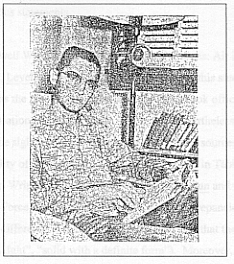
Newell Wright - 1957
Newell Wright was a 19-year-old freshman student at Texas Tech.University in Lubbock. He was driving late on Saturday night (Nov. 2) on his way to Levelland for a weekend visit with his parents. Shortly after midnight (at about 12:05 AM), he witnessed the ball of light and his car engine stopped. After the event, he went home and went to bed. He did not call the Levelland Police Department that evening because he did not think much of the event. The following day (Sunday Nov. 3) he was encouraged by his parents to report the incident to Sheriff Weir Clem. His parents felt that he should report it because they had read about similar incidents in the Levelland newspaper and because they knew and trusted Sheriff Clem. Newell described the incident to Sheriff Clem on Sunday at 1:30 PM. He was subsequently interviewed by a journalist from the Levelland Daily Sun. He was also interviewed by the Air Force officer who came to Levelland to investigate on Tuesday November 5. Newell’s story was also documented in the Texas Tech student newsletter titled Toreador and 25 years later he was interviewed by a Hockley County News-Press reporter. The author recently interviewed him to better understand his previous statements.
In summary, Mr. Newell Wright is on record on several sources: Air Intelligence Information Report , Levelland Daily Sun, and Toreador. In this study, we will consider the Air Force report as the most accurate because the Blue Book officer’s main purpose was to determine causation and not to create newsprint. Nevertheless, we compared how key descriptions of the sighting were reported in each of these sources in order to determine the reliability of the press at the time (shown below in Table 1). It appears that the description of Mr. Wright’s sighting on Levelland Daily Sun and the Toreador were very close to the Air Force report. While there are minor discrepancies on the location of the sighting, the key difference is that the newspapers implied that the object was solid (ie. “image not just a light”, “solid with a definite form”). Moreover, while the Air Force Report and the Toreador said that the sighting lasted minutes, the Levelland Daily Sun states more accurately that the Mr. Wright thought it was minutes. In a recent interview, Mr. Wright said that while it might had seemed minutes at the time it probably was more like 4 to 5 seconds. The key point here is that witness testimony is subjective and facts and figures are just rough estimates made after a stressful event. The same comment can be made about the size of the object. Recently Mr. Wright said that the glow from the ball of light covered the whole width of the two-lane road. This size estimate is less than 30 ft (see note below), but back in 1957 he said the object was between 75 and 125 ft wide.
Table 1: Comparison of Three Reports of Newell Wright’s Sighting
| Sighting Descriptions | Air Intelligence Information Report | Levelland Daily Sun | Toreador |
| 1. Date of Interview | Nov. 5, 1957 | Nov. 4, 1957 | Nov. 4, 1957 |
| 2. Date of Report | Nov. 18,1957 | Nov. 5, 1957 | Nov. 5,1957 |
| 3. Investigator/Reporter | Sgt. Norman P. Barth | Dale Johnson | |
| 4. Location | On Hwy. 116, 4 mileswest of Smyer | Near the town of Smyer | On Route 116, one mile west of Smyer |
| 5. Event Duration | 4 to 5 minutes | Thought it was minutes | ~ 5 minutes |
| 6. Weather: (Clear,Cloudy, Rain, etc) | Heavy clouds and a light rain falling | Not Available | Night was overcast |
| 7. Description: UFO Shape | Shaped like a loaf of bread | Like an egg but flat on the bottom | Egg-shaped and flat on the bottom; solid with a very definite form |
| 8. UFO Size: How was it estimated? | 75 to 100 ft long He did not know how far object was. Size of a baseball at arm's length. | ~75 ft long but he did not know how far object was | ~75 ft long but he did not know how far object was |
| 9. UFO Color | White with a little greenish tint | Saw an image not just a light; not as bright as neon | White with a little greenish tint |
In the Air Force report of Mr. Wright’s sighting, he was considered to be a reliable witness. It is interesting to note that James A. Lee, a NICAP investigator from Abilene, TX, also interviewed Mr. Wright and described him as the “most important and authentic of all” the witnesses in the Levelland case . The comment is curious because Mr. Lee concluded on Nov. 4, 1957 that the sightings were due to “space craft from one of the neighboring planets” but his best witness never believed in the spaceship theory. Mr. Wright always thought it was some sort of natural phenomena. After the sighting, he went to bed and did not think much of it. On Sunday he reported it only because his parents asked him to do so. The Monday after the sightings, Mr. Wright met a professor of Electrical Engineering at Texas Tech (who he worked for part-time) who explained the sighting as ball lightning. This explanation was reasonable to Mr. Wright and he has been satisfied with this explanation ever since.16 In a interview in 1982 he tells the Hockley County News-Press that people did not want him to say he thought what he saw was something from nature. He said “nobody that ever talked to me was ever satisfied to hear that (his explanation) because the other was more exciting”.
Pedro Saucedo
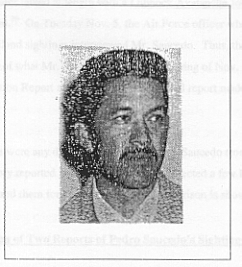
Pedro Saucedo - 1957
Pedro Saucedo was a 30-year-old farm hand and part time barber from Levelland. He was the first witness to call the Levelland Police Department (PD) on the Saturday evening of November 2, 1957. Saucedo had his sighting on Hwy. 116 about 4 miles west of Levelland near the Pettit Community. After the sighting, he drove towards Whiteface and made the call to the Levelland PD. Mr. Saucedo talked to A.J. Fowler who was the officer working the night shift at the Levelland police dispatch. The Saucedo sighting was the only vehicle interference case that evening that had two witnesses. A friend of his, Joe Salaz, also witnessed the event. Nevertheless, nobody ever interviewed Mr. Salaz to confirm the story.
Saucedo returned to the Levelland PD the following day (Nov. 3, 1957) in order to give a more complete report. Saucedo gave a complete statement of his sighting to Officer Shelby Hall and he later talked at length with a Lubbock Avalanche Journal reporter named Bill Wilkerson. On Tuesday Nov. 5, the Air Force officer who came to investigate the Levelland sightings interviewed Mr. Saucedo. Thus, there are two documented sources of what Mr. Saucedo saw on the evening of Nov. 2, 1957: the Air Intelligence Information Report and the Avalanche Journal report made by Mr. Wilkerson.
To determine if there were any discrepancies between the Saucedo story reported by the Air Force and the story reported in the newspapers, we selected a few key descriptors of the event and compared them for each report. This comparison is shown Table 2 below.
| Sighting Descriptions | Air Intelligence Information Report | Lubbock Avalanche Journal |
| 1. Date of Interview. | Nov. 5, 1957 | Nov. 3, 1957 |
| 2. Date of Report | Nov. 18, 1957 | Nov. 4, 1957 |
| 3. Investigator/Reporter | Sgt. Norman P. Barth | Bill Wilkerson |
| 4. First Thing Noticed | Saw a large flame in the West | Flash of light in a field to his right |
| 5. Sound | None Reported | Sounded like thunder |
| 6. Physical Effects | Felt heat | Felt rush of wind and truck rocked from the blast. Felt a lot of heat |
| 7. Location | On Hwy. 116, 4 miles west of Levelland | On Hwy. 116, 4 miles west of Levelland |
| 8. Event Duration: | 2 to 3 minutes | None Reported |
| 9. Description: UFO Shape | Shaped like a torpedo | Torpedo shaped orlike a rocket but much larger |
The are three slight discrepancies in the two statements. First, the Air Force does not mention any sound heard during the Saucedo sighting, while the Avalanche Journal reported that it sounded like thunder. Second, the Air Force reports that the sighting lasted 2 to 3 minutes while the Avalanche Journal did not mention time. The fact that the object described by Mr. Saucedo flew past him very fast (like a rocket) implies that it could not have been minutes. Thirdly, the air force report does not mention that Saucedo’s truck rocked from the blast while Wilkerson’s report does mention this.
Mr. Saucedo told the Air Force investigator (Sgt. Barth) that he thought the object was an electronically controlled rocket. The Air Force, however, considered Mr. Saucedo not reliable and to be below average intelligence. It is interesting to note that the Air Force never stated in its report that Mr. Saucedo was a Korean War veteran but the Lubbock Avalanche Journal did report it. According to A.J. Fowler, the Levelland police officer that took Saucedo’s call on that Saturday evening, Mr. Saucedo did not speak very good English and it was difficult to understand him. This might be the reason why the Air Force investigator did not think much of Mr. Saucedo. Moreover, in his Air Intelligence report Sgt. Barth wrote that Mr. Saucedo “had no concept of direction and was conflicting in his answers.”
Ronald Martin
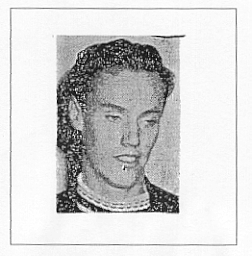
Ronald Martin - 1957
Ronald Martin was an 18-year-old truck driver who happens to have been in Levelland at the time of the sightings. While Loren Gross writes that he was staying at the Padgett Hotel in Levelland , nobody was able to determine where he was from. Ronald Martin never called A.J. Fowler on the evening of his sighting (Nov. 3, 1957 at 12:45 AM). Martin was the 2nd witness who showed up at the Levelland Police Station the day after the incident (Nov. 3, 1957). At the Levelland Police Station he gave a report to Officer Shelby Hall. Moreover, the Lubbock Avalanche Journal reporter, Bill Wilkerson, was able to interview Mr. Martin on Nov. 3. Besides interviewing the witness in person, the Avalanche Journal was also able to photograph Mr. Martin and showed his picture on the Lubbock Morning Avalanche of Nov. 4, 1957. The Air Force officer who showed up on Nov. 5 was not able to locate Mr. Martin and concluded in a memo to file that “contrary to newspaper reports, source (Ronald Martin) did not live in Levelland ”. Therefore, the only good source of information for the Ronald Martin story comes from the Lubbock Avalanche Journal report. This story was subsequently sent via Associated Press wire to numerous papers across the country.
According to Civilian Saucer Intelligence (CSI), there was a probable hoax in the Levelland case . CSI speculated that the unreliable witness was Ronald Martin based on the fact that he reported the sighting the day after. CSI quotes a press report stating that “an unidentified employer said the facts simply would not have allowed one of the local witnesses to be where he was under the circumstances described.” The Levelland Daily Sun claimed the discovery that at least one of the dramatic sightings appeared to be of the imaginary variety . However, they did not identify the witness. As a result, we have to withhold judgement on Mr. Martin. He is one of the few who did come back the afternoon following the sightings and interviewed with newspaper reporters. By then, he had already heard the news of the sightings and it is possible that he embellished the story. Martin’s story, however, is more reliable than that of other witnesses who were not interviewed and who just reported the sightings to A.J. Fowler.
James D. Long
James D. Long was a truck driver from Waco who, like Ronald Martin, was driving on the outskirts of Levelland in the early morning hours of Sunday, Nov. 3, 1957. Right after his sighting, he called the Levelland Police Department and talked to A.J. Fowler to report the sighting. Nevertheless, Sheriff Weir Clem is the one who is quoted in most of the newspaper stories that mention Long’s sighting story. While Sheriff Weir Clem was quoted in the El Paso Times as saying that he talked to Mr. Long, this quote is doubtful.
In a recent interview with A.J. Fowler, A.J. said that he talked to a negro man who called on the early hours of Nov. 3 to report a sighting and car stoppage. While A.J.’s description of the man’s sighting is different than the one reported 42 years earlier, this man must have been James D. Long because there was only one negro man quoted on the whole Levelland case. Moreover, Long’s sighting happened at 1:15 AM, which is only 15 minutes earlier than Sheriff Clem sighting of a streak of light. It is difficult to have Mr. Long calling Mr. Clem within a 15-minute period when both of them were on the outskirts of Levelland. It is more likely to conclude that Mr. Long called the Levelland PD and talked to A.J. Fowler, who then communicated the news to Sheriff Clem via radio.
No newspaper reporter or Air Force investigator claimed to have talked to Mr. Long. It was presumed that Mr. Long continued to his home in Waco after the incident and there was no further follow-up interview. As a result, the descriptions available about Mr. Long’s sighting are based on what Sheriff Clem told the press on November 3 and 4 and on what Officer Fowler told the press on November 3.
A.J. Fowler is the only person who is on record talking to Mr. Long. A.J. Fowler told the author that George Dolan, from the Fort Worth Star-Telegram, was the only reporter who called him the day after the sightings on Sunday, November 3, shortly before noon . He also recalls talking later to the local newspaper (Levelland Daily Sun) but does not recall talking to anybody from the Lubbock Avalanche Journal. Nevertheless, no full-length interview of Mr. Long took place.
In conclusion, if we rely on Sheriff Clem’s description of James Long’s sighting then we are relying on third hand information: Long told Fowler, Fowler told Clem and Clem told the Lubbock Avalanche Journal reporter. If we rely on what A.J. Fowler told the Fort Worth Star Telegram, then we minimize the potential for error. Nevertheless, the Star Telegram account is still second hand information. As a result, the quality of the details in the Long story is not the most reliable.
Jim Wheeler, Jose Alvarez, and Frank D. Williams
Jim Wheeler, Jose Alvarez, and Frank D. Williams also called the Levelland Police Department to report similar sightings and vehicle interferences. According to the Fort Worth Star-Telegram, Wheeler and Williams had their sighting north (8 and 4 miles) of Levelland on Route 51 at 11:50 PM and 12:15 AM respectively. Alvarez had his sighting at midnight about 14 miles east of Levelland on Highway 116. There is very little information available on these three independent witnesses. Jim Wheeler and Jose Alvarez were supposedly from Levelland while Frank Williams was from Kermit.
On November 4, the Levelland police searched for Wheeler and Alvarez but were unable to locate them. Sheriff Clem asked Winkler County Sheriff L.B. Eddins to search there for Frank Williams. Sheriff Eddins said that he “turned Kermit upside down” and even had an appeal broadcast on the Kermit radio station but was unable to find Williams. Neither newspaper reporters nor the Air Force investigator ever interviewed these three witnesses. As a result, the story that Wheeler, Alvarez, and Williams told was only available via whatever A.J. Fowler wrote on the Levelland police records on the evening of November 2 and whatever Officer Fowler recalled and told the press.
In October of 1998, the author contacted the Levelland Police Department and asked the Chief of Police whether they had kept any records going back to 1957. The Chief of Police said that there were no records in Levelland prior to 1978. Given the lack of primary interviews available, the most reliable information available on the Wheeler, Alvarez, and Williams stories is the report that George Dolan wrote on the Fort Worth Star-Telegram on November 4 supplemented with reports from the Levelland Daily Sun and Associated Press wires from Levelland.
Conclusion on Sources of Evidence and Witnesses
Of the seven Levelland witnesses who reported a ball of light that shut down their vehicles, only three of them were interviewed and questioned by investigators. Of these three, only two were interviewed by the Air Force. Newspaper reporters were also able to document these three witnesses. The reports of the remaining four witnesses were secondary reports. The newspaper reporters obtained their stories on these other 4 witnesses by interviewing Sheriff Clem and Officer Fowler. As a result, there is a lack of consistent data amongst the reports, a lack of consistent investigation procedure, and a lack of details on four of the seven reports. Nevertheless, there is enough data available for analysis.
We can analyze the data and draw conclusions from it as long as we take into account its source of origin. One way of ranking the level of accuracy in the reports is by using the Information Quality Index proposed by MUFON. This Index (with a value between zero and one) indicates the relative strength that a report has for analysis based on how it was acquired. MUFON’s criteria for indexing the quality of the information is based on the type of investigation conducted (direct or indirect), the time spent interviewing the witness and the level and source documentation. The ranking classification is shown below in Table 3.
| Type of Investigation | Level of Investigation | Time/Length | Index |
| Direct Investigation | At the Site | >= 2 hours | 1.0 |
| At the Site | < 2 hours | 0.9 | |
| Interview Person to Person | >= 1 hour | 0.9 | |
| Interview Person to Person | < 1 hour | 0.8 | |
| By Telephone | >=1/2 hour | 0.7 | |
| By Telephone | <=1/2 hour | 0.6 | |
| Indirect Investigation | Questionnaire with Follow-up | Extensive | 0.7 |
| Questionnaire with Follow-up | Brief | 0.6 | |
| Letter with Follow-up | Extensive | 0.6 | |
| Letter with Follow-up | Brief | 0.5 | |
| Questionnaire | 0.6 | ||
| Letter/Narrative | >= 1 page | 0.4 | |
| Letter/Narrative | < 1 page | 0.3 | |
| Others | Newspaper | >= 500 words | 0.2 |
| Newspaper | < 500 words | 0.1 | |
| Radio/TV | 0.1 | ||
| Witness Relative | 0.1 | ||
| Verbal/Rumor | 0.0 |
Based on the level of investigation and reporting done on the seven Levelland witnesses, we rated the level of accuracy using the MUFON’s Information Quality Index. We also rated the level of Accuracy of the information using the author’s subjective levels (Low, Medium and High). The author’s criteria for accuracy of data is shown below:
-
High: Witness was interviewed in person; a full record of witness testimony is available; witness was questioned thoroughly by Air Force investigator
-
Medium: Witness was interviewed in person; the witness report was documented but only in newspapers; no formal Air Force investigation took place
-
Low: Witness was not interviewed in person; witness was not interviewed by an investigator or journalist; no record of witness testimony is available
The resulting Information Quality Index and the author’s own subjective
rating are shown below in Table 4. The Information Quality Index given to Long,
Wheeler, Alvarez and Williams is zero because nobody interviewed them and wrote
a report. The source of information for their sightings was based on a verbal
conversation via phone with A.J. Fowler. No report or record of these sightings
was made. A.J. Fowler gave the details of these sightings to the press via another
phone call. Thus, these witnesses were not really investigated (directly or
indirectly). Their reports were obtained verbally.
Table 4: Subjective Rating of Accuracy of Witness Report
| Witness | InformationQuality Index | Level of Accuracy in Report | Type of Investigation |
| Pedro Saucedo | 0.8 | High | Interviewed in person by Air Force officer and Avalanche Journal Reporter |
| Newell Wright | 0.8 | High | Interviewed in person by Air Force officer and Avalanche Journal reporter |
| Ronald Martin | 0.8 | Medium | Interviewed in person by Avalanche Journal reporter |
| James Long | 0.0 | Low | Talked to Officer A.J.Fowler via phone; A.J. then told reporters |
| Jim Wheeler | 0.0 | Low | Talked to Officer A.J.Fowler via phone; A.J. then told reporters |
| Jose Alvarez | 0.0 | Low | Talked to Officer A.J.Fowler via phone; A.J. then told reporters |
| FrankWilliams | 0.0 | Low | Talked to Officer A.J.Fowler via phone; A.J. then told reporters |
Quality of Information is different that reliability of witness. In the Levelland case, most witnesses were credible and truly experienced something that they never saw before. The issue is not whether they saw a ball of light in sky in the early morning hours of Nov. 3 1957, but the details of what they saw. It is the details that will help determine and or explain what they saw. Thus Quality of Information is deemed more important than witness reliability. Witness Reliability is usually estimated using parameters like age, occupation, and education. In this study, however, source of information at the time of the sightings is deemed more important than a potentially biased Witness Reliability Index.
A key point to make with regard to witness reliability is that during and after the sightings, neither the Air Force, Sheriff Clem, nor Officer A.J. Fowler doubted that the witnesses saw something and that their vehicles were stopped. Even today, A.J. Fowler says that all the witnesses who called and talked to him were credible, scared, and did see something that night. The issue of reliability of the report has only to do with how accurate the report was made and how well documented was the sighting description from each witness. It is the details of the description of the phenomena seen that will help the most in finding a solution to the mystery.