5/11/50 - Trent, McMinnville, Oregon, 7:30 PM

| Introduction | The McMinnville event still stands as the most strongly verified
UFO photograph case ever. This document contains the text of the investigation
by the Condon Committee, which concluded that "This is one of the few UFO
reports in which all factors investigated, geometric, psychological, and
physical appear to be consistent withthe assertion that an extraordinary
flying object, silvery, metallic, disk-shaped, tens of meters in diameter,
and evidently artificial, flew within sight of two witnesses. It cannot
be said that the evidence positively rules out a fabrication, although there
are some physicalfactors such as the accuracy of certain photometric measures
of the original negatives which argue against a fabrication."
This is a large document with several images. Please be patient while it loads. |
||||||||||||||||||||||||||||||||||||||||||||||||||||||||||||||||||||||||||||||||||||||||||||||||||||||||||||||||||||||||||||||
| The photos (enlargements) |
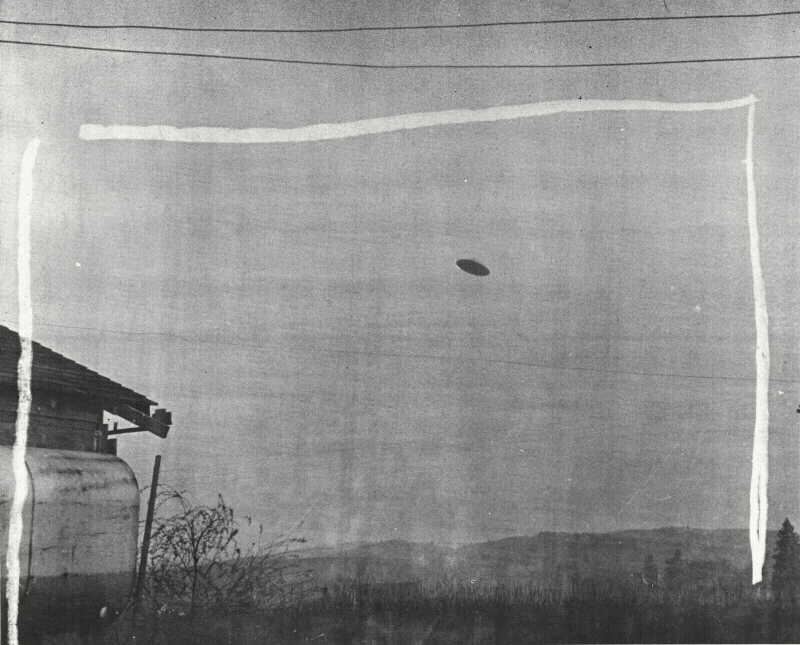
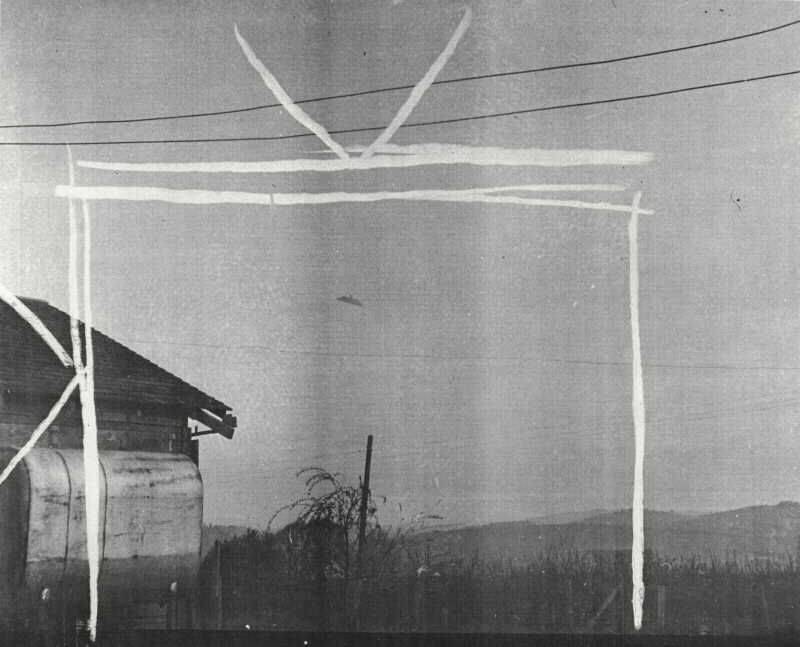
The full, uncropped photos:
Note that the object is traveling away from the photographer.
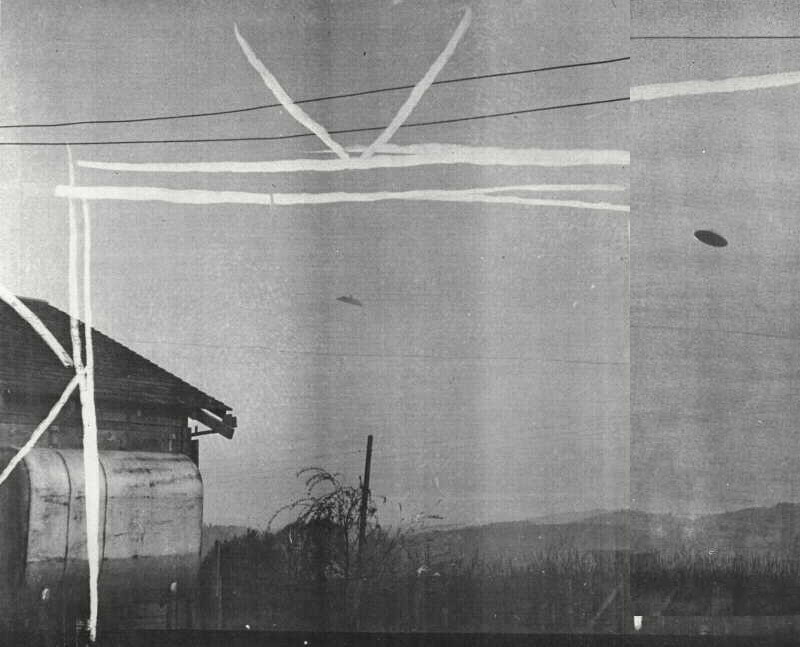
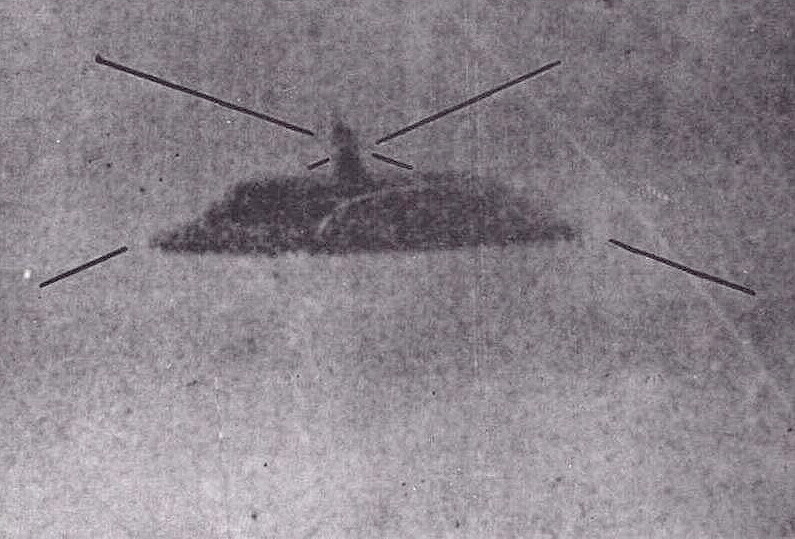
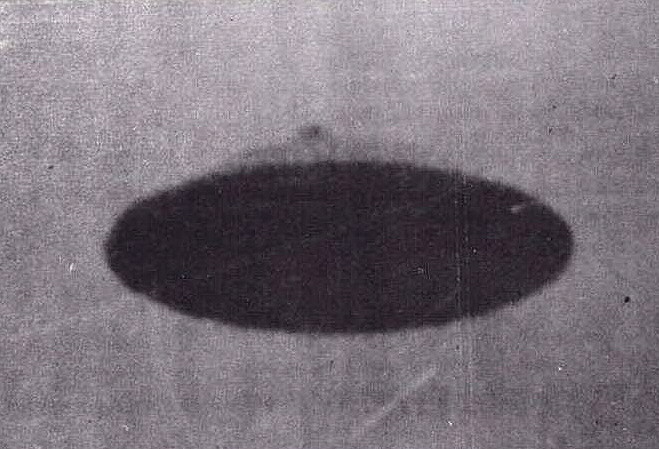
Enlargements of the object from the photos - not in sequence, but in their relative positions (i.e. the right picture which is the first photo, represents the object as it appeared to the right of the photographer - it is the first photo). Note that the projection on the top of the object seems to be pointed roughly in the direction of travel. Click here for other photos and comments from David Rudiak, who performed an on-site visit years later. |
||||||||||||||||||||||||||||||||||||||||||||||||||||||||||||||||||||||||||||||||||||||||||||||||||||||||||||||||||||||||||||||
| Report Summary (Condon) (footnotes are to references which never appeared in the report) Page numbers are from the Condon report |
Abstract:
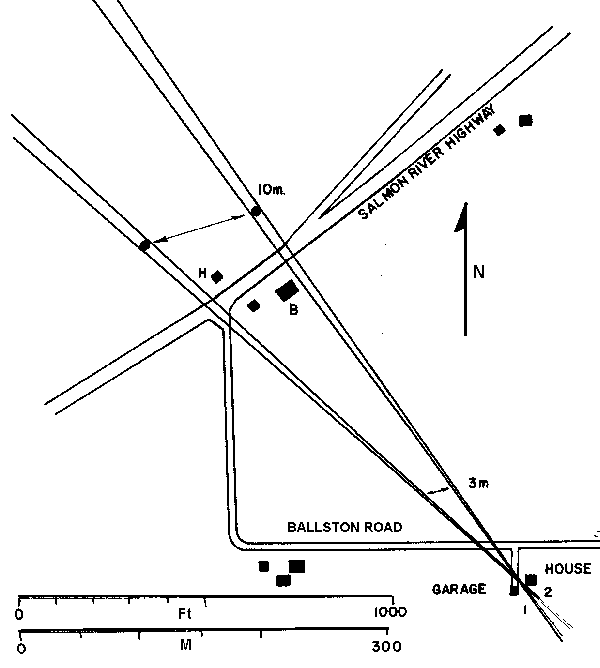
Witness I reportedly saw a metallic-looking, disk-shaped UFO. She called her husband, they located their camera, and he took photographs of the object before it disappeared in the distance. Background: Time: 7:45 p.m. PST (1,2); 7:30 p.m. (3). Position: Approx. 10 mi. SW of McMinnville, Ore. on the farm of the witnesses: 123 19' 50" W, 45 06' 15" N (7). Terrain: Rolling farm country, elv. 210 ft.; houses several hundred meters apart (7). Weather Conditions: Dull with an overcast at about 5,000 ft. (2, confirmed by the photos). Sighting, General Information: The sighting occurred in the back yard of a farm about 0.2 mi. S of the "Salmon River Highway" (U.S. 99W (7). Witness was feeding rabbits in the back yard, S of the house and E of the garage when the object was first sighted (1,2,3,6), apparently toward the NE (6). Witness II was apparently in the house at this moment, as three of the accounts (2,3,6) refer to Witness I calling to him and running into the house to fetch him from the kitchen, although one account (1) states that they had "been out in the back yard," and "both... saw it at the same time." As far as Witness I could remember 17 yr. later (6), the rabbits gave no indication of disturbance. [[607]]
Immediately after they both saw the object, apparently as it was still in a NE direction, moving slowly toward the W (6), they thought of their camera (1,2,3,6). Witness II ran to the car, thinking it was there, but Witness I remembered it was in the house and brought it (1,6). Witness II took the camera, which was already loaded. The roll of film had been purchased during the winter and already had two or three shots on it (4). At this time "the object was coming in toward us and seemed to be tipped up a little bit. It was very bright -- almost silvery -- and there was no noise or smoke" (1). Witness II explained that he took the first picture, re-wound his film as fast as possible and then as the object gathered speed and turned toward the northwest, he had to move rapidly to his right to get the second picture. Both were snapped within thirty seconds, he estimated (1). According to another early reference: "[Witness II] elaborated, 'There wasn't any flame and it was moving fairly slow. Then I snapped the first picture. It moved a little to the left and I moved to the right to take another picture.'" (3). Plates 23 and 24 show the two photographs in the sequence taken. During this interval the object was moving quite slowly, apparently almost hovering, and it apparently shifted both its position and orientation in a complex way, changing direction and tipping just before it moved away, as indicated in Plate 25 (2,6). However, Witness I described it as "not undulating or rotating, just 'sort of gliding'" (2). The UFO accelerated slowly during or just after the second photograph and moved away rapidly toward the west (2) . Witness I ran into the house to call her mother-in-law, got no answer, and returned outside just in time to see the UFO 'dimly vanishing toward the west' (2). Investigation: The witnesses described the object as "very bright - almost silvery" (1); "brightly metallic, silver or aluminum colored, with a touch of bronze...appeared to have a sort of superstructure... 'like [[608]]
a good-sized parachute canopy without the strings, only silvery- bright mixed with bronze'" (2); silvery on top but with more bronze on the bottom, the bottom being different (but, this being seventeen years later, Witness I was unsure whether it was darker)...shiny but not as bright as a hub cap...resembling a dull, aluminum-painted tank (which Witness I pointed out to the writer in our interview)... "awful pretty" (6). The rather bright, aluminum-like, but not specular, reflecting surface appears, to be confirmed by analysis of the photos (see below). There was no noise, visible exhaust, flames, or smoke (1,3,6). When the object tipped up, exposing its under side to the witnesses, they felt a gust of wind which they thought may have come from the UFO. "'...there was a breeze as it went overhead... which died down later'" (2). In the interview with the writer, Witness I stressed this, remarking the wind was "about to knock you over," though Witness II (interviewed separately) remarked that it made only a "very little" breeze as it was getting ready to fly off (6). As to size, speed, and distance, the witnesses were reluctant to hazard a guess (1,2), as Witness II had no way of knowing its size (2), although one of the references quotes Witness II as estimating a diameter of "20 or 30 ft." (3), and Witness I compared its appearance (though not explicitly its size) to a parachute canopy (2,6). As to the origin of the UFO, Witness II remarked both at the time and in 1967 that he thought it was a secret U.S. craft (1). "'...you hear so much about those things...1 didn't believe all that talk about flying saucers before, but now I have an idea the Army knows what they are'" (3). Witness II recalls finishing his roll of film on Mother's Day (4) and had it developed locally (1). Witness II mentioned his observation and showed the pictures to a few friends. He did not seek publicity about the pictures, admitting that he was "'kind of [[609]]
scared of it'" (2,3), and "afraid they would get in trouble with the 'government' and be bothered by the publicity" (2). However, McMinnville Telephone Register reporter Bill Powell learned of the sighting from two McMinnville bankers, Ralph and Frank Wortman, and followed up the story (1,2). He found the negatives "on the floor under a davenport where the Witnesses' children had been playing with them" (2). The Telephone Register broke the story Thursday, 8 June 1950 with a front page article containing the two pictures and Editor's Note: "...in view of the variety of opinion and reports attendant to the saucers over the past two years, every effort has been made to check Trent's photos for authenticity. Expert photographers declared there has been no tampering with the negatives. [The] original photos were developed by a local firm. After careful consideration, there appears to be no possibility of hoax or hallucination connected with the pictures. Therefore the Telephone Register believes them authentic..." (1).Various McMinnville residents, including the bankers Wortman, offered to sign affidavits vouching unreservedly for the reputation and veracity of the witnesses (1,2,4). On Friday and Saturday, 9 and 10 June, the Portland, Ore., and Los Angeles newspapers carried the story (2,3). Life magazine carried the pictures the following week (4). The witnesses accepted an invitation to appear on a television program "We the People," in New York (6). Witness I remarked that they were encouraged by the people responsible for this show to make statements they (the Witnesses) regarded as inaccurate. The witnesses, however, did not make such statements, but told only what they saw (6). While in New York, the witnesses were to receive their negatives from Life magazine, but were informed that the negatives were temporarily misplaced (6). Life promised to return them by mail to [[610]]
Oregon, but apparently never recovered them (6). With the cooperation of Life the Colorado project discovered that in 1950 the negatives had been in the possession of International News Photo Service later merged with United Press International. The Project located the original negatives and was permitted to examine them. As mentioned above, various reputable individuals volunteered to attest to the witnesses' veracity. They appear to be sincere, though not highly educated or experienced observers. During the writer's interview with them, they were friendly and quite unconcerned about the sighting. Witness II was at work plowing his field and did not even get off his tractor. From interviews throughout this district one gained the impression that these were very industrious farm people, not given to unusual pranks. Two inferences appear to be justified: 1) It is difficult to see any prior motivation for a fabrication of such a story, although after the fact, the witnesses did profit to the extent of a trip to New York; 2) it is unexpected that in this distinctly rural atmosphere, in 1950, one would encounter a fabrication involving sophisticated trick photography (e.g. a carefully retouched print). The witnesses also appear unaffected now by the incident, receiving only occasional inquiries (6). The over-all appearance of the photographs, in particular the slightly underexposed land foreground and properly exposed sky, is consistent with the reported time 7:30 PST (sunset being roughly a few minutes after 7:15, and twilight lasting until after 8:45). There could be a possible discrepancy in view of the fact that the UFO, the telephone pole, possibly the garage at the left, and especially the distant house gables (left of the distant barn) are illuminated from the right, or east. The house, in particular, appears to have a shadow under its roof that would suggest a daylit photo, and combined with the eastward incidence, one could argue that the photos were taken on a dull, sunlit day at, say, 10 a.m. [[611]]
But accepting the UFO makes scarcely less sense than arguing that the witnesses staged a hoax at 10 a.m. and then claimed the photographs were taken at 7:30. Densitometry of the original negatives shows that the sky itself is brighter toward the west, as expected. It seems posslble that, half an hour after sunset, the cloud distribution could result in a dull illumination preferentially from the NE (certainly there will be skylight from above). Reality of physical object. As stated previously, it is unlikely that a sophisticated "optical fabrication" was performed. The negatives had not been tampered with. Further, a geometric test was performed to determine whether the object shown in Plate 24 in approximate cross section was the same object photographed in Plate 23 at a different angle. The apparent inclination, i, can be determined from the ratio of the axes of the apparent ellipse in Plate 23. Measures on several copies of photo 1 (the UPI print, an enlargement thereof, and two magazine reproductions) gave sin i = 0.368, and Plate 26 shows enlargements from UPI print with lines of sight superimposed on the Plate 24 "cross section" at 21°.6. The way in which these lines cut the image is in perfect agreement with the appearance of the object in Plate 23. Judging from the apparent position of the pole it is likely that the object has simply tipped, without rotation, between the two photos. The lighting is also consistent with that in the rest of the photo. Both photographs, therefore, show real objects and that the object in Plate 23 is a view of the same object in Plate 24, seen in different perspective. Asymmetry of UFO. It will be noted in Plate 26 that the UFO is distinctly asymmetric. The "pole" is off center and inclined, and there appears to be a difference in the profiles of the right and left sides (Plate 24), the left having a more pronounced notch defining the flange. The shading of the object also indicates a [[612]]
more distinct flange on the left in Plate 24. The asymmetries are judged physical, not optical effects. Absence of rotation. The top of the "pole," barely visible in photo 1, is off center to the left by the same amount as in photo 2. This would be rather improbable if the object were rotating, and supports Witness II's statement that it was not rotating. This is a rather strong argument against a fabrication using a necessarily (for stability) spinning model similar to a "frisbee," especially in view of the fact that only 2 exposures were made in the middle of an intact roll of film. Angular size of object. From measurements of recent photos (6) the photos were scaled and the UFO diameters estimated to be:
The P.E. is probably about 0°.1, but the object subtends a smaller angle in photo 2, consistent with the allegation that photo 2 was made as the UFO was beginning to depart. It follows immediately that the distance-diameter relation is determined, and a man of the locale (based on ref. 7) is shown in Fig. 1 with the azimuths, angular sizes, and example, that the object was less than a meter in diameter and over the driveway. Psychological reaction. I judge it reasonable that as the object allegedly drifted to the left, in danger of being lost to sight behind the garage, that the observer should step unconsciously to his right, as the photos show he did, although one might expect the observer even more reasonably to step forward, to get in front of the garage. The reason for the first response may have been that the second would put the observer close to the house, where the object might be lost to sight if it moved back to the east, while by moving away from the garage, one moves toward the open Yard SE of the house. In summary, the movement of the observer is consistent with the alleged observation. [[613]]
Possibility of fabrication. The above tests all appear to be consistent with the witnesses' testimony. The possibility of optical fabrication seems remote. A model thrown into the air by hand appears an unlikely possibility because of the evidence for absence of rotation. Another possibility can be considered, however. The object appears beneath a pair of wires, as is seen in Plates 23 and 24. We may question, therefore, whether it could have been a model suspended from one of the wires. This possibility is strengthened by the observation that the object appears beneath roughly the same point in the two photos, in spite of their having been taken from two positions. This can be determined from irregularities, or "kinks," in the wires. The wires pass between the camera positions and the garage (left). We know from the change in orientation of the object that it moved, or was re-oriented by hand, between exposures. The possibility that it is a model hanging beneath a point on the wire suggests a further test: Is the change in distance of the object in Plates 23 and 24 equal to the change in distance from the wires? Measures of the disk indicate that it is about 8% further away in Plate 24. Measures of the irregularities in the wires indicate that they are further away from the camera in Plate 24. The amount of the latter increase from the wires (measured by the separation of rather ill-defined "kinks") is less certain than the distance increase from the disk, but it is measured to be about 10%. These tests do not rule out the possibility that the object was a small model suspended from the nearby wire by an unresolved thread. Given the foregoing analysis, one must choose between an asymmetric model suspended from the overhead wire, and an extraordinary flying object (See Table 1). Photometric analysis. Although it is often stated that a single photograph of an object contains no information on the distance, this is not strictly true. Atmospheric extinction and [[614]]
scattering, combined, serve to reduce contrast as distance increases, an effect perhaps best appreciated by artists. The shadowed bottom of the UFO in Plate 23 has a particularly pale look, suggestive of scattering between observer and object, and if such scattering is detectable, it may be possible to make some estimate of the distance involved. [[615]]
Table 1Summary of Possible Interpretations
[[616]]
The luminance, or apparent surface brightness at distance r of an object of intrinsic luminance Bo (r = 0) is where Beta is the scattering coefficient. The first term represents scattered light; the second, extinction. Since all measures must be based on the witnesses' two photographs, we will determine Beta for the given day from the photographs themselves. Normalizing all brightnesses (measured from the film and assuming that the images measured fall on the linear portion of the gamma curve) to that of the sky near the horizon, i.e. on a line within a few thousand feet of the ground, where the UFO is constrained to be by the reported cloud height and probably nearness to the camera, we have Notice that if an object is sufficiently far away, its brightness equals the sky brightness (in physical terms, the optical depth T >> 1). Given the brightness of an object at zero distance, Bo, and the observed brightness B, one may solve for the distance r. The first necessary step is to determine the scattering coefficient Beta. The original negatives were subjected to densitometric analysis, and Table 2 lists observed values of B. "Hill 2" lies at a distance of about 2.2 km (7). The photometry indicates that B = .685 for the distant hill, but the foreground foliage gives Bo = .403. This gives = 0.289 km-1, which appears consistent with the appearance of the photos. At this point the theory was checked against objects of known distance. For example, the roof of the distant barn ("B" in Fig. 1 ) has B = .506. If one assumes that its intrinsic brightness equals that of the foreground garage, then Bo = .495, so that r = 0.073 km. [[617]]
Table 2Values of B for Objects Photographed*Based on densitometry of original negatives; aperture 75µ x 75µ
Measures in parentheses have lower weight * B values are normalized to horizon sky brightness [[618]]
The true r is about 0.32 km, and our error is a factor 4. One can resolve the discrepancy by assuming the barn roof was slightly (7%) darker than the garage roof. Again, one can check the theory on the distant "Hill 1." B = .610 and
A third check, more comparable to the UFO problem, is the distant house
("H" in Fig. 1 ). Unfortunately the densitometer did not clearly resolve
the illuminated white facade from the intervening branches; however, supplementary
measures with enlargements indicate that the facade brightness should
be only slightly more than 1.00, e.g. B = 1.02, and It is concluded that by careful consideration of the parameters involved in the case of recognizable objects in the photographs, distances can be measured within a factor-four error. This justifies the assumption that we are on the linear part of the gamma curve. [[619]]
Figure 1: Sighting Locale
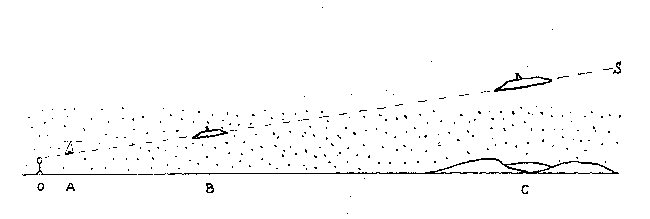
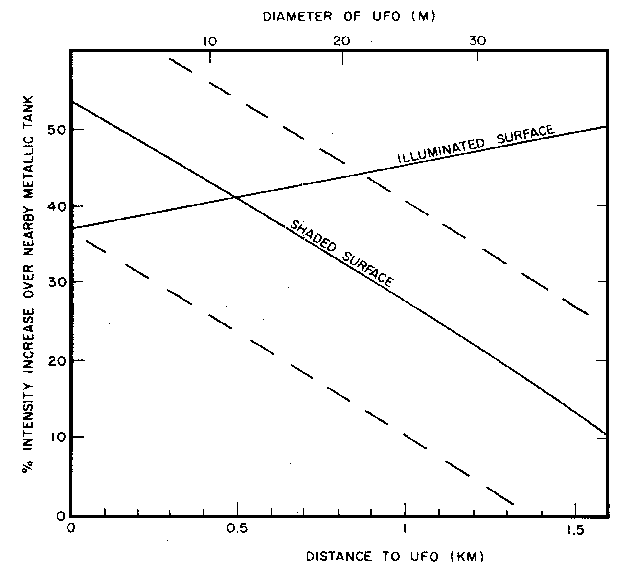
If such a good measure could be made for the UFO, we could distinguish between a distant extraordinary object and a hypothetical small, close model. At this point we must be explicit about the geometry of the situation. We represent the environment as in Fig. 2 . We assume that the UFO is within a homogeneous scattering layer with T = 1 at 3.5 km. If the UFO were far away and at an altitude greater than the characteristic dimension of the layer (C in Fig. 2), it would be large and extraordinary in any case. If it is relatively close, r = 1 km, the assumptions are justified. Our objective is to distinguish between cases A and B in Fig. 2 . The sky brightness, to which all the brightness values are normalized, must be the sky brightness at the horizon, since this is the value characteristic of long path length through the scattering layer. For the solution of the UFO distance, we have two independent solutions from two independent observations: the illuminated and shadowed surfaces of the UFO. As was remarked above, it is the shadowed surface in particular that looks pale and hence suggests large distance. Immediately from Table 2 we see that B = 1.21 describes the part of the UFO, while the illuminated part of the nearby dull aluminum-painted tank Bo = .885. Since, as the UFO recedes, B must approach 1.00. We thus know that 1.21 is the minimum intrinsic brightness of the UFO surface, i.e. Bo>1.21. Thus the UFO in any interpretation is known to have a brighter surface than the foreground tank. Thus, the photometry at once confirms the witnesses' report that the UFO was shiny, like a fresh, aluminum-painted surface, but not a specular surface. The question is, how bright is the surface intrinsically, and what surface properties would be consistant with both the observed illuminated and shadowed side? Fig. 3 shows two families of solutions, one for the illuminated top surface and one for the shaded bottom side. Solutions for the latter have [[621]]
Figure 2: Sighting Geometry
Figure 3: Brightness/Diameter/Distance PlotClick on thumbnail to see full-size image.
an uncertainty introduced by the difficulty of measuring the true shadow intensity or the tank. The distance is given as a function of the assumed increase in brightness over the value for the illuminated or shaded side of the aluminum-painted tank, respectively. Fig. 3 graphically illustrates the problem. For example, if the object is a model suspended from the wire only a few meters away, its surface is some 37% brighter than that of the tank, and the shaded side is probably more than 40% brighter than the shadow on the tank. But this is nearly impossible to maintain in the face of the photometry. Although the distant house's surface is roughly twice as bright as the tank's surface, its shadows can be only a few percent brighter, intrinsically, than those on the tank. This is basically the problem that was suggested by initial inspection of the photos: the shadowed side of the UFO appears to be so bright that it suggests significant scattering between it and the observer. The upshot is that if the top and bottom surfaces of the UFO are made out of essentially the same material, i.e. with the same albedo, the photometry indicates that the UFO is distant, at roughly r = 1.3 ± 0.4 km (est. P. E.). The witnesses referred to a slightly different hue of the bottom side of the UFO: they said it was more bronze than the silvery top side. We have assumed this change in tint had negligible effect on the photometry, although the implication is that the bottom has slightly lower albedo. If so the UFO would be still more distant. There is one last possibility for fabrication which has not been ruled out. Suppose the object is a small model with a pale grey top and a bright white bottom (e.g. an aluminum pie pan sealed on the bottom with white paper). Could this account for the apparent lightness of the bottom, shaded side of the UFO? It is difficult to defend this idea in the face of the photometry. Our analysis of the house indicated that its shaded white surface had an intrinsic brightness of 0.43, which is very [[624]]
close to the value measured for the shaded part of the aluminum-painted tank. Yet hypothetical fabrication requires a surface on the shaded bottom of the model that is of intrinsic shaded brightness 0.68, considerably brighter than the shaded part of the white house. In other words, the photometry appears to indicate that a very white surface on the bottom of a small model would be required to match the appearance of the photographs. To the extent that the photometric analysis is reliable, (and the measurements appear to be consistent), the photographs indicate an object with a bright shiny surface at considerable distance and on the order of tens of meters in diameter. While it would be exaggerating to say that we have positively ruled out a fabrication, it appears significant that the simplest, most direct interpretation of the photographs confirms precisely what the witnesses said they saw. Yet, the fact that the object appears beneath the same part of the overhead wire in both photos can be used as an argument favoring a suspended model. Conclusion: This is one of the few UFO reports in which all factors investigated, geometric, psychological, and physical appear to be consistent with the assertion that an extraordinary flying object, silvery, metallic, disk-shaped, tens of meters in diameter, and evidently artificial, flew within sight of two witnesses. It cannot be said that the evidence positively rules out a fabrication, although there are some physical factors such as the accuracy of certain photometric measures of the original negatives which argue against a fabrication. [[625]] |
||||||||||||||||||||||||||||||||||||||||||||||||||||||||||||||||||||||||||||||||||||||||||||||||||||||||||||||||||||||||||||||
| Additional Comments |
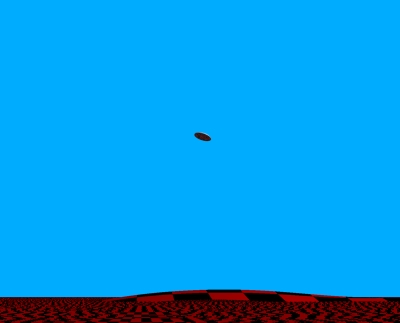
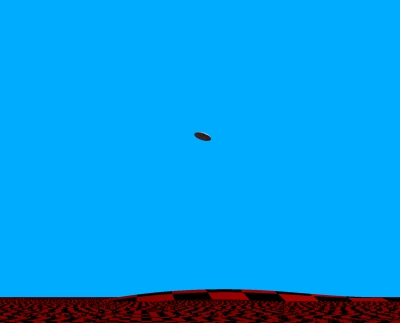
The following image was developed initially based on Bruce Maccabee's estimate of 1.06km distance and 30m diameter. However experimentation showed that to attain an angular size similar to that in the main photo, a simulated distance of 1.2km was needed for the 30m object. The altitude, based on attempting to duplicate the framing of the photo using a simulated 100mm lens, was 250m. The camera altitude was set at 3 feet, as estimated by Joel Carpenter. The object in this image is in a bank of about 20 degrees, and a "nose" up of about 9 degrees.
Interestingly, the composition is extremely insensitive to camera height. At 3 feet the image is essentially the same as at 6 feet.
Naturally, if the object were closer to the camera, it would be more sensitive to camera height. |
||||||||||||||||||||||||||||||||||||||||||||||||||||||||||||||||||||||||||||||||||||||||||||||||||||||||||||||||||||||||||||||
| Hynek Classification | DD | ||||||||||||||||||||||||||||||||||||||||||||||||||||||||||||||||||||||||||||||||||||||||||||||||||||||||||||||||||||||||||||||
| Original Vallee Classification | Type IVa | ||||||||||||||||||||||||||||||||||||||||||||||||||||||||||||||||||||||||||||||||||||||||||||||||||||||||||||||||||||||||||||||
| Current Vallee Classification | FB1 | ||||||||||||||||||||||||||||||||||||||||||||||||||||||||||||||||||||||||||||||||||||||||||||||||||||||||||||||||||||||||||||||
| Minimum Distance | 1.3+- 0.4 km | ||||||||||||||||||||||||||||||||||||||||||||||||||||||||||||||||||||||||||||||||||||||||||||||||||||||||||||||||||||||||||||||
| Object Appearance | Disk tens of meters across with a central or near central spike, possibly streamlined. | ||||||||||||||||||||||||||||||||||||||||||||||||||||||||||||||||||||||||||||||||||||||||||||||||||||||||||||||||||||||||||||||
| Object Behavior | Flew past | ||||||||||||||||||||||||||||||||||||||||||||||||||||||||||||||||||||||||||||||||||||||||||||||||||||||||||||||||||||||||||||||
| Physical Effect | None | ||||||||||||||||||||||||||||||||||||||||||||||||||||||||||||||||||||||||||||||||||||||||||||||||||||||||||||||||||||||||||||||
| Comments / Conclusion |
So far, these photos have withstood the tests of controversy and excellent photo analysts. The superstructure on the object seems to be pointing in the direction of travel. |
||||||||||||||||||||||||||||||||||||||||||||||||||||||||||||||||||||||||||||||||||||||||||||||||||||||||||||||||||||||||||||||