
t e m p o r a l
d o o r w a y
8/25/51 - Ducker et. al.; Hart, Lubbock, TX, 9:10PM

| Report Summary | "Four Texas Technical College professors were sitting in
the backyard of one of [their] homes... [watching for meteors]... they observed
a group of lights pass overhead from N to S. The lights had about the same
intensity as a bright star but were larger in area. Their altitude was not
determined but they traveled at a high rate of speed. The pattern of the
lights was almost a perfect semi-circle containing from 20 to 30 individual
lights. Later in the evening a similar incident was observed and during
a period of about three weeks a total of approximately 12 such flights were
observed by these men... Attempts were made to obtain an altitude measurement...
however all attempts failed because the objects did not appear on the nights
the observers were waiting for them...The objects were observed by at least
100 people in and around Lubbock... "On the evening of 31 August 1951 at about 2330 CST (11:30PM), a college freshman observed a flight... pass over his home... two more flights of objects allegedly did occur and were photographed"[footnote 1] "In one instance, the lights were observed to have a "wiggling" motion. "at 12: 17 AM on 9/2/51 by 5 people ... in the case of this flight, an irregularly shaped yellow light appeared in the rear. The formation included dark diffuse areas and the arc itself quivered or pulsated in the direction of travel.. a group of individually distinct yellow flames, approximately 12 or 15 in number, travelling at extremely high velocity, each with an angular magnitude that would be the equivalent of 12 inches across at a distance of 30 or 40 feet and in violent agitation... moving noiselessly." |
| Hynek Classification | NL |
| Original Vallee Classification | Type IV a/c |
| Current Vallee Classification | FB1 |
| Minimum Distance | Unknown |
| Object Appearance | 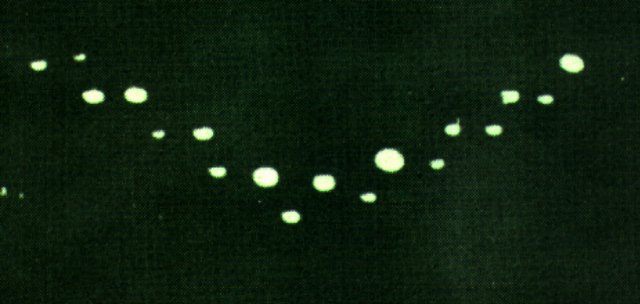
Photo by Carl Hart "There was no sound that could be attributed to the object; the color of the lights was blue-green; there were from 15 to 30 separate lights in each formation; the first two flights observed were a semi-circle of lights but in subsequent flights there was no orderly arrangement; The object did not gradually come into view as would an aircraft approaching from a distance, neither did it gradually disappear; there was no apparent change in size as the object passed overhead; the angular span was estimated to be 10 degrees" One observation was of a dark / diffuse dark area with "violently agitated" yellow flames emitted to the rear. "There is relative movement within the [photographed] formation of spots, so they are not lights on a fixed object. The relative motion is such that it is unlikely they are co-planar and photographed from different angles... The angular size corresponds to an object size of 310 ± 30 feet, seen by the camera 1 mile away. The actual size of the formation may be calculated from this ratio, if the actual distance from the camera can be determined... Although the image size in frame 8 is about 2% less than in frame 7, suggesting that the objects are receding from the camera, the aspect of the V formation does not correspond to a horizontal V travelling parallel to the earth's surface unless at an enormous altitude." |
| Object Behavior | "The angular velocity of the object was very nearly 30 degrees of arc per second; the flight path was from north to south in the majority of the flights; there were two or three flights per evening; the period between flights was about 1hr and 10 mins; the objects always appeared at an angle of about 45 degrees from the horizontal in the north and disappeared at about 45 degrees in the south." |
| Physical Effect | None |
| Medical Effect | None |
| Comments / Conclusion | This fascinating case may correlate with the North China Sea, Hudson Valley, and Arizona cases. |
Footnotes
1. Project Blue Book, Steiger, ISBN 0-345-26091-0-195