
t e m p o r a l
d o o r w a y
7/20/64 - Anonymous Government Clerk, Illinois State Route 101, Illinois, 4:45 AM

| Report Summary | "...about four miles west of Littleton... he saw an object rising above the tops of the trees; it appeared to be in the process of taking off... he thought of a rocket [and noted] that the jets seemed to be purple-red in color... the object had the shape of a half sphere... and... [the] 'jets' were in reality formed by a luminous cone that opened under the object, giving the impression it was rising on flames. It rose still higher in the sky, then turned around and faced him. The object then looked like a dark circle with a luminous ring; it reminded him of a sunflower with yellow petals. This lasted only a few seconds and the object turned again, rose into the sky and disappeared... When the object accelerated the ['jets'] became three times smaller and lost [their] brightness, changing to a blue-yellowish color at the same time... fifteen minutes later, an air force man driving 8 mi W of Clinton, IA, about 120 mi N of [the first sighting] saw an unusual light in the sky... [its appearance was of] a large cone, very bright at the top, and more and more diffuse at the base, which blended with the background of the sky."[footnote 1] |
| Hynek Classification | NL |
| Original Vallee Classification | Type IVa |
| Current Vallee Classification | FB1 |
| Minimum Distance | Unknown |
| Object Appearance | 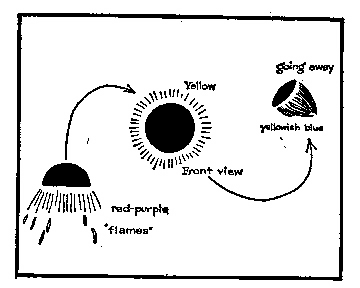 |
| Object Behavior | Flyby |
| Physical Effect | None |
| Medical Effect | None |
| Comments / Conclusion | Part of the "Jellyfish" correlated category. |
Footnotes
1. Challenge To Science, Vallee, Ace paperback , 1966, p 62