
8/3/65 - Heflin, Santa Ana, CA, morning

| Report Summary | "Rex Heflin is a Highway Accident Investigator for the Los Angeles County
Highway Commission... he carried a Polaroid camera...[which] contained film
rated at 3000 ASA... [On] Myford Road near Santa Ana.. he spotted an unusual
object approaching the road. He stopped the truck, grabbed the camera off
the seat beside him and made three pictures as rapidly as possible... As
the object moved away, Heflin... scrambled out of the truck and took his
fourth and final picture... Heflin tried to contact his office by radio
while the UFO was near [his vehicle], [but] the radio refused to operate."[footnote
1] The photos were examined by UPI (United Press International) photographic specialists, who also took test photos with the same equipment. They pronounced the photos genuine. Heflin was reportedly approached by a man who claimed to be from NORAD, to whom he gave the original Polaroids. Both NORAD and the Air Force denied having the photos. NICAP investigators, including scientific advisors, also believed the photos were genuine. They claimed that frame 1 shows a swirl of material below the object, rising about a foot in the air. |
| Hynek Classification | CE-I |
| Original Vallee Classification | Type Ia or Type IIIa |
| Current Vallee Classification | MA1 or CE1 |
| Minimum Distance | tens of feet |
| Object Appearance | "hat-shaped" |
| Object Behavior | Flew past truck, with nose up in direction of travel. Tilted nose down when past truck and departed, leaving behind dark smoke ring. |
| Physical Effect | Possible radio interference. |
| Medical Effect | None |
| Comments / Conclusion | This is an interesting and controversial case. The original photos have
never been found, and all subsequent analyses have had to work from copies.
While it is possible for the photos to have been hoaxed, there has never
been any definite proof that they were, and Heflin has continued to maintain
their truth. Furthermore, these photos were taken in the midst of one of
the largest flaps in US history. The evening before, photos had been taken
in Tulsa OK, Sherman TX, and then five days later in Beaver Falls, PA two
more were taken. None of the photographed objects, however, bore any resemblance
to each other. For more details, see the Photoanalysis, below. |
Photoanalysis
Panorama
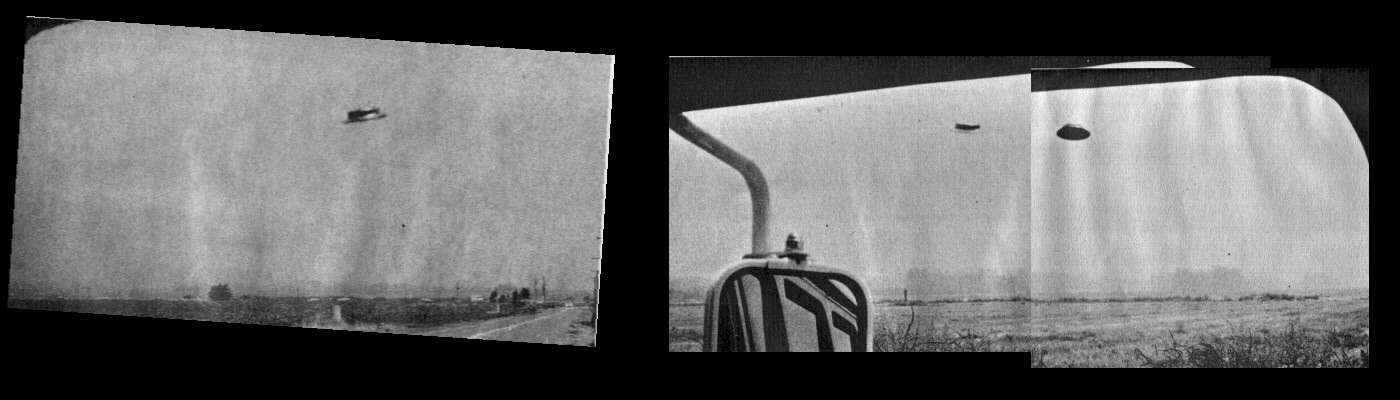
In this "panorama" you can see three of the four Heflin frames. According to Frank Edwards, these frames would be 1,3,2; however, under the assumption that the object moves left to right across the landscape, the panorama shows the correct order. Notice that frame 1 is tilted 4 degrees to properly level the horizon. Also note that for frame 3, Heflin apparently leaned toward the passenger side of the truck, and slightly toward the dashboard, as shown by the displacement of the doorframe when the horizon is kept level.
The "wrinkles" in the image are on the paper which was scanned to make this panorama.
Marked Panorama
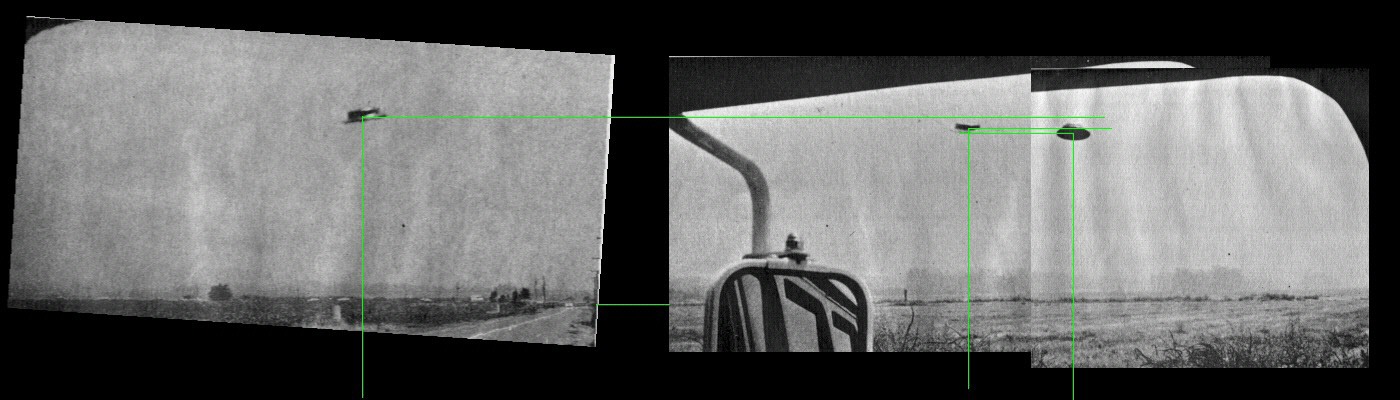
In this copy of the panorama, the position of the objects in an aligned horizontal plane has been marked. The line between frame 1 and 2 is at the horizon and serves to show the horizon alignment. The object center is estimated, and a horizontal line is drawn from each horizontal center, showing that the object seems to be losing angular altitude between frames. In addition, the angular altitude lost between frames 1 and 2 is nearly twice as great as that between frames 2 and 3.
Composite
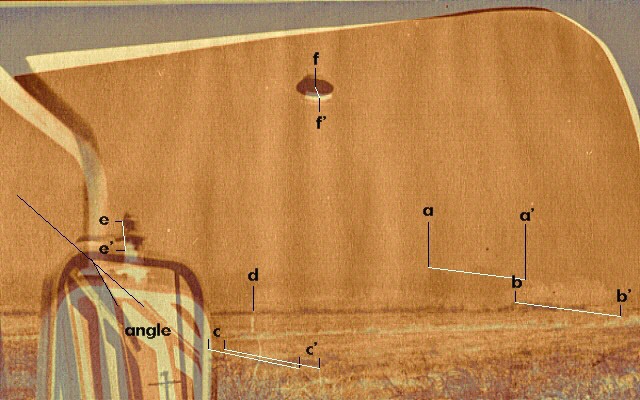
In this image, frames 2 and 3 have been merged at a 50% level for each. Frame 2 has been made a negative, while frame 3 has been left positive. Frame 3 features are indicated by letter alone. Frame 2 features are indicated by a letter followed by ', except for d.
- Feature a and a' are at the horizon and represent a clear edge on a distant group of trees.
- Feature b and b' are closer, but still near the horizon; they are on a hedge or bramble line.
- Feature c and c' are just past the tangle beside the road, and are a pair of distinctive grass blades or brambles.
- Feature e and e' are and edge on the nut at the top of the mirror mount.
- Feature f and f' are the center of the object.
- Feature d is a feature only visible in frame 2; in frame 3 it is apparently behind the mirror.
This composite clearly shows Heflin's effort to keep the image of the object as close to the center of the frame as possible, within the limits imposed by the truck cab. It is indeed fortunate that he did not simply center the object in the frame, since if he had done so, it is likely that no ground features would have been visible.
The image also indicates that the mirror is translated almost not at all, while features as close as the side of the road brambles are translated almost as much as the most distant features such as the treeline.
Assuming that the object remains still (i.e. it is hoaxed, and hanging from a wire outside the cab), then the only way this behavior can be duplicated is for the object to be at almost exactly the same distance as the mirror. If the object is even a small distance (feet) beyond the mirror, it is impossible to not translate one or the other, even with small angles of movement. However, if the object is at the same distance as the mirror, then how is its vertical translation only about half that of the mirror? If the object is swinging in a pendulum motion, the obvious explanation for its different attitudes, in the one situation, one frame is at the near apex of the swing, and the other frame is at the nadir of the swing (not likely, since the object would be close to horizontal), then the vertical translation is from f' to f is less than half of that from e' to e (it is (f' to f) minus (apex-nadir)). In the opposite situation, f' and f are the apex of the near and far ends of the swing, and the object is at the same actual height in both frames, and the vertical translation is half that of e' to e.
In regard to the pendulum explanation, the object is almost exactly the same size at frame 2 and 3. Also, the support for the object would have to rise at an angle of 30-40 degrees to remain out of the field of view.
On the other hand, if the object moved between frames 2 and 3, then Heflin remained in about the same position, and swiveled to follow the object, probably by shifting at the waist to the left, and also twisting, which kept the mirror in about the same position in each frame, and the object in the same relative position in each frame.
Footnotes
1. Flying Saucers: Serious Business, Edwards, 1966