
7/20/67 - Captain Ardanza and crew, Naviero, 120 mi off Cape Santa Maria Grande, Brazil; 6:15 PM

| Report Summary |
"...Captain Ardanza beheld a shining object in the sea no more than about 50 feet away on the starboard side. It was cigar-shaped and he estimated its length at about 105-110 feet. It had a powerful blue and white glow, made no noise whatsoever, and left no wake in the water. There was no sign of any periscope, or railing, or tower, or superstructure... no control surfaces or protruding parts... [it] paced [the ship] for 15 minutes... [estimated speed] up to 25 knots. [It] suddenly dived and passed right under the [ship] and vanished rapidly in the depths at great speed. As it went, it glowed brightly below the water... The possibility that the object seen was a whale or a conventional type of submarine is ruled out... The case has been classified by the Argentine maritime authorities as an "Unidentified Submarine Object"."[footnote 1]
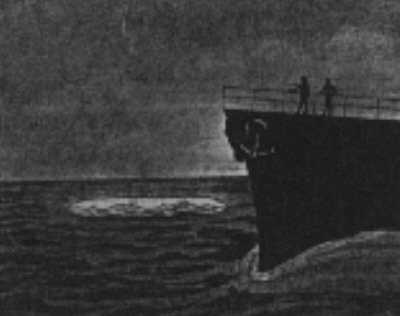
Artist's conception from Phenomenes Spatiaux, created by Joel Mesnard, Sept 1968 Phenomenes Spatiaux no. 15 (March 1968) p. 30 In the " Vanguardia ", from Barcelona, dated 1st Oct. 1967, appeared an information sent to us by Mr. Joan Crexells, whom we thank. This the translation: "Seagoing saucer " To the comments and guesses which are made here about the real existence of the flying saucers is added now a serious and trustworthy testimony, the one from Julian Ardanza, captain of the Argentinian merchant ship "Naviero". Upon his arrival in Buenos Aires, he fully confirmed what he already said in his radio message sent from the sea: "At the level of Brazil, he was surprised by a strange object which emitted a strong bluish glow and sailed parallel to his ship during 18 minutes. At one point, the object dived and went under the ship to go back to the surface on the other side." It was shaped like a cigar. It was like a submarine but without conning tower or any protruding part on its surface. It was also observed by first officer Julio Montoya and a few sailors, which created the ensuing alert. The encounter happened at the level of the gulf of Santa Catarina, facing the brazilian coast. The captain denied it was a submarine. And even less a whale. At a speed of 25 knots the object went away leaving behind it an intense light. "Upon his arrival, captain Ardanza was besieged by journalists and his testimony has enriched the already copious chronicle of similar events happening in Argentina the last days."
Phenomenes Spatiaux no. 16 ( June 1968 ) p. 13-14 From diving to "sinking", by Rene Fouere In our last issue, we made a mistake regarding the diving "saucer". Being too used to call "saucer" a mostly flying vehicle, while reading the text, quite short, of "La Vanguardia" about the strange object which sailed parallel to the "Naviero", we interpreted "sailed" as flying. We even, in our comments, presented some considerations based upon this interpretation about which, reading in the FSR March-April 1968 p. 22 the article by Mr. Oscar Galindez, we found out that it was wrong. At least apparently as if, one might think, the diving "saucer" was of extra-terrestrial origin, it had to be in the air before going on the water surface or in the water. Nevertheless Captain Ardanza and the men from his crew saw it only on the sea or under the sea. Mr Galindez's article brings us interesting precisions [precise information? Ed.] and, first, gives us the time of the sighting ( 18.15 local time which is 22.15 universal time ) and the coordinates of the place: L: 28° 48' S and G: 46° 44' W, these coordinates defining a point located approximately 220 km east of the cape Santa Marta Grande and where the depths are more than a thousand meters. This article tells us also that the strange " submarine " was seen very close, at a distance of about 15 meters and had a length of about 30 meters. It had no periscope, no conning tower, no guard rail, no superstructures. That is to say no horizontal rudder, no vertical rudder, no protruding parts. It was noiseless. It is not said that it went under the " Naviero " to reappear on the other side but that, suddenly, it dived right under the ship, at high speed, towards the depths, to disappear quickly and that while it was going down it could still be seen under the water, brightly illuminated. It didn't leave behind any wake (our emphasis). We found too, about this same incident, a few more complementary details in a document kindly sent to us by our sevillan correspondent Mr. Ignacio Darnaude. This document is a photocopy of an article published in the Buenos Aires newspaper "La Voz del Interior" dated 3 August 1967. This article precises [states? Ed.] that the night was dark and the sea phosphorescent. This last point doesn't surprise us as the sighting happened in the open sea off the Cape Santa Marta Grande where we ourselves observed, each time we were there, waters with an intense, homogeneous and fairylike phosphorescence. It is said that the object was 4 to 5 meters wide and was itself showing a very strong phosphorescence but its color, an azure white ('blanc azure': a very light bluish white - JLR), contrasted strongly with the Nile green color, which is light green, of the sea. According to "La Voz del Interior", this phosphorescent object was on the starboard side 9 meters ahead of the forecastle and, first, sailed parallel to the "Naviero" at a depht of 15 to 20 meters - which is corresponding quite well, it seems, with the distance given by Mr Galindez in his article. According to Captain Ardanza, the object didn't follow a natural course but "sailed", in the voluntary meaning of the word (<< para mi navegaba no se desplazaba >>). After a while, the object speeded [sped, Ed.] up and, starting a turn toward the port side, went under the hull of the ship, to reappear on the starboard side at the level of the No. 2 hold and disappeared going approximately to 145° ( S 35 E ? ). It will be noted that it [was? was not? Ed.] detected by the radar and never came to the surface during the sighting. Even it is not clearly said, it seems the strong light emited by this singular "submarine" was not produced by one or several discreet and more or less localised sources, by lights or searchlights located on some points of its hull but by the entire surface of the hull. Furthermore the relation of the incident as writen on the logbook of the "Naviero" specifies that << the body showed a quite clear outline ( " silueta " ) >> ( our emphasis ) and, upon his arrival in Buenos Aires, Captain Ardanza declared that in his telegram sent from the high sea to the Argentinian National Sea Prefecture, he should not have mentioned an << illuminated >> ( << iluminado >> ) object but a << luminous >> ( << luminoso >> ) object. We must add that, the << submarine >> sailing at 15 or 20 meters depth, if it had not been entirely luminous, it would have been difficult to see its outline, [e]specially through this kind of phosphorescent sea found off the Cape Santa Marta Grande, and which is familiar to us. Usually very weak, the phosphorescence of the sea becomes intense only with a superficial movement exciting the innumerable animalcules responsible for it and one knows that at 15 or 20 meters deep there is practically nothing left of the surface movement. It is thus mainly the surface which is lighted and, in our case, the veil of light created could only hamper the sighting of a dark object below. If our interpretation is correct and if the light - which must have been diffused [diffuse? Ed.] as seems to be indicated by the term << phosphorescence >> - was coming from the entire surface of the object, one cannot see how a << submarine >> surrounded by this strange light could have come from any terrrestrial shipyard. Furthermore it had no upper works, no helms [rudders? Ed.] and even nowhere it is said that a propeller was observed ! Mr Raymond Lucas, one of our vice-presidents (of the GEPA - JLR), told us that a sperm whale might have the same approximate dimensions than this object, but how can we imagine a sperm whale doing [these] kind of moves around a ship at night? Furthermore will remain the problem of the light, light which cannot even be attributed to animalcules being in the depths and whose luminescence, excited by the movement of the object, would have created around its hull a sheath of light as the color, azure white, of the light emitted by the object contrasted with the light, greenish, produced by these animalcules. Still according to "La Voz del Interior", Captain Ardanza affirmed again that the object didn't leave a wake ( << reiterando que estela non dejaba >> ), which confirms the indication already given in Mr Galindez's article. But how to understand exactly this indication? According to Mr Lucas, it is not sure that an object with this volume, sailing at that speed ( 25 knots or approximately 46 km/h ) and that depth would leave a wake at the surface. However it should have left one at its own level - and which could have been visible either because caught in the rays of light coming from the object or even because of the luminescence created in the depth by its eddy (or wash ? - JLR). In any case, as long as Captain Ardanza said again and again that the object didn't leave any wake, we can assume that with his experience as a sailor he was expecting one and was surprised, even struck, not to find one. It is not forbidden to assume too that, in his mind, this absence of wake could also mean an absence of propeller as a propeller always creates whirls. We must emphasize that the seriousness and objectivity of the sighting is comforted [supported? Ed.] by the unchallengeable fact the captain of the " Naviero " was enough worried by this unforeseeable escort under water to not hesitate to send immediately a radio telegram to the Argentinian National Sea Prefecture. His [worry] was even more understandable as his ship, travelling at a cruise speed of 17 knots, transported military explosives. < Second case and comment removed> Phenomenes Spatiaux no. 23 ( March 1970 ) p. 18 About the " Naviero ", our investigation [continues]. We mentionned the " Naviero " incident in our issue no. 15 p. 30. We spoke about it again in our last issue p. 13 and noticed that the stories reported by the different sources of information presented some significant and quite embarassing differences. Willing to know more, we kept our investigation running by writing to our Argentinian collaborators who answered us with a kindness we cannot thank enough. Mr Gainza Paz has given us all the necessary informations to write directly to Captain Ardanza himself. But if Captain Ardanza answers us, it will not be soon as he was near the Ghana coast when Mr Gainza Paz gave us the exact address of the shipping company employing him. Mr Oscar Galindez took the time to answer very promptly and in detail to the questions we asked him. Thus we can give to our readers, thanks to him, the following indications of which they will appreciate the importance: 1/ The object was detected on the radar. 2/ When it was seen the first time, it was resting on the sea: captain Ardanza mentioned an object "half submerged". 3/ The object was on the starboard side, 15 meters ahead of the forecastle and sailed parallel to the "Naviero" for 15 minutes. 4/ It was without portholes, propellers, fins or any protruding part. 5/ It didn't leave any visible wake on the surface. 6/ It was luminous and the intensity of the light it emited was the same everywhere. 7/ It was shaped like a "havana" cigar and a length of approximately 30 meters. 8/ It submerged and went under the "Naviero" but didn't emerge on the other side of the ship. Captain Ardanza and first officer Julio Montoya were both witnesses of the phenomenon. They didn't call the other sailors - who were having supper - because they thought the sailors could panic, the "Naviero" transporting explosives. 9/ The sea was phosphorescent and the phenomenon was completely noiseless. Mr Galindez added he thought he could get from Mr Alberto Ramos, the radio [officer] of the "Naviero", a drawing of the object, drawing he has not received yet. While waiting, he tried to do for us, according to all the informations he received, an approximate drawing of the observed object. We reproduce this drawing. < Commentaries removed > The following from Jean-Luc Rivera who kindly provided all of the Phenomena Spatieux articles above... I hope my translation is not too bad; I didn't have time to smooth it and I am not familiar with sailing and nautical terms. I have found in an article entitled "Le mystere marin des UFOs" ( "The marine mystery of UFOs" ) by Oscar A. Galindez, a passage devoted to the "Naviero" incident with some very important new details. Phenomenes Spatiaux no. 23 ( March 1970 ) p. 18 <<.... In December 1969, the C.A.D.I.U. ( Centro Argentino de Investigaciones Ufologicas ) was granted a meeting with the officer Jorge Montoya who, amongst the crew members of the Argentinian cargo ship "Naviero", was the first to see the tubular phenomenon of the Gulf of Santa Catarina, incident which happened on 30 July 1967 [Note conflict with date from Sanderson, above, Ed.], in front of the Brazilian coast, at nightfall. The present magazine has dealt several times with this incident so it doesn't seem useful to report the main story. But faced [with] the declarations of Officer Montoya, it is necesssary to bring a few complementary details. The witness told us that, while he was going to the stem of the ship being on the starboard side, he noticed, not deeply, some kind luminous projection of a great length. [At] first it didn't seem important as he assumed it was the reflection in the water from the lights going through the row of portholes of the "Naviero". But immediately he changed his opinion because this luminosity was near the stem where there were no portholes. Observing closely he noticed it was some kind of << tube >>, 30 meters long and 1 meter to 1m 50 in diameter, moving at the same speed [as] the "Naviero" ( approximately 17 knots ) and at about 3 to 5 meters deep (this detail is important because it corrects the version given by the newspapers speaking of a << half submerged >> object with part of the hull at water level). In spite of it, the outline of the phenomenon was sharp and uniform. It didn't look like any whale or any animal. On all its length it was the same diameter, it was of the same size. Its brightness of light was a yellowish white (and not bluish as said in the papers) and didn't seem to come from a precise spot as the entire surface of the object was fluorescent. The officer didn't hear any engine noise and didn't notice any whirl created by the object moving. For 15 minutes the object went along with the "Naviero" being only 15 meters away from the ship. This is why Captain Julian Lucas Ardanza - thinking about the chances of running into it - gave orders to the helmsman to change course very gradually if he was given such order. But it was not necessary. The << object >> turned 90°, went under the ship and gained quickly some depth at a speed of 25 knots. When it turned there was no deformation of its linear structure which ruled out even more the possibility of some kind of unknown animal. First Officer Montoya promised us to give us a copy of the logbook on which were noted the other significant details of the phenomenon....>> I searched Phenomenes Spatiaux until the end of 1972 without finding any more news about the " Naviero ". (JLR) FSR Vol 14 No 2 March / April 1968 p 22 CREW OF ARGENTINE SHIP SEE SUBMARINE UFO by Oscar A. Galindez Senor Galindez has been correspondent of Flying Saucer Review in Argentina since 1962. A TOPIC which seems to be connected with the UFO problem is that of the mysterious submarine bodies which have been observed in the seas of our world. Many of these cases appear in fact to be part of the astonishing enigma of the Unidentified Flying Objects. Not long ago consideration was being given by FLYING SAUCER REVIEW to these marine aspects of the phenomenon,* and some authors have suggested the possibility of underwater UFO bases in areas where these strange happenings have been recorded. I would like to relate a recent occurrence which is quite sensational in comparison with most of those reported so far. My sources are press reports which appeared in the Argentine newspapers La Razon Cordoba and Los Principios. On July 30, 1967, the Argentine steamer Naviero, belonging to the Argentine Shipping Lines Company, was some 120 miles off the coast of Brazil, opposite Cape Santa Marta Grande (Lat. 28 48 S., Long. 46 43 W.) in the State of Santa Catarina, when an elongated submarine craft was sighted. The time was about 6.15 p.m. Argentine time (10.15 p.m. G.M.T.), and the Naviero was running at 17 knots. The officers and crew were at their evening meal at the time. The Master, Captain Julian Lucas Ardanza, received a call on the intercom system from one of his officers, Jorge Montoya, to the effect that there was something strange near the ship. Arriving at once on deck, Captain Ardanza beheld a shining object in the sea no more than about 50ft. away on the starboard side. It was cigar-shaped and he estimated its length at about 105 to 110ft. It had a powerful blue and white glow, made no noise whatsoever and left no wake in the water. There was no sign of any periscope or railing or tower or superstructure, in other words no external control surfaces or protruding parts. The mystery craft paced the Naviero for 15 minutes. Captain Ardanza estimated its speed at 25 knots, as against the 17 of his own vessel (an old Liberty-type ship built in the U.S.A.). The next development however was disconcerting to say the least. The mystery craft suddenly dived and passed right under the Naviero and vanished rapidly in the depths at great speed. As it went it glowed brightly beneath the water. The Naviero was carrying explosives and gunpowder, and in order to stave off any panic among the crew should they get the idea into their heads that they were being "pursued" because of this type of cargo, Captain Ardanza and his officers judged it prudent to assemble the crew and tell them what had been seen. In the subsequent interviews with reporters from the Argentine press, the Captain said that during his twenty years at sea he had never seen anything like that before. Chief Officer Carlos Lasca described the object as "a submergible UFO with its own illumination". The possibility that the object seen was a whale or a conventional type of submarine is ruled out. The witnesses were firm in their insistence that the "luminous cigar" looked totally different from a submarine or a whale and could not possibly have been either of these things. The case has been classified by the Argentine maritime authorities as an "unidentified submarine object". NOTES Gordon Creighton, Argentina 1962 (Pedro Atilli's experience) and item about Soviet submarines, FSR, July/August 1964, pp. I I and 13. Antonio Ribera, UFOs and the Sea, FSR, November/December 1964, P. 8. W. S. Robertson, UFOs and the Scottish Seas, FSR, May/June 1965, p 36 Antonio Ribera, More About UFOs and the Sea, FSR, November/ December 1965. p. 17. H. J. Hinfelaar, Submarine Craft in Australasian Waters, FSR, July/ August 1966, p. 28. |
| Hynek Classification | ? |
| Original Vallee Classification | ? |
| Current Vallee Classification | ? |
| Minimum Distance | 50 feet |
| Object Appearance | Luminous blue / white cigar (though one witness claimed yellowish white). No features. |
| Object Behavior | Followed ship, dove underneath ship, disappeared. No deformation of object in turn. |
| Physical Effect | None - not even a wake! However, was detected on radar (sonar?) |
| Medical Effect | None |
| Comments / Conclusion | Within speed and size range for blue whale, but luminosity, lack of wake, lack of streamlining, and lack of deformation in turn weigh against this possibility. |
Footnotes
1. Invisible Residents, Ivan T. Sanderson, 70-124287