
1/8/81 - Renato Nicolai; Trans en Provence, France; 5PM

| Report Summary |
The Trans-en-Provence UFO event occurred on January 8, 1981 and was observed by a single witness. Due to the French privacy laws, the case was originally published with the witness name replaced with the pseudonym Renato Collini; however the witness name is by now well known to the UFO community as Nicolai. The account provided by the witness to the police authorities is as follows: I have lived in Trans-en-Province at my current address for nearly 14 years. My wife and I live alone. She is the cleaning lady at the social security office in Draguignan. I have not worked since November 1979. I was previously an employee of the SCNI company. This firm went out of business and I was laid off. I recieve a disability pension because I suffered from a heart problem since 1973. Yesterday, January 8. 1981, I was busy around the house as I am practically every day. I was behind the house, which is built over a restanque (raised level). I was building a concrete shelter for a water pump. Behind my house on the same level is an expanse of flat ground. It is reached through a path along the base of the house. It was about 5PM. The weather was turning colder. My attention was attracted by a slight noise, a sort of faint whistling. I turned around and saw a device in the air at the height of a big pine tree at the edge of the property. This device, which was not spinning, was coming lower toward the ground. I was only hearing a slight whistling sound. I was not seeing any flames, either below or around this device. While it was continuing to come down, I went closer by walking towards the stone cabin above my house.When I placed myself against the wall of the cabin, I could see very well over the roof, since this cabin too is built over a raised level. I was on the higher level, about 1.2 m from the roof. From that position, I clearly saw the device resting on the ground. Right away it lifted off, still emitting a slight whistling sound. Reaching a point above the trees, it left at high speed toward the forest of Trans, that is, towards the northeast. When the device lifted off, I saw four openings below, through which neither flame nor smoke were escaping. The device kicked off a little dust when it left the ground. At that instant, I was about 30 m away from the landing site. Later I went to the spot and I noticed a circle about 2 m in in diameter. At certain places along the circumference of the circle were traces like abrasions... The device had the shape of two saucers, one inverted on top of the other. It must have measured about 1.5 m in height. It was the color of lead. This device had a ridge all the way around its circumference. Under the machine I saw two kinds of pieces as it was lifting off. They could be reactors[1] or feet. There were also two other circles which looked like trapdoors. The two reactors, or feet, extended about 20 cm below the body of the machine. I have not felt any disturbance of the sense of vision or hearing.[2] Parts of the account obtained by a civilian investigator are also relevant: There [the witness] discovers a sort of ovoid vehicle, with the general shape of two half spheres of unequal volume, clearly separated by a flat ledge, extending at least 15 cm and forming a ring around the metallic mass which has a... height of between 2 and 2.5 m/... The machine lifts off, making a slight amount of dust and with a soft whistling. Then it seems to tilt, exposing its underside, and it takes off at lightning speed, passing exactly between the two tall trees, at the exact spot from which it had seemed to fall. The witness has noted that the landing trajectory is not identical to the takeoff trajectory.[3] GEPAN (a department of the French Space Agency responsible for the investigation of UFO reports) also reconstructed the trajectory and duration. Trajectory The witness states he began to perceive the phenomenon in the sky above the trees at the back end of the large platform, more precisely between the two tall conifers that tower above the wood. Mr. Nicolai states that the motion was fast and continuous, without sudden changes in speed, and that there was no stop until the time when contact was established with the ground... The departure path is described by the witness as similar to the path of arrival... Sound ... He compares it to a wind blowing fairly strongly. He does not say[4] whether or not the sound stopped during the landing. The shock at the impact point was recalled like that of a stone falling to the ground[5]... The Takeoff Phase ... the object was resting on the ground for several seconds[6] before it suddenly rose vertically over several meters, tilted... continued to rise in this position and disappeared in the sky.[7] Note that this object is engaging in the behavior I have termed "drop-in", where the object arrives on a steep trajectory and departs on a steep trajectory, with only a short period in the landing or near landing location. Detailed Sequence Of EventsOf importance to determining the point or range of events in the sequence which might correspond to the creation of the trace, is a detailed and measured sequence of events, which, based on the reference, seems to be as follows:
An analysis of the formation of the trace is available. |
||||||||||||||||||
| Hynek Classification | CE2 | ||||||||||||||||||
| Original Vallee Classification | Type 2 | ||||||||||||||||||
| Current Vallee Classification | CE2 | ||||||||||||||||||
| Minimum Distance | Unknown | ||||||||||||||||||
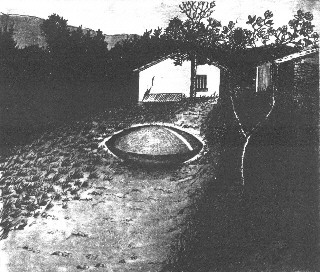
| Object Appearance |
This image (from the excellent French journal Lumineres Dans La Nuit ((LDLN)) shows the approximate appearance of the object in the landing area (M. [ Monsieur ] Phillippe Planard created this "croquis montage [ line drawing ] modeled after a photo of the actual scene with the UFO drawn in):
|
||||||||||||||||||
| Object Behavior | Object landed, stayed for a brief period, and then took off and retraced its course. | ||||||||||||||||||
| Physical Effect | Ring showing effects of heat and pressure, at the approximate diameter of the disk. | ||||||||||||||||||
| Medical Effect | None | ||||||||||||||||||
| Comments / Conclusion | This fascinating case may correlate with the North China Sea, Hudson Valley, and Arizona cases. |
Footnotes
1. The witness may mean the sort of "bell" that extends from a rocket engine.
2. Report on the Analysis of Anomalous Physical Traces: The 1981 Trans-en-Provence UFO Case, Journal Of Scientific Exploration (Society For Scientific Exploration), Vol 4, No 1, pp 27-48, 1990
3. Report on the Analysis of Anomalous Physical Traces: The 1981 Trans-en-Provence UFO Case, Journal Of Scientific Exploration (Society For Scientific Exploration), Vol 4, No 1, pp 27-48, 1990
4. Perhaps this should be "cannot say".
5. Unfortunately the size of the comparison stone nor the height from which it might have been dropped were not provided. If they had been, it might be possible to make some comparisons.
6. The analysis below implies the object was on the ground for nearly 30 seconds.
7. Report on the Analysis of Anomalous Physical Traces: The 1981 Trans-en-Provence UFO Case, Journal Of Scientific Exploration (Society For Scientific Exploration), Vol 4, No 1, pp 27-48, 1990
8. Report on the Analysis of Anomalous Physical Traces: The 1981 Trans-en-Provence UFO Case, Journal Of Scientific Exploration (Society For Scientific Exploration), Vol 4, No 1, pp 27-48, 1990
9. Report on the Analysis of Anomalous Physical Traces: The 1981 Trans-en-Provence UFO Case, Journal Of Scientific Exploration (Society For Scientific Exploration), Vol 4, No 1, pp 27-48, 1990
10. This turns out to be an incorrect translation. According to M. Bourdais, "'Dozens of meters' is an incorrect translation of the original French text which is 'une dizaine de mètres de haut'. This means exactly 'about 10 meters high'. I suppose that the translator, failing to find a word to translate 'dizaine' (it does not exist), called it a dozen and then made a mistake which was to add 'some' with the plural on dozens. The result is completely misleading, unfortunately."
11. Report on the Analysis of Anomalous Physical Traces: The 1981 Trans-en-Provence UFO Case, Journal Of Scientific Exploration (Society For Scientific Exploration), Vol 4, No 1, pp 27-48, 1990