
t e m p o r a l
d o o r w a y
3/30-31/90 - near Wavre, Belgium, police officers, ground-based and airborne radar detection

| Report Summary | 3/30 23:00 - A call from a gendarme is recieved by the Glons CRC (Control Reporting Center); 3 unusual lights are under observation, constantly changing color, in the shape of an equilateral triangle. 23:10 - A second formation moves toward the first. Glons CRC has an unidentified radar contact at 5 km N of Beuvechain Airport, speed 25 knots. 23:45 - After a series of erratic movements, the second formation forms a triangle similar to the first. Glons CRC confirm unidentified radar contacts at the correct location. Semmerzake TCC / RP (Traffic Control Center / Reporting Post) confirms radar contact. 23:56 - Glons CRC scrambles 1 J Wing. 3/31 0:05 - Two F16s depart for the ninth interception attempt. Previous attempts have failed to maintain radar lock. 0:13 - First lock on (see graph below). 0:19 - Semmerzake and Glons lose contact with the target. 0:30 - Fighter AL-17 has a radar contact; lock-on lasts for 6 seconds and is then broken with a jamming indicator shown on the on-board radarscope; speed 740 knots. Ground witnesses see the F-16s pass through the center of the first formation. The second formation disperses - one point goes up - the others disappear. 0:32 - Glons and Semmerzake both detect a a high speed contact 6 nm from Beauvechain. Speeds are 478-690 knots. 0:47 - Beauvechain RAPCON watches a contact on its scope for 9 mins, confirmed by Glons radar. Further attempts at interception fail. Ground observers see the last of the phenomenon disappear in the NNW.[footnote 1] |
| Hynek Classification | RV |
| Original Vallee Classification | Type IVb |
| Current Vallee Classification | MA1 |
| Minimum Distance | 5-6 nm |
| Object Appearance | Triangular formations of erratically moving lights which later disperse. |
| Object Behavior | 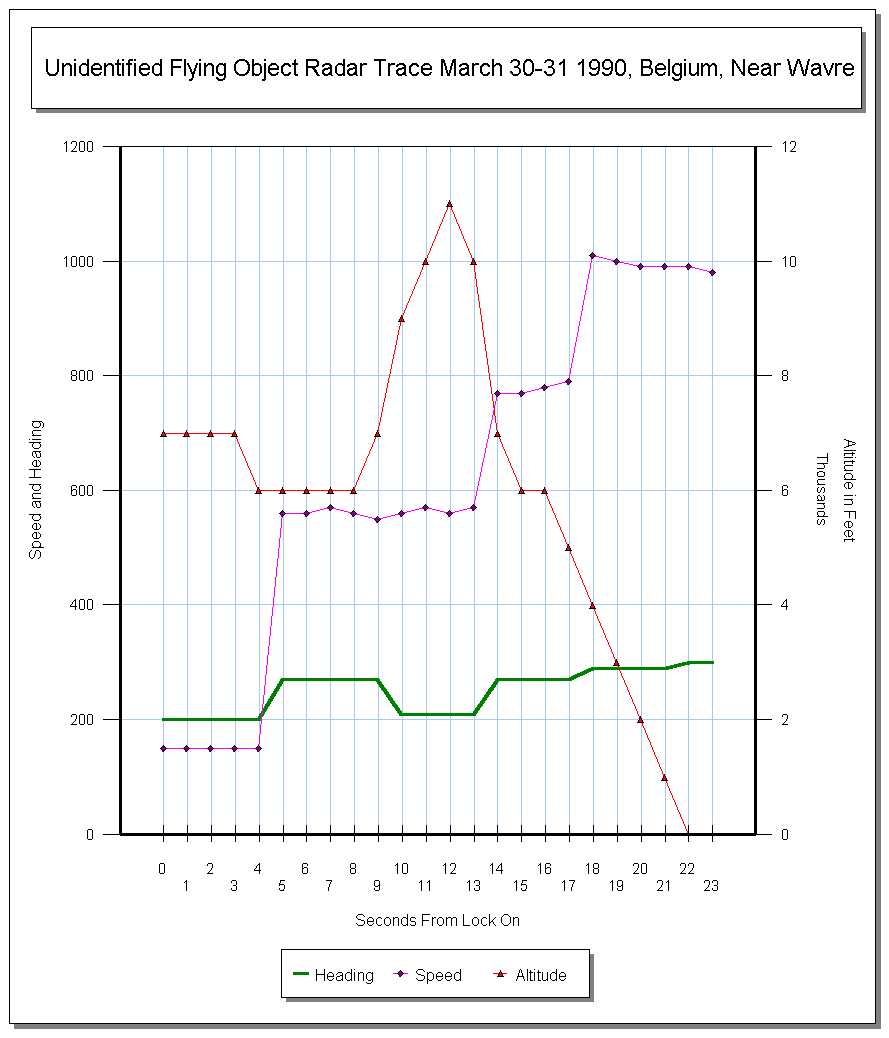 |
| Physical Effect | None |
| Medical Effect | None |
| Comments / Conclusion | The performance shown on the graph is one which has some strong correlations.
Note how speed increases as the UFO dives. Note also how the UFO maintains
speed during its ascent. Several manuvers are combined - increase in speed,
altitude gain, and turning. This graph is similar to one obtained from a US radar contact, shown in one of Vallee's earlier books. |
Performance Data
Here is the performance data used in the graph[footnote 2]:
| Seconds from lock | Heading (degrees) | Speed (knots) | Altitude (feet) |
| 1 | 200 | 150 | 7000 |
| 2 | 200 | 150 | 7000 |
| 3 | 200 | 150 | 7000 |
| 4 | 200 | 150 | 7000 |
| 5 | 200 | 150 | 6000 |
| 6 | 270 | 560 | 6000 |
| 7 | 270 | 560 | 6000 |
| 8 | 270 | 570 | 6000 |
| 9 | 270 | 560 | 6000 |
| 10 | 270 | 550 | 7000 |
| 11 | 210 | 560 | 9000 |
| 12 | 210 | 570 | 10000 |
| 13 | 210 | 560 | 11000 |
| 14 | 210 | 570 | 10000 |
| 15 | 270 | 770 | 7000 |
| 16 | 270 | 770 | 6000 |
| 17 | 270 | 780 | 6000 |
| 18 | 270 | 790 | 5000 |
| 19 | 290 | 1010 | 4000 |
| 20 | 290 | 1000 | 3000 |
| 21 | 290 | 990 | 2000 |
| 22 | 290 | 990 | 1000 |
| 23 | 300 | 990 | 0 |
| 24 | 300 | 980 | 0 |
Footnotes
1. UFO: A Deadly Concealment, Sheffield, ISBN 0-7137-2620-2, p 22
2. UFO: A Deadly Concealment, Sheffield, ISBN 0-7137-2620-2, p 22