| Links | |
| Books |
|
|
The objects viewed in the second sighting offer the possibility of path and thus distance and size determination. This arises from several factors:
This map shows the approximate azimuth of the first and final observations in red...
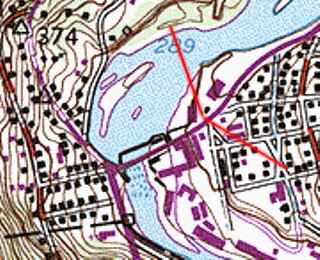
At the final observation, the witnesses report the objects to be heading apparently directly away from them. Therefore we can assume an approximate course at that point close to directly along the sight line. This is not inconsistent with the original observation azimuth, especially since, for most of the sighting, the objects were observed to the east of the witnesses.
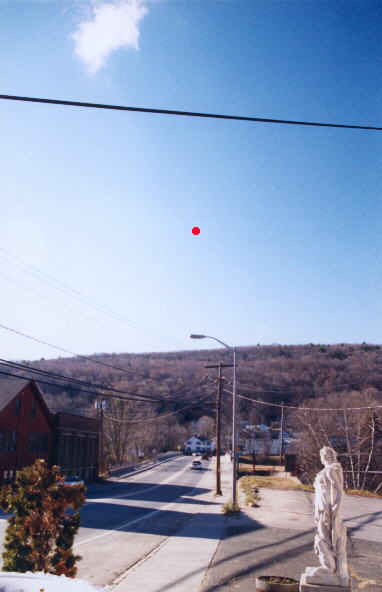
The following map shows the possible course if the objects distance at the first appearance was the same as the comparison building used by F (see photograph from Site Information).
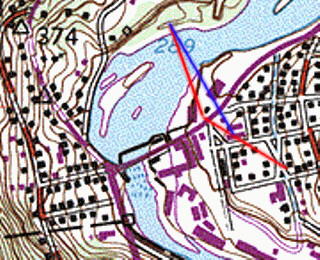
This course is not unreasonable, but it is essential to understand that the start point of the course could be anywhere along the SE trending azimuth line. However, there are some constraints. As the object is shifted further out the azimuth line, the altitude increases. At a 25 degree approximate elevation, at some point it might intercept the rising shadow line from the hill. The point at which this might happen is, based on a graphical analysis, around a mile from the witness.
Based on this analysis, the approximate maximum distance of the initial sighting position is within a mile of the witnesses. Beyond that, the objects might show a sharp shadow from the lighting produced by the sun.
There are two angular measurements available. The calibrated measurement, from the interview with F, is 3 inches at 2 feet. This results in an angular size of approximately 1.2 degrees. The other measurement, using "arm length" produces a value of 5 inches. This is very close to 24 inches, or two feet from the eyes. If the two foot distance is used, the resulting angular size is nearly two degrees. Note that these measurements may actually both be correct. The first measurement is from earlier in the sighting, when the objects were apparently more distant. We will follow through both possibilities.
Here is the table for a variety of distances at the smaller size:

And the larger size...

The consensus of the witness testimony is that the object first appeared over a nearby building. If true, the distance would be about 0.1 mi, the size of the object would be about 15-20 feet, and the altitude would be around 250 feet.
Normally, little weight can be given to witness estimation of distance or size. However, these witnesses observed an object which traversed a substantial part of the sky, with all of the consequent perspective changes. The duration was long enough for the second adult witness to go back inside, answer the phone, and return at least once. Under those conditions, it is at least worth considering their estimates.
At the maximum possible distance of about a mile, the object is over 2,000 feet up and is between 100 and 200 feet in length.
Interestingly, if the object were a small balloon, a foot in diameter, it could only be about four feet away. If it were a full size hot air balloon, it would be about a half mile away and would be easily recognizable. If it were a blimp, it would be about a mile away, and still quite recognizable.
The speeds at the various distances (including closer that the 0.1 minimum used above), are as follows:

If the objects' disappearance were the result of acceleration rather than disintegration or some other phenomenon, the objects would have to have traveled outside the field of view in a fraction of a second. Assuming a typical human field of view of 160 degrees, the object would have had to have traveled 80 degrees in some direction from the center of view in that time. Alternatively, the objects could have receeded into the distance at such a rate as to fall below the minimum resolution of the human eye within a fraction of a second.
Since the first alternative would likely provide the minimum speed required, we can use that as the basis for the computation, and we can assume the 0.1 mi distance for a basic frame of reference. Such a calculation indicates a speed of 2,200 mph for an 80 degree traversal in 0.1 second. This is well within previously recorded UFO speeds.
This site is an archive of the content of the MUFON CT website from the late 1990s. The current MUFON CT organization should be contacted through the MUFON web site.