
| Links | |
| Books |
|
|
Because the witnesses reported that the second set of objects observed had no distinct shading, and because the aircraft which appeared afterward showed orange reflections from the setting sun, it is worthwhile to consider the results if the reason for this might be that the setting sun were below the hilltop and the objects below the altitude of the shadow cast by the hill.
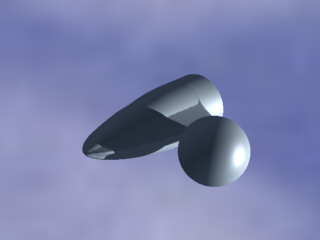
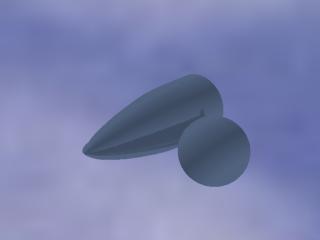
The following simulation shows the distinct shadows which would be expected. based on the approximate relation of the sun (below and behind) to the objects, if the sun were not blocked by the hill and if the objects were, instead, in the shadow of the hill (note that the "Arrowhead" configuration of the object is used..
 |
 |
|
With Sun
|
In Shadow
|
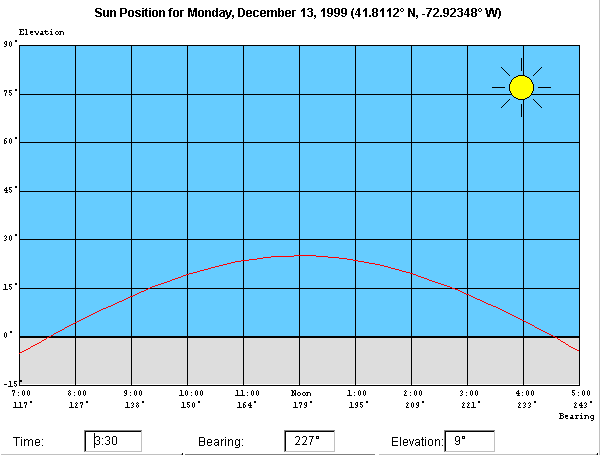
The above is a graphical representation of the path of the sun as seen from the sighing location, generated by http://www.cs.ucla.edu/~simonw/sunpos/. At the estimated time of the sighting, the sun was at true north relative bearing 222 degrees and elevation 9 degrees.
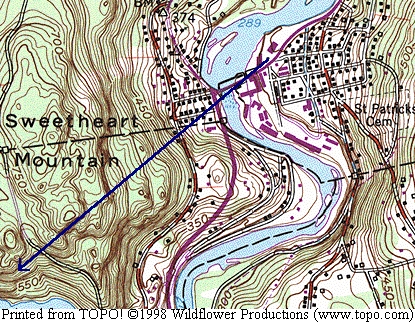
The following is the topographical map showing the azimuth of the sun at 3:30 PM with a blue line toward the lower left. The anchor of the line is in the center of the parking lot where the objects were observed.
The following is an approximate profile of the topography along the 227 degree TN bearing. In yellow is shown the triangle which intersects the top of the hill. The left side angle represents the smallest angle at which the sun would touch the sighting location - calculated at 10.4 degrees by the following dimensions:
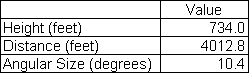
using the following formula
'Angular Size (degrees)' = ATAN('Height (feet)' /'Distance (feet)' )*(180/@PI)
Note, however, that there is a projection which enlarges this angle, as follows:
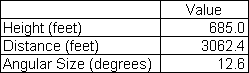

Once the sun falls below approximately 11 degrees, the shadow cast by the hill instantly becomes effectively parallel to the ground, and as the sun continues to descend, the shadow begins to be cast upward into the sky. The line of the shadow at sunset is a tangent to the curvature of the earth.
At 3:16 PM, the sun is at 11 degrees elevation. At approximately that time, any object below an MSL altitude of 750 feet (450 feet above the witness altitude) will be in shadow.
In order to avoid excessive complexity, we can assume that the top of the hill acts as a horizon. Thus, at 3:30 PM, the sun is effectively about 2 degrees below the horizon. This means that the angle of the shadow should be 2 degrees above the horizontal. If that is the case, the following diagram shows the space within which an object will be shaded at 3:30 PM .
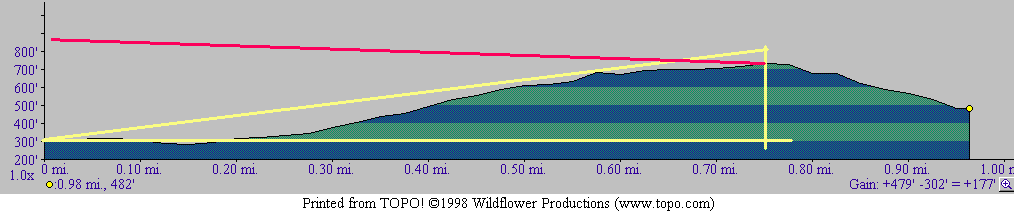 Looking a little
to the south of the sighting location (anchoring the vector slightly south of
the brownstone visible in the observation point 2 site photo)...
Looking a little
to the south of the sighting location (anchoring the vector slightly south of
the brownstone visible in the observation point 2 site photo)...
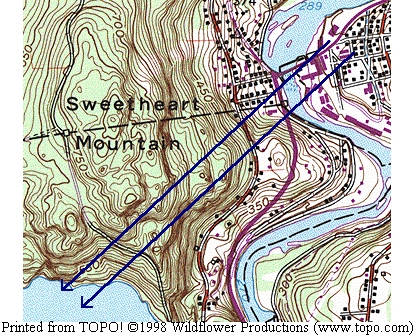
...since the topography falls off toward the south, we find that the highest elevation toward the sun is 667 feet at 0.76 mi (4012 feet), which results in a "horizon" of 9.4 degrees. Since at 3:30, the sun is at 9 degrees, this leads to a maximum altitude of around 700 feet.
In other words, objects below approximately 700 feet at the witness position will be in shadow. Assuming the correctness of the witness claim for the lack of shadows on the objects and that this was due to the lack of exposure to the sun, it seems reasonable to conclude that the maximum altitude of the objects was between 700 and 900 feet.
These calculations were confirmed by direct observation of sun angles and the occlusion of the sun by Sweetheart Mountain near 3:30 PM on December 27, 1999.
This site is an archive of the content of the MUFON CT website from the late 1990s. The current MUFON CT organization should be contacted through the MUFON web site.