

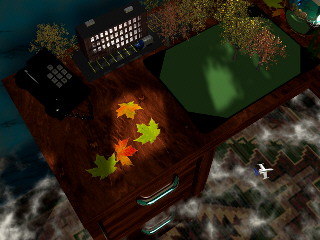
This image comprises several enduring themes - the unity of human life, business, nature, and technology; the fractal surprises of reality, and my love for combining different scales into one.
|
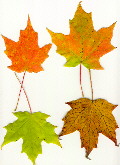
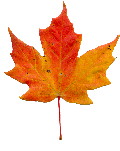
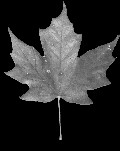
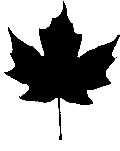
Many complex techniques were used to produce this image. It began with the leaves, seen and gathered on an autumn walk, immortalized into digital form by the scanner. Each leaf was clipped, the white areas filled to a pure white, and then a bump and transparency map were derived by grayscaling and maximizing brightness and contrast respectively. In Carrara, transparency mapping requires a subtract of the transparency mask from the color map in the color channel of the shader, and also the use of the mask in the transparency channel. If you don't use the color subtract, a white line around the color map is the typical result.
|
|
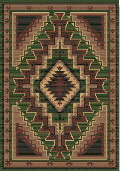
| Then a rug in my favorite southwestern style, echoing the forms of the ground I had photographed on my recent trip to California. |
|
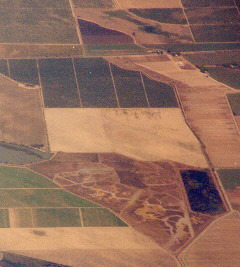
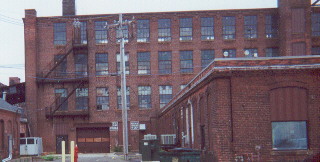
| A long session with Canoma produced the factory, based on a set of photos like this one. Canoma allows the user to interpolate the actual geometry of an object (mostly architectural objects) based on matching the orientation, size, and proportion of geometric shapes to the image. |
|
| In this close-up of the detail of the resulting rendered object, you can see that some editing of the window areas was performed to eliminate the secondary building. Note the realistic window effect... | 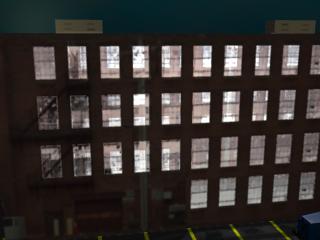 |
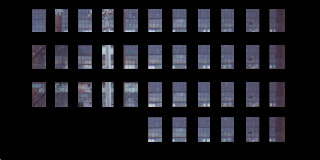
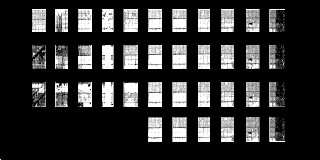
| ... which is produced by the glow and transparency maps. Three lights inside the building cast light out onto the parking lot through the transparency map, while the glow map provides the illusion of translucency. These maps are derived from the Canoma normalized color map, but the brick section of the maps are colored to opacity and darkness, while the glow map is greyscaled and its dynamic range increased through gamma, brightness and contrast. |
|
Other areas of care included, most importantly, the lighting. Primary lighting is a spot from outside the walls with soft shadowing to make the pools of sunlight on the desk. A bulb light on the inside provides a slightly warm fill. But a third light was needed to illuminate the top of the trees on the deskpad - and it had to be carefully aimed to just intercept the trees and the aircraft.
Numerous procedural shaders were created - one for the walls, one for the cloud surface, one for the autumn foliage, and one for the parking lot stripes.
The models comprise a variety of those from Carrara's library and one from the 3D Cafe site (the phone), and, of course, the Tree Druid extension was used for the trees.