
An Analysis of The 3/30/90 Belgian Radar Data: Draft In Progress

Updated 11/13/98
Abstract
The data gathered from an airborne radar during the intercept of a UFO on 3/30/90 in Belgian airspace provides a unique opportunity to analyze the three-dimensional flight profile of a possible UFO.
Of particular interest is to determine if the profile represents anomalous performance for an aerodynamic vehicle while at the same time demonstrating consistencies which are difficult or impossible to equate with observational errors or ECM from a conventional aircraft.
Background
The radar observation of a UFO in Belgian airspace beginning on 3/30/90 and continuing into the early morning hours of 3/31/90 was merely one incident in an extensive period of UFO activity over Belgium and neighboring countries during that year. Observations at Eupen, which were made by citizens and public officials (including uniformed police officers), indicated the presence of a large triangular object which was capable of low altitude / slow speed, hovering, high acceleration, and high speed. In this, the observations were similar to those of nearly a decade before in the Westchester County area of New York state (USA).
A case summary of the Wavre events of 3/30/90 through 3/31/90 indicates that several ground-based radars simultaneously obtained radar signals from the same object at the same time, as judged by the radar operators. At 11:56PM local time, the required conditions for an intercept having been met, two F-16 fighter aircraft of the Belgian Air Force departed their base and attempted to engage the unidentified aircraft. One of the F-16s had a video camera operating which recorded the radar readings and the HUD (Heads Up Display) presented to the pilot. Readings from the HUD display based on the frame rate of the video allowed military analysts to extract information on the performance of the unknown target.
At the time of the intercept, the visibility was 8-15km, wind was high (50-60 knots at 1000 feet, 230 degrees), and there were two slight temperature inversions (ground level and 3000 feet).
The UFO was not observed visually by the F-16s at any time. An analysis by the author, based on distance data, indicates that the object would have had to have been exceptionally large or well illuminated to have been observed visually under the conditions that evening.
The radar data originally appeared in Annex I (letter I) of the official Belgian Air Force report. It represents the information gathered from radar contact 3, at 00:15 local time.
Basic Data
The following is a table of the basic data derived from the radar observations[1]:
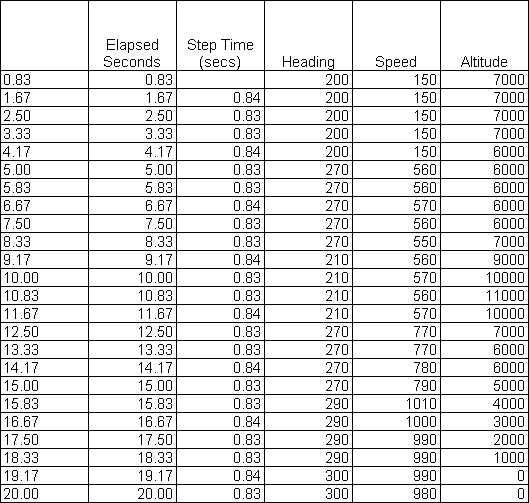
When graphically profiled, the salient aspects of the performance in question become clear:
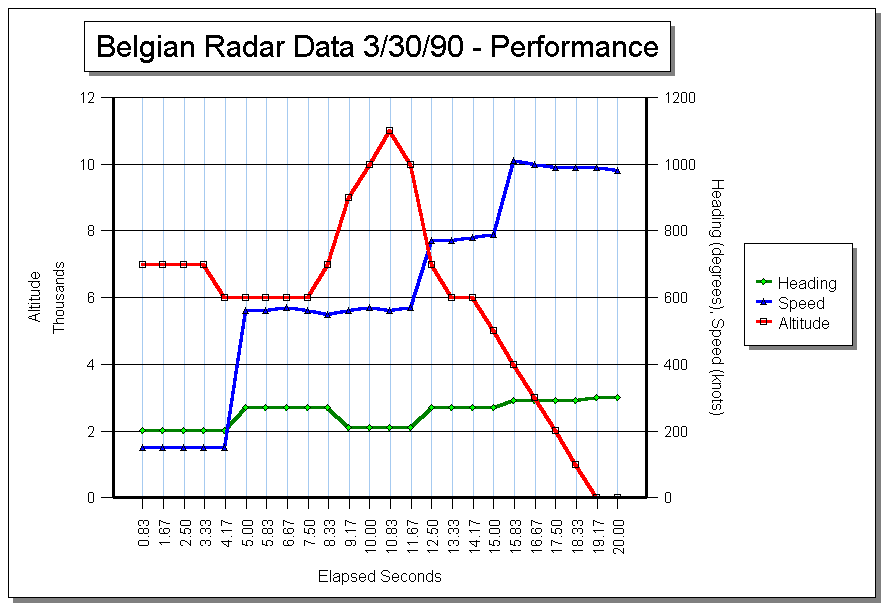
It is clear that the UFO engaged in radical manuvers involving changes in altitude, speed and heading. In one case (11.87 secs to 12.50 secs) these all occur simultaneously, while in another case (4.17 to 5.0 secs) speed and heading change simultaneously (this occurs immediately after a drastic change in altitude)[2].
The following describes this profile by interval number (all actions within an interval are effectively simultaneous):
- 1-4: level flight 150 knots; UFO apparently detects interceptor
- 5: descends 1000 feet
- 6: resumes level flight, accelerating to 570 mph, 70 degree heading change
- 7-8: continues level flight, small speed changes
- 9: continues level flight, slowing, may be losing energy in the entry to the ascent
- 10: ascends 1000 feet, continues slowing, may be losing energy post ascent entry
- 11: ascends 2000 feet, regains some speed, turn -60 degrees
- 12: ascends 1000 feet, regains some speed to highest pre-ascent speed
- 13: ascends 1000 feet, loses some speed; top of a nearly ballistic trajectory
- 14: descends 1000 feet, regains speed to amount in (12)
- 15: descends 3000 feet, turns 60 degrees, increases speed by 200 knots
- 16: descends 1000 feet
- 17: levels off, increases speed slightly
- 18: descends 1000 feet
- 19: descends 1000 feet, turns 30 degrees, increases speed by 200 knots
- 20-23: continues descent at 1000 fps with shallow turn and gradual speed decrease
Comparisons of raw numbers to the performance of fighter class aircraft can be useful:
| Parameter | UFO | F-14 | F-15 | F-16 | Tornado |
| Max level speed low altitude (knots) | ~570 | 791 | 800 | 1,120 (at 30,000 feet; low level speeds probably comparable to other fighters) | 704 (Mach 1.2) |
| Max ascent (fps) | 1,000 - 2,000 | 500 | 660 | 700 | |
| Stall speed (knots) | below 150 | ||||
| Operational weight (lbs)[3] | 58,539 (normal take off) | 42,000 | 22,500 (design take-off gross) | 42,000 | |
| Length / span (feet) | 61 / 38 (swept), 64 (unswept) | 63 / 42 | 47 / 32 | 54 / 28 (swept), 45 (unswept) | |
| Wing area (ft2) | 565 | 608 | 300 | ||
| Thrust (lbs) | 41,800 | 47,000 lbs w/ afterburners | 23,810 | 30,000 |
It is important to note that the UFO was observed to sustain supersonic speeds at relatively low altitude, yet no reports of sonic booms were received. It is not known whether the fighters also exceeded supersonic speeds during their pursuit. It would certainly be interesting to see the comparable profiles for the intercepting aircraft, especially in regard to determining the relevance of any ACM (Air Combat Manuvers) by the intruder in comparison to the relative position of the pursuer.
Derived Information: How Radical Were The Manuvers?
The next table provides an indication of the nature of the manuvers:
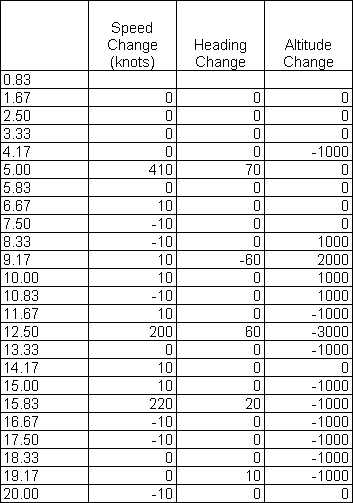
Clearly, some radical manuvers are occurring:
- Speed changes of up to 410 knots in one second.
- Heading changes of up to 70 degrees in one second.
- Altitude changes of up to 3000 feet per second (1,777 knots) maintained for one second or less and typical ascent / descent rates of 1000 feet per second (592 knots).
That these manuvers are radical can be seen by comparing them to some representative figures for commonly available fighter aircraft. For instance, the F-4 Phantom is known be able to turn at only 11.5 degrees per second, less than 1/6 as fast as the observed UFO profile.
The nature of these manuvers and their coincidence in time is also visible in this graph, which only shows the value of the changes:
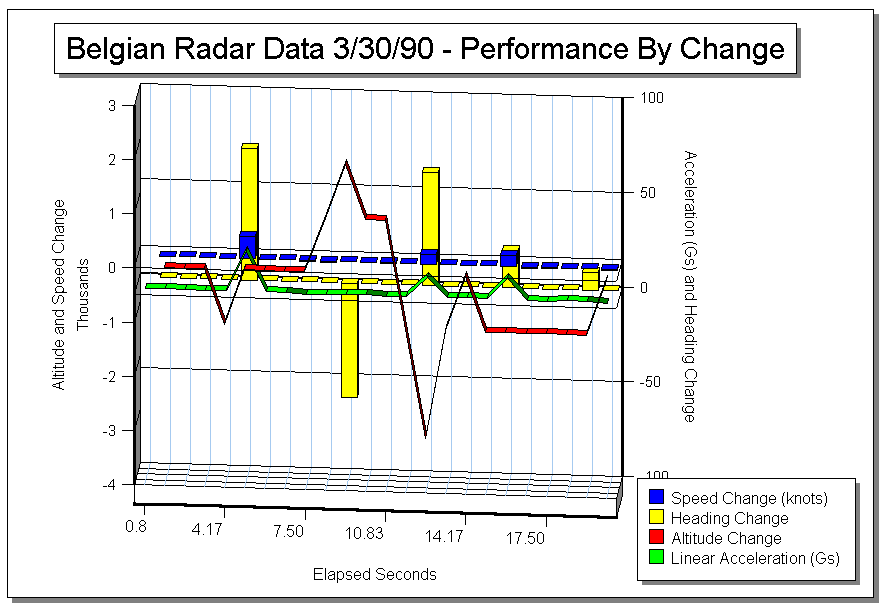
A number of observations can be made from this data:
- 3 out of 4 positive heading changes were accompanied by notable speed increases, and acceleration to the speed required only as long as it took to make the heading change.
- 1 out of 4 positive heading changes and 1 of 1 negative heading change showed no notable accompanying speed increase (0 and 10 knots respectively)
- No heading changes were accompanied by deceleration.
- 4 of 5 heading changes occurred at the onset of a change in altitude (2 at troughs, 1 at a peak, and one at the onset of an altitude change after a period of steady altitude).
- Speed changes were not proportional to the size of the heading change.
- No notable speed changes correlate to changes in altitude except when there is a change in heading.
Acceleration Information
The following table indicates acceleration findings:
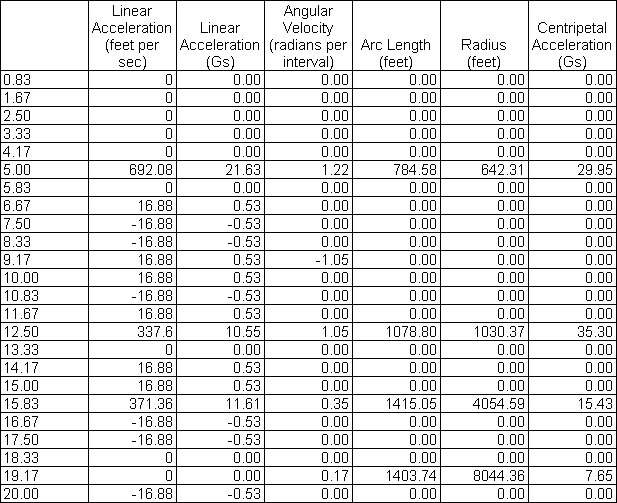
The following points are of interest:
- Linear accelerations ranged from 0.5G to 21G.
- The largest acceleration occurred at the lowest speed; at higher speeds maximum accelerations were only half of that maximum value.
- Turn radii of less than a mile are the rule, despite speeds for some turns in excess of 1000 knots.
- Centripetal accelerations range from 8 to 35 G. Combined with linear accelerations, total forces on the UFO structure or occupants would be as high as 50G.
Note: a 12 G strain was reported to have broken the wing panels on an F-4, while the F-16 is expected to meet strain of 9G in combat as a routine matter.
Analysis
A Conventional Flight Profile
To help consider whether or not the data shows an anomalous flight profile, we need to consider a standard flight profile.
The speed of an aircraft in level flight depends on the power it exerts in forward motion balanced against the drag produced by the resistance of the air to the passage of the surfaces of the aircraft. The maximum speed is limited by the thrust vs. drag ratio, and by the conversion of drag into heat, which can cause structural changes or damage[4]. The maximum acceleration is limited by the thrust of the powerplant, the resistance of the air, the current speed, and the structure of the aircraft (which can be destroyed by excessive acceleration).
When an aircraft enters a turn, it typically does so by tilting into the turn. This translates lifting force into a sideways force, which, balanced against forward velocity, causes the aircraft to arc through the turn. Unfortunately, the change in the direction of lift will normally cause the aircraft to lose altitude unless additional thrust is applied, which then allows the vertical lift component to be maintained. However, as the additional thrust is applied, it increases centripetal acceleration, which can, at the highest levels, cause structural disruption; additionally, it can cause aerodynamic instability, which can lead to a spin, spiral or flat spin.
When an aircraft begins to ascend, it does so by altering its angle of attack. As the angle of attack increases, the balance of thrust devoted to lift is increased, while that devoted to forward motion is decreased. As the angle of attack continues to increase, the smooth airflow over the wing is disrupted and lift drops off sharply.
When an aircraft descends, it generally does so by reducing forward speed, which in turn reduces lift.
Thus, a conventional flight profile should show the following characteristics:
- Linear acceleration is limited by inertia.
- Aircraft may lose altitude at entry to turn.
- Aircraft will generally lose forward speed during ascent.
- Aircraft will generally lose forward speed prior to descent.
ACM (Air Combat Manuvers)
ACM techniques use advanced manuvers to allow a pursuer or the pursued to gain an advantage - which, in this environment means a firing solution.
In this encounter there is no indication that the UFO attempted to gain an advantage, that is, to get behind the pursuing F-16. This is indicated by the lack of deceleration anywhere in the encounter, such manuvers being essential in attempting to get the pursuer to overshoot. Therefore the relevant manuvers are escape manuvers, and advantage manuvers such as barrel rolls, spiral dive, yo-yo, and rollaway are not likely to be seen in this encounter.
However, the Immelman and the Split-S are relevant:
"Immelman
"Use this maneuver to increase altitude and reverse direction.
"The Immelman is neither an offensive nor defensive procedure. Instead, it is a high-thrust maneuver that changes your bearing and increases your altitude. By pitching the nose up and climbing, you can execute one-half of a loop. To terminate this maneuver, invert and execute a roll. (The amount of roll applied determines your new direction of flight, as indicated in the diagram.) This leaves you flying in a different direction, but at a higher altitude. Once your wings are level, perform a half-roll again to reassume a vertical position.
"The Immelman is more useful for aircraft that have low-thrust capabilities. Modern high-thrust aircraft can broaden this maneuver by making a vertical climb, then using an aileron roll to complete the half loop. "[5]
"Split-S
"Use the Split-S to increase airspeed or bleed off altitude.
"A Split-S maneuver is a diving half-loop that is useful when you want to disengage a threat. It is a high altitude maneuver that requires a lot of vertical airspace, so make sure you're at least several thousand feet above the ground beforehand.
"During a turn, invert by rolling, then immediately pull back on the stick to go into a dive. Your aircraft will rapidly accelerate and gain airspeed. Pull back on the stick until the aircraft levels out, then ease into level flight. You'll be uninverted, and you'll have a higher airspeed and lower altitude.
"The split-S has the advantage of providing a quick burst of speed. Additionally, rolling while inverted adds the aircraft's lift vector to gravity, thus increasing the force of acceleration and adding speed. On the down side, however, the increased speed increases the vertical turning radius, thus making it hard to pull the nose up into level flight. Starting a split-S from low altitude, or maintaining too much speed during the dive, can prevent the aircraft from pulling out of the dive.
"The split-S makes a great escape maneuver in a guns-only environment because the rapid speed gain moves you out of gun range. It's usually ineffective against missiles, since they have significantly longer ranges."[6]
Disengagement
" The object in the disengagement from close air combat is to leave when the bandit has the most work to do in order to catch you. There are some situations that you will find yourself in where you just cannot leave the fight (without surely being shot). The head-to-head fight allows you one opportunity to exit--at the merge. Make the merge occur as neutral as possible, and don't allow the bogey any lateral separation. Any angles or turning room that you give him will result in him getting his nose on you earlier, and could mean the difference in a shot being taken on you or not. At the merge, select full afterburner, unload, and extend. It is extremely important that you unload the aircraft. Go straight to zero g for as long as your altitude will allow. The acceleration difference between an aircraft at 1g and an aircraft at 0g is remarkable, as shown below:
"Energy Addition Data (v1.1.3b1) at mil power from 250-400 KIAS: 1g Flight: ~ 37 seconds 0g Flight: ~ 11 seconds
"As you extend, look back over your shoulder and determine which way the bandit is turning. Check-turn your jet away from the bandit in about 30 degree increments. The object is to keep him just from getting his nose on you until you have opened the distance from him to either prevent a missile shot, lessen its Pk, or give you a better chance to defend against one (by giving you more time to evaluate if it's guiding on you or your expendables).
"In the nose-to-tail fight, there are two places to disengage from: the merge, just like in the one circle fight, or when the distance between the fighters is greatest when they are across the circle from each other. The most optimum place to disengage from is the merge, as you have eliminated angles and turning room. When across the circle from one another, you can eliminate the angles, but not the turning room. In this case, you should use the built in separation and add to it by selecting full AB and unloading. Check-turns will probably not be as effective or as necessary as in disengaging at the merge, as the distances will be great."[7]
Critique
Several of the manuvers seem unusual from an ACM perspective.
For instance, the extreme turns would seem to increase the probability of the interceptor being able to maintain lock and gain a firing solution, since they cause the UFO to be moving at near right angles to the intercept course. Further, due to aerodynamic considerations, high-G turns (and these are extremely high-G turns), are generally avoided, since they use up the available energy budget for the pursued aircraft more quickly. Yet the UFO made three high-G turns in a span of less than half a minute - and during those turns provided no sign of losing energy (i.e. rapid loss of forward speed). This suggests an extremely high performance vehicle with an unconventional aerodynamic profile.
Most "dogfights" are held near stall speed. That is clearly not the case for this encounter. Indeed, the 150 knot initial speed of the UFO is only half the nominal cruise and battlefield loiter speed of the A-10 (an aircraft noted for the ability to engage in low and slow battlefield performance). Yet within moments the UFO has exceeded the design maximum for the A-10 (450 knots) and it continues to attain a level flight speed similar to that of an advanced, high speed fighter. This indicates an unusual performance versatility.
If the intentions of the intruder were hostile, most descriptions of ACM tactics indicate that abrupt decelerations aid in causing a pursuer to overshoot, providing targeting opportunity to the pursued, yet no such manuvers were attempted by the UFO.
The most conspicuous manuver seems to be the ballistic trajectory at the center of the contact time interval. Prior to this manuver, we can see the UFO dive slightly, which might be an attempt to gain energy for the subsequent ballistic trajectory or acceleration. However, the UFO at this time also engages in an extremely high-G 70 degree turn which would drastically bleed energy at just the time a conventional aircraft would want as much energy as possible. The UFO then maintains level flight, but does not continue to accelerate; in fact, just before entry to the ascent, it slows slightly, which, in a conventional aircraft would follow the profile of losing speed as the airfoil angle of attack is increased. However, no altitude change emerges until the next interval, during which speed continues to drop slightly. In the next interval, the UFO doubles its ascent rate, gains some speed AND makes a -60 degree turn. This may indicate a period during which the UFO has "unloaded" and is attaining 0 G flight, which would make acceleration more efficient, but once again the turn is an extremely odd manuver to perform when acceleration would be desirable; that the turn is negative makes it impossible to classify this manuver as a spiral climb, but it could be classified as an offensive vertical scissor, if it were not for the way the manuver plays out (the vertical scissor is intended to cause the pursuer to overshoot). Almost immediately, the ascent rate returns to normal (1000 feet per second), speed declines slightly as would fit a normal ballistic trajectory and in the next interval the top of the trajectory is reached while a little more speed is lost. Nevertheless, there is no indication that speed falls to 0, as would be expected in a pure ballistic trajectory. This suggests that the UFO is under power throughout the trajectory, and that the downward part of the trajectory is caused by the application of power. By the next interval, the UFO has regained a slight amount of speed and is descending 1000 fps. In near symmetry with the other side of the trajectory, it then increases speed (this time a much larger amount), triples its descent rate, and turns 60 degrees. In a normal aircraft the speed increase would be attributable to the loss of lift arising from the turn, but the presence of a corresponding increase in speed while ascending may instead point to a correlation between speed and turning which is highly unconventional. This is especially true since speed is added during this turn, and yet that speed fails to offset the loss of lift. At the end of the turn, the descent rate returns to the normal 1000 fps. Then, for a brief "ledge", the UFO levels off for a second. Its speed increases, as if some of the downward speed is translated into forward speed[8]. It then almost immediately resumes its fall at the 1000 fps rate, a rate which does not decrease even as it approaches to within 1000 feet of the ground - a manuver which, in the words used by USAF personnel in a different UFO report, might be considered "suicidal"; it also continues a slight positive turn until contact is lost due to altitude.
Possible Identifications
High performance aircraft
Several aspects of the UFO performance contradict the idea of the UFO as a high-performance manned aircraft:
- Linear accelerations in excess of 20G, which would lead to injury if sustained for one full second[9]; combined with centripetal accelerations of up to 30G, for a total maximum of approx 50G - a level which leads to injury even if sustained for no longer than 0.005 sec.
- Terminal profile of the UFO indicates a suicidal dive toward the ground. The UFO approaches at least 1000 feet of the ground descending at a constant rate of 1000 feetr per second.
- Descent and ascent performance of the UFO are significantly in excess of that for standard high-performance aircraft.
- Linear acceleration performance of the UFO is significantly in excess of that for standard high-performance aircraft.
- Rate of turn performance for the UFO is significantly in excess of that for standard fighter aircraft for which that data is readily available.
Air Launched Cruise Missile (ALCM) or Air Launched Decoy (ALD)
A number of portions of the UFO performance suggest such a possibility:
- The UFO performance suggests the tracked vehicle is not manned.
- The initial track may have been the decoy launch platform, in which case the first 1000 foot drop is the pre-ignition fall of the decoy. This might also correlate with the terminal profile, indicating that 1000 fps is terminal velocity for the decoy (where drag balances gravitational acceleration).
- The level flight portion of the track could be the initial distancing of the decoy from the launch platform, which, in the meantime, is undertaking evasive manuvers.
- Subsequent arc trajectory and otherwise unusual turns could be attention getting activities by the decoy.
- Terminal profile is the decoy either post engine exhaustion or is the decoy / ALCM seeking a ground-hugging path for "escape" or recovery.
However, a number of other factors contradict such a conclusion:
- The UFO performance is in excess of all published specifications on ALCM / ALD speed and acceleration (typically 500-600 mph[10]).
- The decoy did a poor job - the performance profile does not match that of a normal aircraft. However, it may have been a decoy malfunction or an intended anomaly to attract attention and confuse the target as to the source by deliberately providing unusual but not immediately recognized as impossible performance.
- No information has ever been released suggesting the recovery of a decoy - however, the terrain following characteristic of ALCM type drones may have been used to fly the decoy to a friendly base.
Non ALCM decoy
A missile-based decoy could provide some aspects of the performance shown for the UFO without the performance drawbacks of the ALCM drone. However, a missile-based decoy would be much likelier to have been recovered by civilian or military authorities. Secrecy could, of course, conceal such an occurrence.
Conclusion
The performance of the UFO intercepted cannot be ascribed to a conventional manned aircraft. The possibility that the UFO was a decoy launched from a low-observability aircraft cannot be discounted, however there is only suggestive evidence of that as an answer, and some significant negative evidence (B2 bombers first flew overseas in 1995[11], but the F117 was first delivered in 1982 with completion delivery in 1990[12] and all flights were at night until 1989[13]; there is, however no information on whether the F117 carried decoys capable of the demonstrated performance in 1990 (the previous reference does not mention any ALD capability as late as the Gulf War)) It is, for instance, also difficult to understand why three conventional air defense radars would have detected a stealth aircraft for long enough to launch an intercept[14].
The UFO demonstrates a number of performance characteristics suggestive of high thrust to weight ratios:
- High linear accelerations.
- High centripetal accelerations.
- Extremely small turn radius and high turn speeds without normal high-G "bleed".
- Acceleration and sharp turns during ascent.
The UFO also displayed a number of unusual manuver patterns, particularly a predilection for turning while accelerating and either ascending or descending. The UFO did not display a classic disengagement pattern or a classic ACM offensive pattern.
A UFO tracked both visually and on radar in Morocco in 1954[15] shows a similar performance pattern (though, unfortunately, heading data is not available). That UFO performs rapid simultaneous changes of altitude and speed, and the changes are not well-correlated, unlike what would be expected from conventional aircraft. A speed change of 150 kph in approximately a second is not so different from the observed performance of the Belgian UFO.
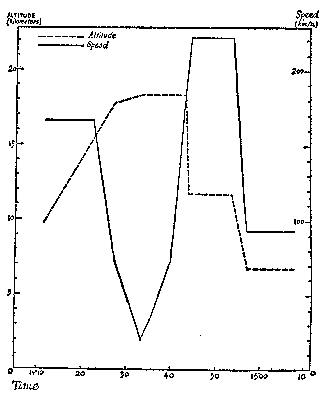
It is interesting to note some of the similarities to the Belgian graph. First, the rapid rise in altitude, followed by an even more rapid decline to a "ledge", followed by an additional decline. One difference, however, is in the speed profile, which is much more conventional - an initially rapid ascent with a somewhat ballistic falloff near the top of the altitude curve, and apparent correspondence of speed in the initial descent to the steepness of the fall. This correspondence, however, is broken after the ledge, where, dispite continued descent, the speed decreases, indicating powered deceleration.
Formulae
- 'Linear Acceleration (feet per sec)' = 'Speed Change (knots)' * 1.688
- 'Linear Acceleration (Gs)' = 'Linear Acceleration (feet per sec)' / 32
- 'Angular Velocity (radians per interval)' = (Heading Change * .01745)
- 'Arc Length (feet)' = if(Heading Change > 0,(Speed *1.688*'Step Time (secs)' ),0)[16]
- 'Radius (feet)' = if(Heading Change > 0,'Arc Length (feet)' /'Angular Velocity (radians per interval)',0)[17]
- 'Centripetal Acceleration (Gs)' = if (Heading Change > 0,('Arc Length (feet)' ^2)/'Radius (feet)' / 32,0)
- 'Linear Acceleration (feet per sec per sec)' = 'Speed Change (knots)' * 1.688
- 'Linear Acceleration (Gs)' = 'Linear Acceleration (feet per sec per sec)' / 32
- 'Angular Velocity (radians per interval)' = (Heading Change * .01745)
- 'Arc Length (feet)' = if(Heading Change > 0,(Speed *1.688*'Step Time (secs)' ),0)
- 'Radius (feet)' = if(Heading Change > 0,'Arc Length (feet)' /'Angular Velocity (radians per interval)',0)
- 'Centripetal Acceleration (Gs)' = if (Heading Change > 0,('Arc Length (feet)' ^2)/'Radius (feet)' / 32,0)
- 'Altitude Speed (feet per second)' = if (not(Isempty(Altitude Change )),(abs(Altitude Change)/'Step Time (secs)'),0)
- 'Altitude Speed (knots)' = 'Altitude Speed (feet per second)' *.5925
- 'Vertical Acceleration (ft per sec)' =('Altitude Speed Change (knots)' * 1.688)
- 'Vertical Acceleration (Gs)' = 'Vertical Acceleration (ft per sec)' /32
Limits Of Accuracy
These figures offer an impression of conclusive accuracy based on the use of the computer and various mathematical formulae which do not take into account the possible errors in the original measurements. As pointed out by a reviewer[18], the following should be noted:
- Fluctuations of +- 10 knots are probably errors from radar system accuracy limits.
- Altitude measurements seem to be quantized to 1000 feet. Therefore all altitude measurements are +- 1000 feet (they may be closer to 0 or 2000 feet than 1000 feet).
- The arc of the turn and the forces involved are calculated as if the turn were a completely separate action from the ascent or descent (though assumed to take as long) - in other words, the turn is estimated as a flat turn. No effort has yet been made to estimate the possible interaction between the various vectors at work.
Acknowledgements
Thanks to Brad Sparks (author of the excellent research article on the RB47 radar / visual sighting in Clark's "UFO Encyclopedia") for originally suggesting and performing calculations on the Belgian data; especially important were his suggestions for the calculation of the centripetal acceleration on the object, though the computations as designed are my own. Also, thanks are due to a researcher on the Project 1947 mailing list who wishes to remain anonymous. That individual assisted in correcting the data based on his knowledge of the official government documents of the sighting.
Though these and others offered helpful comments, any errors in this document remain the author's.
Footnotes
1. Based on material published in Sheffield, UFOs: a deadly concealment, these observations have been corrected to adjust for the fact that the video rate from which the elapsed time was generated was actually 30 fps not 25 fps as assumed in the Belgian government document Annex I (letter I), as pointed out by a researcher on the Project 1947 e-mail list (who wishes to remain anonymous). Also, the 9th altitude value has been corrected from the original reference to 7000 feet from 6000 feet, again as suggested by that researcher.
2. Note that using the data from Sheffield's book, which places the altitude change one second later, all three variables change simultaneously. However, I am informed by a correspondent who has specialized in these events that the version of events as shown in this paper is correct.
3. Halfway between empty weight and max takeoff is used for this value.
4. For instance, the SR-71 actually lengthens in response to the intense heat produced by its speed.
5. ATF Combat Zone - http://atf.stomped.com/acm2/
6. ATF Combat Zone - http://atf.stomped.com/acm2/
7. http://www.pytlik.com/VFA-13/takeoff/acm6.html
8. Can this be shown by converting speed of descent to forward speed?
9. http://www.millennial.org/pubs/point/fp1/fp1-6.htm
10. http://www.wpafb.af.mil/museum/modern_flight/mf53b.htm and http://www.fas.org/nuke/guide/usa/bomber/alcm.htm
11. http://www.af.mil/news/Jun1995/n19950613_611.html
12. http://www.af.mil/news/factsheets/F_117A_Nighthawk.html
13. http://www.pbs.org/wgbh/pages/frontline/gulf/weapons/stealth.html
14. However, this could be part of an exercise to test the performance of the F117 in an intercept situation.
15. Vallee, Challenge to Science, p 207
16. This is the linear distance the object would have traveled at the specified speed.
17. Based on the standard equation theta in radians = arclen / radius, transformed to radius = arclen / theta in radians.
18. Brad Sparks offered these and many other helpful comments on the calculations.