
Gallery

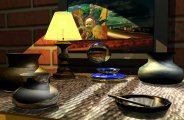
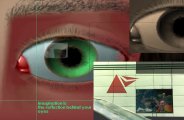
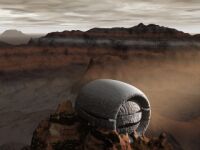
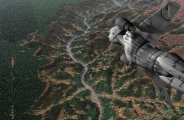
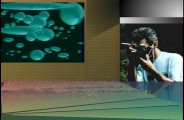
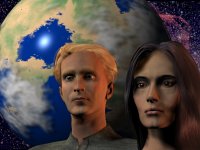
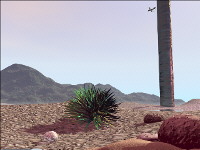
These are the products of over a decade of computer graphics work. Some pencil drawings that predate that period are also represented. These works have been created with a wide variety of software ranging from image processors to paint programs, to 3D visualization programs such as Imagine and Carrara.
You can visit the current show (featured works), have a look at some of my illustrations, or, in the Workshop, find out how some of these images were created. Or try one of the galleries below, using my special classifications of work by topic.
|
Other Arrangements and Information
- Workshop
- Animations and recommendations for animation players
- Images created with Imagine for the Amiga (11/98)
- Images created with Bryce for the PC (4/00)
- Images created with Poser for the PC (4/00)
- Images created with Carrara for the PC (4/00)
- Images created with Canoma for the PC (4/00)
- Photo Gallery
Friends
Ron Spellman - Comics
Scott Walker - Photography
Some History And Methods
I began to draw when I was so young that I can't remember where it began. There are images of places which affected me then and to this day:
-
Being a tiny child, sitting alone in a small cluster of bamboo late in the day. The plants were at the edge of my grandmother's yard, and the sunlight cast long shadows across the textures of the ground.
-
Slightly older, at my other grandmother's home, in Pittsburgh. A backyard like a tiny enclosure - floored with aged but bright red bricks, with moss in the spaces between; a walk with my uncle down cobbled streets from that house, past garages and into an industrial district, and then high above the railroad tracks on a black iron bridge.
-
My first grandmother's bedroom and the lace on her dresser top, with rocks and small boxes and objects; a low cross-paned window that looked out on the street.
-
Walking the railroad tracks with my father; a culvert filled with water beside it, populated with millions of tiny water lilies and the occasional frog.
A book at my aunt's home which introduced me to formal drawing. I drew a boxer dog with cubes as a skeleton.
-
Frederick Pohl's "Star" series of science-fiction collections, whose covers were made by the unparalleled John Berkey - a painter of spacecraft whose impressionist rendering seemed more real than any photographic approach. I collected every one and still have them.
-
Salvador Dali's "Last Supper" in Washington D.C., which I watched for 45 minutes, inspecting every perfect inch.
-
As a teenager, studying as an apprentice to Clifton Greene, creator of massive portraits and symbolic works - and upstairs, Barry Fahr, who made intricate effects with airbrush. Clifton taught me how hard it was to live as an artist; he put me into situations where I could develop my ability to create the "reality shock" - instances when it felt that the image had leapt from the page into a reality of its own. Barry taught me that suggestion and hints could be as intense and interesting as explicit reality.
-
The best of the Surrealists, captured in the pages of expensive coffee table books - Dali, Magritte, Tanguy, Matta.
-
Charlie Eisenberg and Liz Crystal, who lived the artist's life together, walled their home with images from Heavy Metal, and created richly in pen and ink - from them I learned about persistence in art, and was introduced to the fantastic richness of Mati Klarwein. And one day in New Haven, when they were unhappy with the lack of mystery in their environment, I took them for a ride, and, within a few blocks of their home, we found a strange building, half buried in the ground, filled with water, surrounded with a dike, whose mystery was pleasing to all of us.
-
1987, and the Amiga computer was on display in a computer store, showing a computer painted image of King Tut that had a realism beyond anything I had ever seen on a computer for the home. Soon it was on my desk, and I was enjoying the potential of digital art. I even composed some of my best music during this period, using the Amigas at the school, their K3 synthesizer, and HR16 drum machine.
-
President of a local Amiga users group, I was approached to teach computer graphics to art students at Springfield College in Springfield, MA. I wrote and delivered the curriculum to three levels of undergraduates, and enjoyed every moment. I discovered I could teach and create, and that the creativity of the students could spur me to higher levels of performance and productivity than I had ever imagined.
-
The lens drew me to photography, and I amassed a huge library of photos. I learned to find beauty in the sand at the edges of the street, in the textures of aged surfaces, in the play of leaves across a wall or the ground, and in the colors of nature and artifice.
-
A 24 bit board in my Amiga, and more advanced art tools...
- Tansition to the PC platform as Gateway fails to develop the Amiga. A shift to (briefly) Ray Dream, followed by transition to Carrara, Bryce, Poser, and Canoma, used together.
Tools
HP Pavilion 6545C (500 Mhz Celeron processor), 256 Mb RAM, 10Gb disk, 100 Mb/ sec LAN with Dell Dimension P120C file server. HP Scanjet 3300C scanner. 24 bit mainboard graphics. Windows 98.
Carrara (general 3D) with Tree Druid (tree designer) anbd various plug ins, Canoma (photo to 3D object translation), Bryce (landscape and 3D), Poser (human figure creation, dressing, posing, and animation), XFrog L-system plant generator, Mimic Poser speech system.
Commodore Amiga 4000 (Motorola 68040 CPU), 24 Mb RAM, .5Gb internal disk, .5Gb external SCSI, 1Gb removable Iomega Jaz, Picasso 24 bit graphics board, JX-100 4x6 scanner. Preemptive multitasking Amiga OS with long filenames, ARexx scripting language, Intuition GUI and Cybergraphx and MUI.
Paint Programs / Image Processing: Deluxe Paint IV, TV Paint Jr., Art Department Professional, DCTV Paint, Pixmate, Photon Paint, Spectracolor, Image FX.
Ray Tracing / Solid Modeling: Sculpt-Animate 4D, Turbo Silver, Imagine, Aladdin 4D.
Landscape Generators: VistaPro, World Construction Set.
Webrings And Links
